eBook - ePub
A City for Children
Women, Architecture, and the Charitable Landscapes of Oakland, 1850-1950
- English
- ePUB (mobile friendly)
- Available on iOS & Android
eBook - ePub
A City for Children
Women, Architecture, and the Charitable Landscapes of Oakland, 1850-1950
About this book
American cities are constantly being built and rebuilt, resulting in ever-changing skylines and neighborhoods. While the dynamic urban landscapes of New York, Boston, and Chicago have been widely studied, there is much to be gleaned from west coast cities, especially in California, where the migration boom at the end of the nineteenth century permanently changed the urban fabric of these newly diverse, plural metropolises.
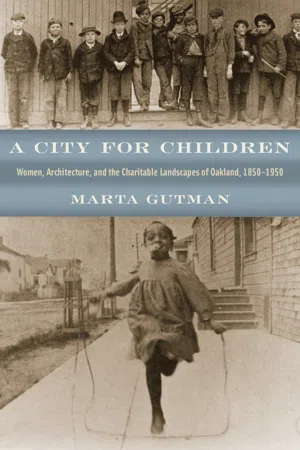
In A City for Children, Marta Gutman focuses on the use and adaptive reuse of everyday buildings in Oakland, California, to make the city a better place for children. She introduces us to the women who were determined to mitigate the burdens placed on working-class families by an indifferent industrial capitalist economy. Often without the financial means to build from scratch, women did not tend to conceive of urban land as a blank slate to be wiped clean for development. Instead, Gutman shows how, over and over, women turned private houses in Oakland into orphanages, kindergartens, settlement houses, and day care centers, and in the process built the charitable landscape—a network of places that was critical for the betterment of children, families, and public life. The industrial landscape of Oakland, riddled with the effects of social inequalities and racial prejudices, is not a neutral backdrop in Gutman's story but an active player. Spanning one hundred years of history, A City for Children provides a compelling model for building urban institutions and demonstrates that children, women, charity, and incremental construction, renovations, alterations, additions, and repurposed structures are central to the understanding of modern cities.
Frequently asked questions
Yes, you can cancel anytime from the Subscription tab in your account settings on the Perlego website. Your subscription will stay active until the end of your current billing period. Learn how to cancel your subscription.
No, books cannot be downloaded as external files, such as PDFs, for use outside of Perlego. However, you can download books within the Perlego app for offline reading on mobile or tablet. Learn more here.
Perlego offers two plans: Essential and Complete
- Essential is ideal for learners and professionals who enjoy exploring a wide range of subjects. Access the Essential Library with 800,000+ trusted titles and best-sellers across business, personal growth, and the humanities. Includes unlimited reading time and Standard Read Aloud voice.
- Complete: Perfect for advanced learners and researchers needing full, unrestricted access. Unlock 1.4M+ books across hundreds of subjects, including academic and specialized titles. The Complete Plan also includes advanced features like Premium Read Aloud and Research Assistant.
We are an online textbook subscription service, where you can get access to an entire online library for less than the price of a single book per month. With over 1 million books across 1000+ topics, we’ve got you covered! Learn more here.
Look out for the read-aloud symbol on your next book to see if you can listen to it. The read-aloud tool reads text aloud for you, highlighting the text as it is being read. You can pause it, speed it up and slow it down. Learn more here.
Yes! You can use the Perlego app on both iOS or Android devices to read anytime, anywhere — even offline. Perfect for commutes or when you’re on the go.
Please note we cannot support devices running on iOS 13 and Android 7 or earlier. Learn more about using the app.
Yes, you can access A City for Children by Marta Gutman in PDF and/or ePUB format, as well as other popular books in History & History of Architecture. We have over one million books available in our catalogue for you to explore.
Information
INDEX
Page numbers in italics refer to illustrations.
abortion, 115–16
Acorn Redevelopment Project, 327–28, 327, 342
Addams, Jane: and culture, 190, 400n66; influence of, 169, 183–84, 298; and libraries, 227–28; and playgrounds, 218; and repurposing, 25, 167; and the settlement movement, 144, 167, 178, 183–84, 191, 209, 242; support of railroad strike, 168; at White House conference, 253; and working mothers, 404n107. See also Hull House
Adeline Street, Oakland, 6, 15, 304
Adler, Felix, 149
admissions policies: for day nurseries, 300, 327; for elder care, 102, 379n103; for orphanages, 24, 48, 66, 90, 106, 117, 118, 122, 123, 264, 272, 418n54. See also racial integration; racial segregation
adobe construction, 45
adolescence, 196, 222
adopted homes, 251
adoption, 124–25
Aesthetic Movement, 188
African Americans: artists’ depictions of, 199; black churches, 73, 122, 263, 303–4, 305, 317, 340; black power movement, 28, 344; civil rights movement, 315; and class, 314–15, 320–21, 324–25, 329; day nurseries for, 291–93, 307–29; Dred Scott decision, 15; elder care for, 106, 304; and homeownership, 335–36; migration to Oakland, 15, 263, 271, 305–6, 320, 334–35; mortality of infants, 117; orphanages for, 45, 268, 291, 307, 309–29; political advances of, 106; in railroad employment, 6, 15, 112; in reform schools, 258; in San Francisco, 15, 305; and unions, 323; and urban renewal, 27–28, 331–43; and urban space, 316–18, 329; women’s clubs for, 106, 180, 209, 214, 215, 291–93, 304–25; and YWCAs, 26, 316–17, 318, 320, 325. See also racial integration...
Table of contents
- Cover
- Copyright
- Title Page
- Series Page
- Dedication
- Contents
- List of Illustrations
- Acknowledgements
- One. New Ideas from Old Things in Oakland
- Two. The Landscape of Charity in California: First Imprints in San Francisco
- Three. The Ladies Intervene: Repurposed and Purpose-Built in Temescal
- Four. The West Oakland Home: The “Noble Work for a Life Saving” of Rebecca McWade
- Five. The Saloon That Became a School: Free Kindergartens in Northern California
- Six. The Art and Craft of Settlement Work in Oakland Point
- Seven. “The Ground Must Belong to the City”: Playgrounds and Recreation Centers in Oakland’s Neighborhoods
- Eight. Orphaned in Oakland: Institutional Life during the Progressive Era
- Nine. Childhood on the Color Line in West Oakland: Day Nurseries during the Interwar Years
- Epilogue
- Oral Histories and Interviews
- Abbreviations Used in the Notes
- Notes
- Index
- Series List