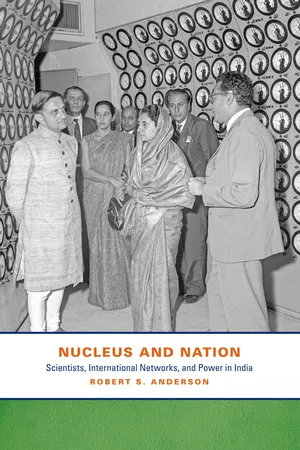
Nucleus and Nation
eBook - PDF

Nucleus and Nation

Scientists, International Networks, and Power in India

  1. English
  2. PDF
  3. Available on iOS & Android
eBook - PDF

Nucleus and Nation

Scientists, International Networks, and Power in India

About this book

In 1974 India joined the elite roster of nuclear world powers when it exploded its first nuclear bomb. But the technological progress that facilitated that feat was set in motion many decades before, as India sought both independence from the British and respect from the larger world. Over the course of the twentieth century, India metamorphosed from a marginal place to a serious hub of technological and scientific innovation. It is this tale of transformation that Robert S. Anderson recounts in Nucleus and Nation.

Tracing the long institutional and individual preparations for India's first nuclear test and its consequences, Anderson begins with the careers of India's renowned scientists—Meghnad Saha, Shanti Bhatnagar, Homi Bhabha, and their patron Jawaharlal Nehru—in the first half of the twentieth century before focusing on the evolution of the large and complex scientific community—especially Vikram Sarabhi—in the later part of the era. By contextualizing Indian debates over nuclear power within the larger conversation about modernization and industrialization, Anderson hones in on the thorny issue of the integration of science into the framework and self-reliant ideals of Indian nationalism. In this way, Nucleus and Nation is more than a history of nuclear science and engineering and the Indian Atomic Energy Commission; it is a unique perspective on the history of Indian nationhood and the politics of its scientific community.

Frequently asked questions

Yes, you can cancel anytime from the Subscription tab in your account settings on the Perlego website. Your subscription will stay active until the end of your current billing period. Learn how to cancel your subscription.
At the moment all of our mobile-responsive ePub books are available to download via the app. Most of our PDFs are also available to download and we're working on making the final remaining ones downloadable now. Learn more here.
Perlego offers two plans: Essential and Complete
  • Essential is ideal for learners and professionals who enjoy exploring a wide range of subjects. Access the Essential Library with 800,000+ trusted titles and best-sellers across business, personal growth, and the humanities. Includes unlimited reading time and Standard Read Aloud voice.
  • Complete: Perfect for advanced learners and researchers needing full, unrestricted access. Unlock 1.4M+ books across hundreds of subjects, including academic and specialized titles. The Complete Plan also includes advanced features like Premium Read Aloud and Research Assistant.
Both plans are available with monthly, semester, or annual billing cycles.
We are an online textbook subscription service, where you can get access to an entire online library for less than the price of a single book per month. With over 1 million books across 1000+ topics, we’ve got you covered! Learn more here.
Look out for the read-aloud symbol on your next book to see if you can listen to it. The read-aloud tool reads text aloud for you, highlighting the text as it is being read. You can pause it, speed it up and slow it down. Learn more here.
Yes! You can use the Perlego app on both iOS or Android devices to read anytime, anywhere — even offline. Perfect for commutes or when you’re on the go.
Please note we cannot support devices running on iOS 13 and Android 7 or earlier. Learn more about using the app.
Yes, you can access Nucleus and Nation by Robert S. Anderson in PDF and/or ePUB format, as well as other popular books in Biological Sciences & Indian & South Asian History. We have over one million books available in our catalogue for you to explore.

Table of contents

  1. CONTENTS
  2. Preface
  3. Acknowledgments
  4. Note on Spelling, Photographs, and Currencies
  5. Map of Atomic Energy, Space, and Defense Research Centers in 1974
  6. Atomic Energy, Space, and Defense Research Centers in 1974
  7. List of Abbreviations
  8. Introduction
  9. Building Scientific Careers in the 1920s: Saha and Bhatnagar, from London to Allahabad and Lahore
  10. The Bangalore Affair, 1935–38: Scientists and Conflict around C. V. Raman
  11. Imagining a Scientific State: Nehru, Scientists, and Political Planning, 1938–42
  12. Homi Bhabha Confronts Science in India, 1939–44
  13. Indian Scientists Engage the Empire: The CSIR and the Idea of Atomic and Industrial Power
  14. Saha, Bhatnagar, and Bhabha in Contrast, 1944–45
  15. Restless in Calcutta: Meghnad Saha’s Institution-Building
  16. Bhatnagar Builds a Chain of National Laboratories and StepsUpward
  17. Bhabha Builds His Institute in Bombay
  18. The Politics of the Early Indian Atomic Energy Committee and Commission
  19. Scientists’ Networks, Nehru, and India’s Defense Research and Development
  20. A Scientist in the Political System: Professor Saha Goes to Parliament, 1952–56
  21. The Indian Cabinet and Scientific Advice in the 1950sand 1960s: Bhabha, Atomic Energy, and Reforming Scientific and Industrial Research
  22. A New Scientific Elite: Sarabhai Builds Another Atomic Energy Network, 1966–71
  23. A Day in the Life of Two Research Institutes in Bombay and Calcutta
  24. Governance, Management, and Working Conditions in Research Institutes Founded by Saha and Bhabha
  25. Governance and Influence in the Research Institutes Bhatnagar Built
  26. Articulating Science and Technology Policy for Indira Gandhi’s Cabinet
  27. Building a High-Technology Economy through Atomic Energy, Space, and Electronics
  28. Nuclear Expectations and Resistance in India’s Political Economy
  29. Scientists in India’s War over Self-Reliance
  30. The First Bomb Test: Its Context, Reception, and Consequences in India
  31. The Scientific Community, the State of Emergency, and After, 1975–80
  32. Conclusions
  33. Chronology of Events
  34. Biographical Notes
  35. Notes
  36. Index of Names
  37. Subject Index
  38. A gallery of photographs appears following page 226