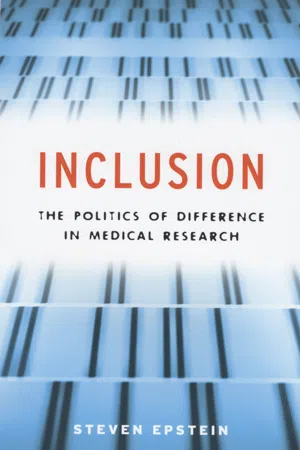
With Inclusion, Steven Epstein argues that strategies to achieve diversity in medical research mask deeper problems, ones that might require a different approach and different solutions.
Formal concern with this issue, Epstein shows, is a fairly recent phenomenon. Until the mid-1980s, scientists often studied groups of white, middle-aged men—and assumed that conclusions drawn from studying them would apply to the rest of the population. But struggles involving advocacy groups, experts, and Congress led to reforms that forced researchers to diversify the population from which they drew for clinical research. While the prominence of these inclusive practices has offered hope to traditionally underserved groups, Epstein argues that it has drawn attention away from the tremendous inequalities in health that are rooted not in biology but in society.
"Epstein's use of theory to demonstrate how public policies in the health profession are shaped makes this book relevant for many academic disciplines. . . . Highly recommended."—Choice
"A masterful comprehensive overview of a wide terrain."—Troy Duster, Biosocieties
- English
- ePUB (mobile friendly)
- Available on iOS & Android
eBook - ePub
About this book
Information
Publisher
University of Chicago PressYear
2008Print ISBN
9780226213101
9780226213095
eBook ISBN
9780226213118
CHAPTER ONE
How to Study a Biopolitical Paradigm
This book tells a story about the politics of how human beings are known, classified, administered, and treated. At the center is the idea of what I call the “inclusion-and-difference paradigm”—the research and policy focus on including diverse groups as participants in medical studies and in measuring differences across those groups.
The word paradigm has become ubiquitous in recent years, and my use of it requires explanation. My goal is not to resurrect historian and philosopher of science Thomas Kuhn’s familiar (but oft-criticized) account of decisive shifts over time in how communities of scientific practitioners look at the world.1 “Inclusion-and-difference” is not a paradigm in the strict Kuhnian sense, because it does not constitute the central set of assumptions guiding any scientific specialty group, nor is it restricted to any single such group.2 Neither am I claiming (as the use of Kuhn’s term might lead some to imagine) that the new emphasis on inclusion and difference is a thoroughgoing medical “revolution,” marked by ideas that are radically incommensurable with those they replaced.
Instead, the inclusion-and-difference paradigm should be understood as an example of what I term a “biopolitical paradigm.” Building on Peter Hall’s concept of the policy paradigm3 and Michel Foucault’s characterization of biopolitics,4 I define biopolitical paradigms as frameworks of ideas, standards, formal procedures, and unarticulated understandings that specify how concerns about health, medicine, and the body are made the simultaneous focus of biomedicine and state policy. The inclusion-and-difference paradigm is one such biopolitical paradigm, both because it reflects the presumption that health research is an appropriate and important site for state intervention and regulation and because it infuses the life sciences with new political import. While some might see the inclusion-and-difference paradigm as an example of how biomedicine (for better or for worse) gets politicized, it might just as well be taken as evidence of the converse—how, in the present period, governing gets “biomedicalized.” Medical research thereby becomes reconceived as a domain in which a host of political problems can get worked out—the nature of social justice, the limits and possibilities of citizenship, and the meanings of equality and difference at the biological as well as social levels.5
The label “inclusion-and-difference paradigm” is my own invention, and no one within the DHHS, the pharmaceutical industry, or the academic world of clinical research uses the term. But this distinctive approach to health research policy can be seen as built into the standard operating procedures, discourse, and organizational structure of the DHHS, and it stretches out from there into a wide range of biomedical contexts. As a biopolitical paradigm, the inclusion-and-difference approach hybridizes scientific and state policies and categories. Specifically, it takes two different areas of concern—the meaning of biological difference and the status of socially subordinated groups—and weaves them together by articulating a distinctive way of asking and answering questions about the demarcating of subpopulations of patients and citizens.
STUDYING KNOWLEDGE, POLITICS, AND DIFFERENCE
Describing and analyzing biopolitical paradigms is impossible except by carefully amalgamating academic literatures that are more typically kept apart. Yet bringing these literatures together is a crucial task for scholars concerned with key features of the modern world. The issues raised in this book point to the intersections among three broad arenas of scholarly investigation: knowledge formation (how medical truths about human beings are uncovered), the politics of institutional change (how social movements and other political actors transform scientific, governmental, and corporate practices), and the making of identity and difference (how the human population is divided and what meaning is assigned to stratifying terms such as race and gender). In this chapter, I assemble my toolkit for studying these three arenas jointly.
As an analysis of how medical knowledge is made and how the population of humans and its relevant subgroups come to be known, this book is rooted in social and cultural studies of science, technology, and medicine. Science studies (for short) has focused attention on how scientific practitioners organize their work activities; make claims about knowledge and strive to endow those claims with credibility; and defend, or extend, the boundaries of their practice.6 Increasingly, scholars working from this framework have turned their attention to understanding biomedical research,7 as well as the ways in which human bodies, in all their organic, cellular, and genetic distinctiveness, appear to take on an ever more central role in defining our selves, our identities, and our places within the society and the polity.8
At the same time, especially since the mid-1990s, the field of science studies has moved decisively “beyond the lab” to analyze—in all their complexity, variability, and volatility—the broader dimensions of public engagement with science and technology. Recently this shift has found expression under quite a number of different banners: the “new political sociology of science,” which unites science studies with sociological approaches to the study of power, the state, and organizations;9 “co-production,” which proposes “that the ways in which we know and represent the world (both nature and society) are inseparable from the ways in which we choose to live in it;10 a focus on the “knowledge society,” and study of “epistemic cultures” and their “machineries of knowing”11; studies of the participation of social movements or other “concerned groups” in questions relating to science and technology;12 and work that tracks the forging of various new forms of citizenship.13 (The list of new approaches could easily be extended.) Although these diverse reformulations or extensions of the project of science studies are by no means entirely compatible, I rely on them collectively to orient me in certain important directions—especially, an institutional focus, and a concern with questions of participation and citizenship.
Institutional Focus
Because this book is a study of how policies, practices, and facts emerge out of conflict and compromise, I am especially interested in understanding both the broader structuring of conflict and the processes by which social and scientific changes come to take an institutionalized form. I attend, therefore, to what Kelly Moore and Scott Frickel have called the “rules and routines, meanings, organizations, and resource distributions that shape knowledge production systems.”14 Such an approach takes seriously the enabling and constraining effects of social structures on those whose work involves or intersects with biomedical science.15
My entry point to these concerns is less immediately at either the macro level of abstraction (“the state,” “the market,” “science”) or the micro level of particularity (the realm of face-to-face interaction or embodied practice) but is located more at what Diane Vaughan has called the “meso” level of the organization16—for example, the government agency, the pharmaceutical company, the advocacy group, or the research institution. As Vaughan has emphasized, organizations function as powerful machineries of knowing that “can complicate and manipulate the entire knowledge-production process”—changing how people and objects are understood; discouraging certain domains of inquiry while encouraging others; and “requiring classification systems and standardized documents that regiment, restrict and reduce experience and understanding into easy digestible and communicable abstractions from more complex, dynamic interactions and situational logics.”17
The analytical approach that I describe here—a structural and cultural analysis of the “rules and routines, meanings, organizations, and resource distributions that shape knowledge production systems”18—is also consistent with particular ways of analyzing the state, social movements, and social institutions that have emerged in recent years. Taking my cue from others who have called for the “disaggregation of the monolithic entity of the state,” I approach “the state” through attention to particular agencies and offices and with an understanding that the practices carried on within them may sometimes merge seamlessly with ones conducted “outside” the state.19 This formulation, which challenges the accepted notion of a sharp dividing line between state and society, is consistent with work that reveals the inextricability of science and the state in the modern West and traces the history of technoscientific activity within processes of state formation.20 It is likewise consistent with a number of ways of approaching the study of social movements as they interact with the state: recognizing that social movements are sometimes inside as well as outside state agencies;21 appreciating that social movements challenge many institutions and not simply the state;22 and observing the powerful effects of social movements in transforming organizational behavior.23 All of these approaches are helpful in thinking about a sequence of changes in biomedical research practices that are, at the same time, changes in the administrative and classificatory practices of state and market organizations.
Lay Participation and Citizenship
The stunning advances in the life sciences in the twentieth century have paved the path for what Nikolas Rose has called “vital politics,” where matters of health, illness, risk, suffering, and life itself move to center stage.24 In recent years, as questions of health and illness have been recast as thoroughly political matters, more and more ordinary citizens, often organized into patient advocacy groups or broader social movements, have demanded a say in how scientists and health professionals go about their work, tossing aside the presumption that technical matters are best left up to the experts.25 I will argue that the creation of the inclusion-and-difference paradigm reflects this participatory impulse to some degree—though I also will show that these policy changes were not brought about by a lay social movement, pure and simple, but rather by a hybrid coalition linking health advocates with experts, bureaucrats, and policymakers.
The language of citizenship—understood here to refer to differentiated modes of incorporation of individuals or groups fully or partially into the national polity through the articulation of notions of rights and responsibilities—is also relevant in understanding this case.26 The program for inclusion of previously underrepresented groups in biomedical research reflected more than a desire for “representation” in a purely statistical sense: it also suggested a demand for political representation and for inclusion in the polity and society more generally. Therefore, I will treat this case as an instance of a broader class of phenomena to which science studies scholars increasingly have been devoting attention—a cluster of concepts labeled variously as “biological citizenship,” “genetic citizenship,” “therapeutic citizenship,” and “sanitary citizenship,” but that might all be characterized as “biopolitical citizenship.”27
As Adriana Petryna described it in her analysis of Ukrainian survivors of the Chernobyl nuclear disaster, such terms apply to moments when the “biology of a population has become the grounds for social membership and the basis for staking citizenship claims.”28 This concept calls attention to what Paul Rabinow has called “biosociality”: the ways in which various sorts of classifications created, or given a transformed meaning,...
Table of contents
- Cover
- Title Page
- Copyright
- Contents
- Acknowledgements
- List of Abbreviations
- Introduction: Health Research and the Remaking of Common Sense
- 1 How to Study a Biopolitical Paradigm
- 2 Histories of the Human Subject
- 3 The Rise of Resistance: Framing the Critique of the Standard Human
- 4 The Path to Reform: Aligning Categories, Targeting the State
- 5 Opposition to Reform: Controversy, Closure, and Boundary Work
- 6 Formalizing the New Regime
- 7 From the Standard Human to Niche Standardization
- 8 Counts and Consequences: Monitoring Compliance
- 9 The Science of Recruitmentology and the Politics of Trust
- 10 To Profile or Not to Profile: What Difference Does Race Make?
- 11 Sex Differences and the New Politics of Women’s Health
- 12 Whither the Paradigm?
- Conclusion: Identity, Difference, Disparities, and Biopolitical Citizenship
- Chronology
- Interviews
- Notes
- Index
Trusted by 375,005 students
Access to over 1.5 million titles for a fair monthly price.
Study more efficiently using our study tools.
Frequently asked questions
Yes, you can cancel anytime from the Subscription tab in your account settings on the Perlego website. Your subscription will stay active until the end of your current billing period. Learn how to cancel your subscription
No, books cannot be downloaded as external files, such as PDFs, for use outside of Perlego. However, you can download books within the Perlego app for offline reading on mobile or tablet. Learn how to download books offline
Perlego offers two plans: Essential and Complete
- Essential is ideal for learners and professionals who enjoy exploring a wide range of subjects. Access the Essential Library with 800,000+ trusted titles and best-sellers across business, personal growth, and the humanities. Includes unlimited reading time and Standard Read Aloud voice.
- Complete: Perfect for advanced learners and researchers needing full, unrestricted access. Unlock 1.5M+ books across hundreds of subjects, including academic and specialized titles. The Complete Plan also includes advanced features like Premium Read Aloud and Research Assistant.
We are an online textbook subscription service, where you can get access to an entire online library for less than the price of a single book per month. With over 1.5 million books across 990+ topics, we’ve got you covered! Learn about our mission
Look out for the read-aloud symbol on your next book to see if you can listen to it. The read-aloud tool reads text aloud for you, highlighting the text as it is being read. You can pause it, speed it up and slow it down. Learn more about Read Aloud
Yes! You can use the Perlego app on both iOS and Android devices to read anytime, anywhere — even offline. Perfect for commutes or when you’re on the go.
Please note we cannot support devices running on iOS 13 and Android 7 or earlier. Learn more about using the app
Please note we cannot support devices running on iOS 13 and Android 7 or earlier. Learn more about using the app
Yes, you can access Inclusion by Steven Epstein in PDF and/or ePUB format, as well as other popular books in Social Sciences & Medical Theory, Practice & Reference. We have over 1.5 million books available in our catalogue for you to explore.