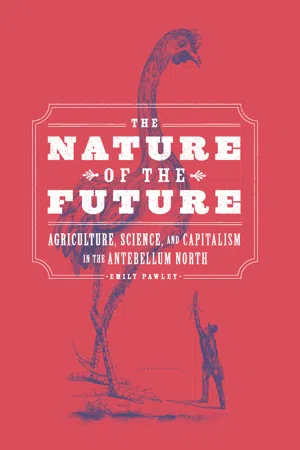
The Nature of the Future plumbs the innovative, far-ranging, and sometimes downright strange agricultural schemes of nineteenth-century farms in the northern US.
The nostalgic mist surrounding farms can make it hard to write their history, encrusting them with stereotypical rural virtues and unrealistically separating them from markets, capitalism, and urban influences. The Nature of the Future dispels this mist, focusing on a place and period of enormous agricultural vitality—antebellum New York State—to examine the largest, most diverse, and most active scientific community in nineteenth-century America. Emily Pawley shows how "improving" farmers practiced a science where conflicting visions of the future landscape appeared and evaporated in quick succession. Drawing from US history, environmental history, and the history of science, and extensively mining a wealth of antebellum agricultural publications, The Nature of the Future reveals how improvers transformed American landscapes and American ideas of expertise, success, and exploitation from the ground up.
eBook - ePub
The Nature of the Future
Agriculture, Science, and Capitalism in the Antebellum North
- English
- ePUB (mobile friendly)
- Available on iOS & Android
eBook - ePub
About this book
Information
Publisher
University of Chicago PressYear
2020Print ISBN
9780226820026
9780226693835
eBook ISBN
9780226693972
PART ONE
Performances
1
Capitalist Aristocracy
In its first decades, agricultural improvement was the domain of the landlords who held surprisingly large parts of New York. It can be hard, frankly, to know what to think of these landlords. With their sometimes county-sized “manors,” their great houses, and their clear aristocratic pretensions, they do not look like Northern rural society is supposed to look. Were they feudal relics or profit-seeking capitalists? Representatives of a dying order or a path not taken?1 Certainly they were a colonial product, their manors parceled out to them by Dutch and British authorities. But if they were a vestige, they were far from powerless. While the loyalist landlords of the southern Hudson had their lands confiscated after the Revolution, on the northern Hudson, powerful families like the Rensselaers, the Schuylers, and the Livingstons would form the backbone of the New York Federalist elite.2 Nor were they declining. In 1824, Stephen Van Rensselaer III was the largest landholder in the United States, with five thousand tenants on holdings of more than two hundred square miles—all of two counties and half of a third.3 Post-Revolutionary developments, moreover, expanded this class of large landholders. As the state legislature clawed territory piecemeal away from the Haudenosaunee, they shunted it into the hands of companies of investors or individual developers. Many of these aspired to the status of more established landlords, competing with them for tenants and buyers among the wave of New Englanders that would quadruple the population of New York between 1790 and 1820.4
Tenants themselves often had strong feelings on the question of landlord modernity, coming down hard on the side of feudal anachronism. “Anti-Renters” described the manors as “relics,” analogous to the feudal holdings of “barbarian chiefs.” One tenant newspaper promised readers, as a sort of how-to text, an account of “the first effort made in the middle ages, the time of the feudal tyranny, and popular servility, to throw off the feudal yoke.”5 Another commentator suggested that the manors had been planned as “a royal stud to propagate and supply the kingdoms of the New World with princes and princesses.”6 Charges of aristocratic pretension were perfectly justifiable. Hudson Valley landlords often spent more than they could afford on liveried servants, coats of arms, carriages, trips to Europe, and named “country seats.” Stephen Van Rensselaer III had given tenants particularly good ammunition by maintaining his title, “Patroon,” persisting in extending two fingers to tenants rather than his whole hand, and having rents paid in wheat rather than cash.7 Like others in his social circle, moreover, he managed his tenants through leases modeled on European leases and sometimes enforced more strictly.8
Then and now, however, accusations of anachronism obscured New York landlords’ focus on the profitable future. In imitating British aristocrats and members of the gentry, New York landlords hoped to re-create the success of classes that had recently risen enormously in wealth, stability, and political clout, classes moreover on which modern definitions of agricultural capitalism have long depended. Agricultural improvement was key to this plan. Copying British institutions, New York’s landlords would lay crucial groundwork for American agricultural improvement and American scientific culture more generally, establishing institutions and agendas that would long outlast their heyday. However, the bases of New York landlords’ power would prove less certain than those of their European counterparts. During the 1840s, New York landlords would be hamstrung and sometimes ruined by the combination of economic volatility, debt, tenant resistance, and electoral politics. As other groups began to take the reins of improving institutions, tenants themselves would appropriate the arguments of improvement for their own purposes, drawing on their own connections to British agrarian networks.
Aristocratic Modernity and the Agricultural Revolution
Far from representing the traces of a dying feudalism, in eighteenth- and early nineteenth-century Britain, landed power was rising. During the mid-eighteenth century, new rules of landownership combined with a demographic crisis had consolidated landholdings into the hands of a smaller, richer set of families. In subsequent decades, the pace of enclosure accelerated, converting common grazing lands, “wastes,” and forests into fenceable private property, undermining rural subsistence while enriching a relative few. In the 1790s, the value of these expanded estates skyrocketed, driven up by wartime food prices. Landlords also profited from the mineral rights granted by enclosure, in particular from the exploitation of new coalfields on their lands and from the new canals that carried coal and food between the expanding cities.9 This increased wealth translated into greater control over political life—a smaller and smaller number of families held the hundreds of “rotten boroughs” that sent representatives to Parliament. By 1816, one contemporary commentator estimated that three-quarters of the lower house was in the hands of 140 peers and 120 landed commoners. Unsurprisingly, these politicians created legislation supporting landed interests: new laws in the 1810s and 1820s punished poaching with death or transportation, and, as prices dropped with the end of the Napoleonic Wars, the Corn Laws preserved landholders’ profits (at the expense of hungry urbanites). As the Erie Canal was being cut in New York, in Britain new “Ejectment Acts” allowed landlords to evict tenants en masse and to replace them with larger, profit-driven enterprises. These developments stabilized and enriched Britain’s landed elite, creating what David Cannadine has called “a distinct group of new super-rich grandees.”10
Theirs was a capitalist landscape. Farms on the estates of wealthy Britons were profit-driven, regionally specialized, and dependent on prices in distant markets. They were administered by a new managerial class of “agents” who produced increasingly elaborate forms of accounting and profit calculation to satisfy their distant employers. They were often worked by a large class of dependent landless laborers, including an annual influx of Irish migrant labor.11 The accelerating pace of enclosures had devastated common usufruct rights and expanded private property in land. These changes in British landscapes were financed and supported by a different branch of agricultural capitalism: the plantations of sugar, tea, opium, tobacco, and cattle spreading from Ireland as far as the Caribbean and India and worked by dispossessed, convict, and enslaved people.12
The features of agricultural capitalism are so visible in this period in part because this place and period have been used to define them. The “agricultural revolution” has long been characterized as a necessary precursor to the Industrial Revolution. Initially historians credited famous wealthy improvers like Coke of Norfolk, “Turnip” Townshend, and Robert Bakewell with inventions and techniques—intensive breeding, labor-saving machinery, new fodder crops, and systems of crop rotation—that released rural labor, created food surpluses, and amassed capital that would fund industrialization. More recent work has complicated this story, showing that eighteenth-century gains in production in fact capitalized on a more fundamental “yeoman’s revolution” in farming practice beginning as far back as the fifteenth century.13 However, though they may not have invented the techniques with which they were credited, Britain’s landed elites capitalized on them, forming a rising, development-minded, profit-seeking class, and publicized them, through agricultural journalists like the famous Arthur Young.
Interested observers, New York landlords among them, mostly perceived British agricultural development filtered through the mass of print that people like Young produced, but many major political figures of the founding generation communicated with British improvers directly.14 Antebellum improvers still purchased print editions of the correspondence between George Washington, Arthur Young, and the Scottish agriculturist and politician Sir John Sinclair.15 Projecting an enticing image of abrupt, top-down social transformation, British improving print provided a model for the first iterations of American improvement.16 Among New York landlords, these efforts at emulation predated the American Revolution. During the 1760s, in imitation of London’s Society for the Encouragement of Arts, Manufactures, and Commerce, the Schuylers, Livingstons, and Rensselaers had established the Society for the Promotion of Arts, Agriculture, and Oeconomy, which offered premiums for agricultural products before it collapsed under the pressure of political rivalries.17
Following the Revolution, land speculation in western New York would enrich landlords and add to their numbers. Federalist New Yorkers, upper Hudson landlords included, had been heavily invested in western expansion. In the 1810s and 1820s, they increasingly merged with western developers who built roads, performed surveys, planned towns, and in general acted in lieu of a state.18 Getting western lands to meet the fevered expectations of their new owners became the project of developers. Wealthy land speculators like the Wadsworths of the Genesee Valley and William Cooper of Cooperstown aimed directly for the kinds of status enjoyed by older landlords, retaining large estates for themselves, struggling to attract tenants, and building manor houses and social connections.19 As it became embedded in the manors of the upper Hudson, agricultural improvement also shaped the developmental push toward western lands. The same moralizing vision of profit that had justified the continuing enclosure of common land in Britain and Ireland, and the mass displacements and appropriations of the British Empire, was also applied to the Haudenosaunee, whose lands came into speculating American hands from the late eighteenth century onward.20
This newly enlarged landed class created New York’s first post-Revolutionary agricultural society, the Society for the Promotion of Agriculture, Arts, and Manufactures (SPAAM). Established in 1791 and chartered by the state in 1793, this society included many of the same political stars who were promoting the Western Inland Lock Navigation Company, the first serious attempt to drive a canal through western lands.21 Borrowing a style of Baconian inquiry from the Royal Society of London, the SPAAM sent out circulars full of inquiries about New York’s potential for profit: “Can the silk-worm be profitably introduced into your neighborhood?” “Can you suggest any thing capable of raising the reputation of our flour in foreign markets?” “Are there any coal-mines?”22 In their Transactions, they outlined projects to expand the capacities of their holdings. In the first volume, William Cooper sketched a future maple sugar industry to rival the West Indies, surveyor Simeon De Witt planned meteorological maps to reveal western New York’s agricultural potential, and Robert Livingston touted lime as a soil-reviving panacea for the worn soils of the Hudson. Like their counterparts in Philadelphia, Massachusetts, and Britain, they also developed correspondence networks, throwing out feelers to British luminaries like Young and Royal Society president Joseph Banks.23
The exclusivity of these efforts limited their scale. Even after receiving a corporate charter from the state legislature in 1792, the SPAAM remained essentially a private club, with seventy-two members admitted by internal nomination and election. Despite constant lobbying, they were unable to carry out their larger plans: county societies, a botanical garden, or more than one professorship at Columbia.24 After Livingston’s death in 1813, the SPAAM petered out. Even as it did so, a new wave of societies, tracking a more successful canal effort, was on the way.
In the 1810s, small landlord-sponsored societies in Otsego, Jefferson, and Rensselaer Counties appeared on a new model evangelized by Elkanah Watson, a speculator in western New York land and a zealous canal promoter. In 1819, these were voted state financial support, to be coordinated by a new institution: the New York Board of Agriculture.25 This body mirrored its namesake, the British Board of Agriculture, established by Sinclair and Young during the food shortages and high agricultural prices of the Napoleonic Wars.26 It drew its membership from the same elevated circles as its predecessors, landlords and land speculators excited by the impending completion of the Erie Canal and worried by the precipitous collapse of wheat prices during the Panic of 1819 (particularly alarming to those who, like the Rensselaers, took their rent in wheat).27
Briefly, at least, this second wave spread more broadly than the first had, focusing on “cattle shows” where farmers would be encouraged to develop more profitable practices through example and healthy competition. By 1822, there were thirty-six societies in New York.28 However, these rapidly came under fire; critics pointed out that only wealthy farmers received the premiums for excellent farming or for expensive imported animals. Worse, in a time of partisan political strife, they had been sponsored by canal-promoting Governor DeWitt Clinton and, at the local level, were led by Clintonian politicians. Martin Van Buren’s anti-Clintonian party, the “Bucktails,” supported by newly enfranchised voters, cut off state support for the societies in 1824.29 Without a regular influx of state money, all but one withered.30
Organizers, who expected their ...
Table of contents
- Cover
- Title Page
- Copyright Page
- Dedication
- Contents
- Introduction: Bending Reality with Large Strawberries
- PART 1 Performances
- PART 2 Experiments
- PART 3 Futures
- PART 4 Values
- Acknowledgments
- List of Abbreviations
- Notes
- Index
Trusted by 375,005 students
Access to over 1.5 million titles for a fair monthly price.
Study more efficiently using our study tools.
Frequently asked questions
Yes, you can cancel anytime from the Subscription tab in your account settings on the Perlego website. Your subscription will stay active until the end of your current billing period. Learn how to cancel your subscription
No, books cannot be downloaded as external files, such as PDFs, for use outside of Perlego. However, you can download books within the Perlego app for offline reading on mobile or tablet. Learn how to download books offline
Perlego offers two plans: Essential and Complete
- Essential is ideal for learners and professionals who enjoy exploring a wide range of subjects. Access the Essential Library with 800,000+ trusted titles and best-sellers across business, personal growth, and the humanities. Includes unlimited reading time and Standard Read Aloud voice.
- Complete: Perfect for advanced learners and researchers needing full, unrestricted access. Unlock 1.5M+ books across hundreds of subjects, including academic and specialized titles. The Complete Plan also includes advanced features like Premium Read Aloud and Research Assistant.
We are an online textbook subscription service, where you can get access to an entire online library for less than the price of a single book per month. With over 1.5 million books across 990+ topics, we’ve got you covered! Learn about our mission
Look out for the read-aloud symbol on your next book to see if you can listen to it. The read-aloud tool reads text aloud for you, highlighting the text as it is being read. You can pause it, speed it up and slow it down. Learn more about Read Aloud
Yes! You can use the Perlego app on both iOS and Android devices to read anytime, anywhere — even offline. Perfect for commutes or when you’re on the go.
Please note we cannot support devices running on iOS 13 and Android 7 or earlier. Learn more about using the app
Please note we cannot support devices running on iOS 13 and Android 7 or earlier. Learn more about using the app
Yes, you can access The Nature of the Future by Emily Pawley in PDF and/or ePUB format, as well as other popular books in History & Agribusiness. We have over 1.5 million books available in our catalogue for you to explore.