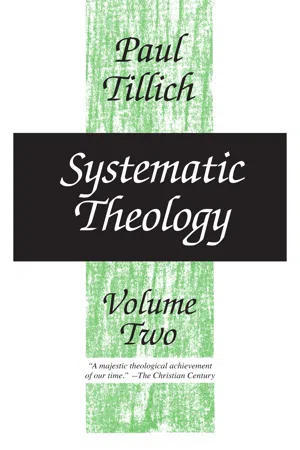
In this volume, the second of his three-volume reinterpretation of Christian theology, Paul Tillich comes to grips with the central idea of his system—the doctrine of the Christ. Man's predicament is described as the state of "estrangement" from himself, from his world, and from the divine ground of his self and his world. This situation drives man to the quest for a new state of things, in which reconciliation and reunion conquer estrangement. This is the quest for the Christ.
- English
- ePUB (mobile friendly)
- Available on iOS & Android
eBook - ePub
Systematic Theology, Volume 2
About this book
Information
Publisher
University of Chicago PressYear
2013Print ISBN
9780226803388
9780226803333
eBook ISBN
9780226160054
Topic
Theology & ReligionSubtopic
Christian TheologyPART III
EXISTENCE AND THE CHRIST
I
EXISTENCE AND THE QUEST FOR THE CHRIST
A. EXISTENCE AND EXISTENTIALISM
1. THE ETYMOLOGY OF EXISTENCE
TODAY whoever uses terms like “existence,” “existential,” or “existentialism” is obliged to show the way in which he uses them and the reasons why. He must be aware of the many ambiguities with which these words are burdened, in part avoidable, in part unavoidable. Further, he must show to which past and present attitudes and works he applies these terms. Attempts to clarify their meaning are numerous and divergent. Therefore, none of these attempts can be taken as being finally successful. A theology which makes the correlation of existence and the Christ its central theme must justify its use of the word “existence” and indicate both its philological and its historical derivation.
One of the ways to determine the meaning of an abused word is the etymological one, namely, to go back to its root meaning and try to gain a new understanding out of its roots. This has been done in all periods of the history of thought but is exaggerated by some scholars to such a degree that a reaction has started against the whole procedure. The nominalists of our day, like the old nominalists, consider words as conventional signs which mean nothing beyond the way in which they are used in a special group at a special time. The consequence of this attitude is that some words are invariably lost and must be replaced by others. But the nominalistic presupposition—that words are only conventional signs—must be rejected. Words are the results of the encounter of the human mind with reality. Therefore, they are not only signs but also symbols and cannot be replaced, as in the case of conventional signs, by other words. Hence they can be salvaged. Without this possibility, new languages would continuously have had to be invented in the fields of religion and the humanities. One of the important tasks of theology is to regain the genuine power of classical terms by looking at the original encounter of mind and reality which created them.
The root meaning of “to exist,” in Latin, existere, is to “stand out.” Immediately one asks: “To stand out of what?” On the one hand, in English, we have the word “outstanding,” which means standing out of the average level of things or men, being more than others in power and value. On the other hand, “standing out” in the sense of existere means that existence is a common characteristic of all things, of those which are outstanding and of those which are average. The general answer to the question of what we stand out of is that we stand out of non-being. “Things do exist” means they have being, they stand out of nothingness. But we have learned from the Greek philosophers (what they have learned from the lucidity and sensitivity of the Greek language) that non-being can be understood in two ways, namely, as ouk on, that is, absolute non-being, or as me on, that is, relative non-being. Existing, “to stand out,” refers to both meanings of non-being. If we say that something exists, we assert that it can be found, directly or indirectly, within the corpus of reality. It stands out of the emptiness of absolute non-being. But the metaphor “to stand out” logically implies something like “to stand in.” Only that which in some respect stands in can stand out. He who is outstanding rises above the average in which he stood and partly still stands. If we say that everything that exists stands out of absolute non-being, we say that it is in both being and non-being. It does not stand completely out of non-being. As we have said in the chapter on finitude (in the first volume), it is a finite, a mixture of being and non-being. To exist, then, would mean to stand out of one’s own non-being.
But this is not sufficient because it does not take into consideration this question: How can something stand out of its own non-being? To this the answer is that everything participates in being, whether or not it exists. It participates in potential being before it can come into actual being. As potential being, it is in the state of relative non-being, it is not-yet-being. But it is not nothing. Potentiality is the state of real possibility, that is, it is more than a logical possibility. Potentiality is the power of being which, metaphorically speaking, has not yet realized its power. The power of being is still latent; it has not yet become manifest. Therefore, if we say that something exists, we say that it has left the state of mere potentiality and has become actual. It stands out of mere potentiality, out of relative non-being.
In order to become actual, it must overcome relative non-being, the state of me on. But, again, it cannot be completely out of it. It must stand out and stand in at the same time. An actual thing stands out of mere potentiality; but it also remains in it. It never pours its power of being completely into its state of existence. It never fully exhausts its potentialities. It remains not only in absolute non-being, as its finitude shows, but also in relative non-being, as the changing character of its existence shows. The Greeks symbolized this as the resistance of me on, of relative non-being, against the actualization of that which is potential in a thing.
Summarizing our etymological inquiry, we can say: Existing can mean standing out of absolute non-being, while remaining in it; it can mean finitude, the unity of being and non-being. And existing can mean standing out of relative non-being, while remaining in it; it can mean actuality, the unity of actual being and the resistance against it. But whether we use the one or the other meaning of non-being, existence means standing out of non-being.
2. THE RISE OF THE EXISTENTIALIST PROBLEM
Etymological inquiries indicate directions, but they do not solve problems. The pointer given in the second answer to the question “Standing out of what?” is that of a split in reality between potentiality and actuality. This is the first step toward the rise of existentialism. Within the whole of being as it is encountered, there are structures which have no existence and things which have existence on the basis of structures. Treehood does not exist, although it has being, namely, potential being. But the tree in my back yard does exist. It stands out of the mere potentiality of treehood. But it stands out and exists only because it participates in that power of being which is treehood, that power which makes every tree a tree and nothing else.
This split in the whole of reality, expressed in the term “existence,” is one of the earliest discoveries of human thought. Long before Plato, the prephilosophical and the philosophical mind experienced two levels of reality. We can call them the “essential” and the “existential” levels. The Orphics, the Pythagoreans, Anaximander, Heraclitus, and Parmenides were driven to their philosophy by the awareness that the world they encountered lacked ultimate reality. But only in Plato does the contrast between the existential and the essential being become an ontological and ethical problem. Existence for Plato is the realm of mere opinion, error, and evil. It lacks true reality. True being is essential being and is present in the realm of eternal ideas, i.e., in essences. In order to reach essential being, man must rise above existence. He must return to the essential realm from which he fell into existence. In this way man’s existence, his standing out of potentiality, is judged as a fall from what he essentially is. The potential is the essential, and to exist, i.e., to stand out of potentiality, is the loss of true essentiality. It is not a complete loss, for man still stands in his potential or essential being. He remembers it, and, through his remembrance, he participates in the true and the good. He stands in and out of the essential realm. In this sense “standing out” has a meaning precisely opposite that of the usual English usage. It means falling away from what man essentially is.
This attitude toward existence dominated the later ancient world in spite of the attempt of Aristotle to close the gap between essence and existence through his doctrine of the dynamic interdependence of form and matter in everything. But Aristotle’s protest could not succeed, partly because of the sociological conditions of later antiquity and partly because Aristotle himself in his Metaphysics contrasts the whole of reality with the eternal life of God, i.e., his self-intuition. Participation in the life of God requires the rise of the mind into the actus purus of the divine being, which is above everything which is mixed with non-being.
The scholastic philosophers, including both the Platonizing Franciscans and the Aristotelian Dominicans, accepted the contrast between essence and existence for the world, but not for God. In God there is no difference between essential and existential being. This implies that the split is ultimately not valid and that it has no relevance for the ground of being itself. God is eternally what he is. This was expressed in the Aristotelian phrase that God is actus purus, without potentiality. The logical consequence of this concept would have been the denial of a living God such as is mirrored in biblical religion. But this was not the intention of the Scholastics. The emphasis of Augustine and Scotus on the divine will made that impossible. But if God is symbolized as will, the term actus purus is obviously inadequate. Will implies potentiality. The real meaning of the Scholastic doctrine—which I consider to be true—would have been expressed in the statement that essence and existence and their unity must be applied symbolically to God. He is not subjected to a conflict between essence and existing. He is not a being beside others, for then his essential nature would transcend himself, just as in the case of all finite beings. Nor is he the essence of all essences, the universal essence, for this would deprive him of the power of self-actualization. His existence, his standing out of his essence, is an expression of his essence. Essentially, he actualizes himself. He is beyond the split. But the universe is subject to the split. God alone is “perfect,” a word which is exactly defined as being beyond the gap between essential and existential being. Man and his world do not have this perfection. Their existence stands out of their essence as in a “fall.” On this point, the Platonic and the Christian evaluations of existence coincide.
This attitude changed when a new feeling for existence grew up in the Renaissance and Enlightenment. More and more the gap between essence and existence was closed. Existence became the place in which man was called to control and to transform the universe. Existing things were his material. To stand out of one’s essential being was not a fall but the way to the actualization and fulfilment of one’s potentialities. In its philosophical form this attitude could be called “essentialism.” In this sense existence is, so to speak, swallowed by essence. The existing things and events are the actualization of essential being in a piogressive development. There are preliminary shortcomings, but there is no existential gap as expressed in the myth of the Fall. In existence, man is what he is in essence—the microcosmos in whom the powers of the universe are united, the bearer of critical and constructive reason, the builder of his world, and the maker of himself as the actualization of his potentiality. Education and political organization will overcome the lags of existence behind essence.
This description fits the spirit of many philosophers of the Renaissance and of the entire Enlightenment. But in neither period did essentialism come to fulfilment. This happened only in a philosophy which was distinctly anti-enlightened and deeply influenced by Romanticism, namely, German classical philosophy and, in particular, the system of Hegel. The reason for this is not only the all-embracing and consistent character of Hegel’s system but also that he was aware of the existentialist problem and tried to take existential elements into his universal system of essences. He took non-being into the very center of his thought; he stressed the role of passion and interest in the movement of history; he created concepts like “estrangement” and “unhappy consciousness”; he made freedom the aim of the universal process of existence; he even brought the Christian paradox into the frame of his system. But he kept all these existential elements from undermining the essentialist structure of his thought. Non-being has been conquered in the totality of the system; history has come to its end; freedom has become actual; and the paradox of the Christ has lost its paradoxical character. Existence is the logically necessary actuality of essence. There is no gap, no leap, between them. This all-embracing character of Hegel’s system made it a turning point in the long struggle between essentialism and existentialism. He is the classical essentialist, because he applied to the universe the scholastic doctrine that God is beyond essence and existence. The gap is overcome not only eternally in God but also historically in man. The world is the process of the divine self-realization. There is no gap, no ultimate incertitude, no risk, and no danger of self-loss when essence actualizes itself in existence. Hegel’s famous statement that everything that is, is reasonable is not an absurd optimism about the reasonableness of man. Hegel did not believe that men are reasonable and happy. But it is the statement of Hegel’s belief that, in spite of everything unreasonable, the rational or essential structure of being is providentially actualized in the process of the universe. The world is the self-realization of the divine mind; existence is the expression of essence and not the fall away from it.
3. EXISTENTIALISM AGAINST ESSENTIALISM
It was in protest to Hegel’s perfect essentialism that the existentialism of the nineteenth and twentieth centuries arose. It was not a special trait of his thought which was criticized by the existentialists, some of whom were his pupils. They were not interested in correcting him. They attacked the essentialist idea as such, and with it the whole modern development of man’s attitude toward himself and his world. Their attack was and is a revolt against the self-interpretation of man in modern industrial society.
The immediate attack on Hegel came from several sides. In systematic theology we cannot deal with the individual rebels, such as Schelling, Schopenhauer, Kierkegaard, or Marx. Suffice it to state that in these decades (1830–50) was prepared the historical destiny and the cultural self-expression of the Western world in the twentieth century. In systematic theology we must show the character of the existentialist revolt and confront the meaning of existence which has developed in it with the religious symbols pointing to the human predicament.
The common point in all existentialist attacks is that man’s existential situation is a state of estrangement from his essential nature. Hegel is aware of this estrangement, but he believes that it has been overcome and that man has been reconciled with his true being. According to all the existentialists, this belief is Hegel’s basic error. Reconciliation is a matter of anticipation and expectation, but not of reality. The world is not reconciled, either in the individual—as Kierkegaard shows—or in society—as Marx shows—or in life as such—as Schopenhauer and Nietzsche show. Existence is estrangement and not reconciliation; it is dehumanization and not the expression of essential humanity. It is the process in which man becomes a thing and ceases to be a person. History is not the divine self-manifestation but a series of unreconciled conflicts, threatening man with self-destruction. The existence of the individual is filled with anxiety and threatened by meaninglessness. With this description of man’s predicament all existentialists agree and are therefore opposed to Hegel’s essentialism. They feel that it is an attempt to hide the truth about man’s actual state.
The distinction has been made between atheistic and theistic existentialism. Certainly there are existentialists who could be called “atheistic,” at least according to their intention; and there are others who can be called “theistic.” But, in reality, there is no atheistic or theistic existentialism. Existentialism gives an analysis of what it means to exist. It shows the contrast between an essentialist description and an existentialist analysis. It develops the question implied in existence, but it does not try to give the answer, either in atheistic or in theistic terms. Whenever existentialists give answers, they do so in terms of religious or quasi-religious traditions which are not derived from their existentialist analysis. Pascal derives his answers from the Augustinian tradition, Kierkegaard from the Lutheran, Marcel from the Thomist, Dostoevski from the Greek Orthodox. Or the answers are derived from humanistic traditions, as with Marx, Sartre, Nietzsche, Heidegger, and Jaspers. None of these men was able to develop answers out of his questions. The answers of the humanists come from hidden religious sources. They are matters of ultimate concern or faith, although garbed in a secular gown. Hence the distinction between atheistic and theistic existentialism fails. Existentialism is an analysis of the human predicament. And the answers to the questions implied in man’s predicament are religious, whether open or hidden.
4. EXISTENTIAL AND EXISTENTIALIST THINKING
For the sake of further philological clarification, it is useful to distinguish between existential and existentialist. The former refers to a human attitude, the latter to a philosophical school. The opposite of existential is detached; the opposite of existentialist is essentialist. In existential thinking, the object is involved. In non-existential thinking, the object is detached. By its very nature, theology is existential; by its very nature, science is non-existential. Philosophy unites elements of both. In intention, it is non-existential; in reality, it is an ever changing combination of elements of involvement and detachment. This makes futile all attempts to create a so-called “scientific philosophy.”
Existential is not existentialist, but they are related in having a common root, namely, “existence.” Generally speaking, one can describe essential structures in terms of detachment, and existential predicament in terms of involvement. But this statement needs drastic qualifications. There is an element of involvement in the construction of geometrical figures; and there is an element of detachment in the observation of one’s own anxiety and estrangement. The logician and mathematician are driven by eros, including desire and passion. The existentialist theologian, who analyzes existence, discovers structures through cognitive detachment, even if they are structures of destruction. And between these poles there are many mixtures of detachment and involvement, as in biology, history, and psychology. Nevertheless, a cognitive attitude in which the element of involvement is dominant is called “existential.” The converse is also true. Since the element of involvement is so dominant, the most striking existentialist analyses have been made by novelists, poets, and painters. But even they could escape irrelevant subjectivity only by submitting themselves to detached and objective observation. As a result, the material brought out by the detached methods of therapeutic psychology are used in existentialist literature and art. Involvement and detachment are poles, not conflicting alternatives; there is no existentialist analysis without non-existential detachment.
5. EXISTENTIALISM AND CHRISTIAN THEOLOGY
Christianity asserts that Jesus is the Christ. The term “the Christ” points by marked contrast to man’s existential situation. For the Christ, the Messiah, is he who is supposed to bring the “new eon,” the universal regeneration, the new reality. New reality presupposes an old reality; and this old reality, according to prophetic and apocalyptic descriptions, is the state of the estrangement of man and his world from God. This estranged world is ruled by structures of evil, symbolized as demonic powers. They rule individual souls, nations, and even nature. They produce anxiety in all its forms. It is the task of the Messiah to conquer them and to establish a new reality from which the demonic powers or the structures of destruction are excluded.
Existentialism has analyzed the “old eon,” namely, the predicament of man and his world in the state of estrangement. In doing so, existentialism is a natural ally of Christianity. Immanuel Kant once said that mathematics is the good luck of human reason. In the same way, one could say that existentialism is the good luck of Christian theology. It has helped to rediscover the classical Christian interpretation of human existence. Any theological attempt to do this would not have had the same effect. This positive use refers not only to existentialist philosophy but also to analytic psychology, literature,...
Table of contents
- Cover
- Copyright
- Title Page
- Dedication
- Preface
- Contents
- Introduction
- Part III. Existence and the Christ
- Note
- Index
Trusted by 375,005 students
Access to over 1.5 million titles for a fair monthly price.
Study more efficiently using our study tools.
Frequently asked questions
Yes, you can cancel anytime from the Subscription tab in your account settings on the Perlego website. Your subscription will stay active until the end of your current billing period. Learn how to cancel your subscription
No, books cannot be downloaded as external files, such as PDFs, for use outside of Perlego. However, you can download books within the Perlego app for offline reading on mobile or tablet. Learn how to download books offline
Perlego offers two plans: Essential and Complete
- Essential is ideal for learners and professionals who enjoy exploring a wide range of subjects. Access the Essential Library with 800,000+ trusted titles and best-sellers across business, personal growth, and the humanities. Includes unlimited reading time and Standard Read Aloud voice.
- Complete: Perfect for advanced learners and researchers needing full, unrestricted access. Unlock 1.5M+ books across hundreds of subjects, including academic and specialized titles. The Complete Plan also includes advanced features like Premium Read Aloud and Research Assistant.
We are an online textbook subscription service, where you can get access to an entire online library for less than the price of a single book per month. With over 1.5 million books across 990+ topics, we’ve got you covered! Learn about our mission
Look out for the read-aloud symbol on your next book to see if you can listen to it. The read-aloud tool reads text aloud for you, highlighting the text as it is being read. You can pause it, speed it up and slow it down. Learn more about Read Aloud
Yes! You can use the Perlego app on both iOS and Android devices to read anytime, anywhere — even offline. Perfect for commutes or when you’re on the go.
Please note we cannot support devices running on iOS 13 and Android 7 or earlier. Learn more about using the app
Please note we cannot support devices running on iOS 13 and Android 7 or earlier. Learn more about using the app
Yes, you can access Systematic Theology, Volume 2 by Paul Tillich in PDF and/or ePUB format, as well as other popular books in Theology & Religion & Christian Theology. We have over 1.5 million books available in our catalogue for you to explore.