![]()
PART I
Western Civilization in World History
During the past four centuries the civilization of Western Europe has undergone an enormous expansion, has destroyed many weaker societies, and has exerted a powerful influence on others, so that no part of the earth today is exempt from its impact. This Handbook describes the growth of this Western European civilization from its roots in classical antiquity to the present. But men existed on the face of the earth long before the Greeks invaded Hellas; and other societies and civilizations have flourished independently of the Classical and Western European traditions until relatively recent times. For the sake of a just perspective one must know something of the distant past and be at least aware of the existence of other civilizations.
A. Background of Classical Civilization
1. OLD STONE AGE (c. 500.000[?]–8000[?] B.C.)
Members of the biological species, homo sapiens, began to scatter their bones on the earth about 500,000 years ago. Skeletons with more or less human characteristics have been found in widely separated regions of the earth: in Java, China, south and east Africa, Palestine and Germany. No clear line of evolution or biological relationship can be traced, however, from the few skeletal fragments that have so far been discovered.
The earliest people whose way of life can be surmised with any accuracy is the Neanderthal, so-called from a valley in Germany where remains of this people were first discovered. Neanderthal skeletons and artifacts have also been found in other parts of Europe, and similar finds have recently been made in Palestine, South Africa and even in far-off Java.
Neanderthal men did not have skeletons identical with those of modern men. Their bones were heavier and their eye ridges and jaws were more prominent. They lived in caves, used chipped stones as weapons for hunting, knew how to control fire, and buried their dead in ceremonial fashion, putting food and implements in the graves, a custom which seems to show a belief in life after death. Neanderthal society was certainly primitive; yet it required the use of skills and knowledge which had slowly accumulated over thousands of years among earlier and still more primitive peoples about whom we know very little.
In Europe, Neanderthal men lived under sub-arctic conditions, and with the last retreat of the great glaciers (12,000 to 20,000 years ago), different peoples, apparently the ancestors of contemporary men. appeared at about the same time in Europe. Africa. China and Palestine. On their first appearance, modern men showed sub-types: tall Cro-Magnon, short Grimaldi, and others. They displaced the Neanderthalers, although some interbreeding between modern and Neanderthal races may have taken place.
The newcomers knew how to make and use a greater variety of tools and weapons than the Neanderthalers. Many different styles of stoneworking developed in various parts of the world, and in some cases it is possible to discern successions: one type of equipment giving place to another, usually more elaborate, type. Such changes may testify to migrations and conquests or to invention and diffusion of new skills. In general the number of special tools and the skill of their manufacture increased as time went by.
Spear and arrowheads, harpoons of bone and ivory, spearthrowers and bows all were known. Shelters constructed of skins or dug into the earth made it easier to follow herds of reindeer and bison onto the tundra where the natural shelter of caves was not available. In southern France and northern Spain a number of cave paintings have been discovered which portray, with an aesthetic appeal still vivid today, the various animals which were hunted. Other remains, such as bracelets and necklaces of shells, show that a decorative effect was striven for and appreciated. Music was made with simple pipes and whistles. Burial practices, the cave paintings, and small statues of men and of animals have been interpreted by archaeologists as evidences of religious beliefs—e.g., the propitiation of the spirits of the animals slain in the hunt.
2. NEOLITHIC AGE (c. 8000[?]–3000 B.C.)
It is worth emphasizing that from the strictly chronological point of view nearly all of man’s career on the earth is covered by the Old Stone Age. Cultivation of crops and the domestication of animals—the economic basis of neolithic and of all subsequent societies—began perhaps no more than 8,000 to 10,000 years ago. These great improvements were first developed into a new way of life in the Middle East; that is, in the area south of the Caucasus, east of the Mediterranean, north of the Persian Gulf, and west of the Hindu Kush. From this center, food-producing economy spread over a wide area of Europe, Asia, and Africa. Its spread was doubtless very slow, measured by the developments of historical times, but was nonetheless rapid when compared to changes that occurred during the Old Stone Age.
In the wide grasslands of Central Asia, southern Russia, and northern Arabia, men became nomads, dependent on flocks and herds. In upland regions of Syria, Asia Minor, Persia and Afghanistan, where tough sod did not impede them, men turned rather to agriculture. When fields were exhausted from repeated cropping, neolithic farmers abandoned them and made new fields in virgin soil. If no promising land could be found near at hand, the whole community simply packed up and moved to some place where suitable soil did exist. Use of fertilizer, crop rotation or fallowing to restore or maintain fertility were all unknown.
All the important food crops of modern times were discovered by neolithic agriculturalists (although several, such as corn and potatoes, were known only in the Americas until after the European discoveries). Similarly, most of the important domestic animals, save for the horse and camel, were tamed before civilized societies came into existence. Other useful arts such as the making of pottery, weaving, brewing and baking, and the polishing of stone to produce a cutting edge were also discovered in neolithic times. With the enlarged food supply which agriculture and stock breeding made available, man was no longer the rare animal of earlier times; but nonetheless, villages were small, and isolated from one another by great stretches of uninhabited forest or grassland.
Female figurines and phallic symbols seem to indicate that neolithic peoples engaged in fertility rites, probably connected with the life cycle of the crops. Tombs and temples were built on a great variety of models. Elaborate grave furniture in some of the tombs suggests that their makers believed in a life after death.
Presumably neolithic villages were almost completely self-sufficient, and probably were inhabited by kindred families. There is some evidence of incipient specialization and trade. Flint mines have been found, for example, with shafts sunk many feet into the ground, following seams of flint nodules; while sea shells and special types of hard stone useful for toolmaking were carried long distances, presumably as a result of trade.
Archaeologists have found many different types of tools and weapons on neolithic sites. The variety and richness of the finds is, of course, much greater than for the Old Stone Age. Traces of wars and conquests are unmistakable. Some villages were fortified, and skeletons have been found with arrow heads embedded in the bones—a silent testimony of ancient battles.
3. THE RIVER VALLEY CIVILIZATIONS (c. 3000–1750 B.C.)
a. Mesopotamia
b. Egypt
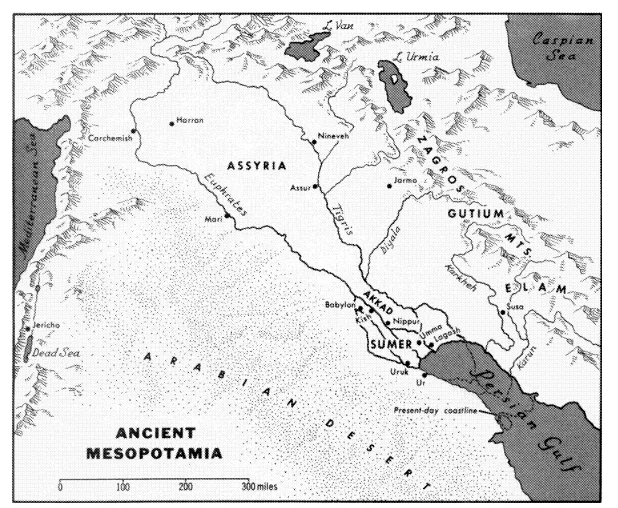
Neolithic agricultural methods made permanent settlement of relatively large populations impossible in most parts of the earth. Only in some river valleys, where annual floods fertilized the fields, could tillage be kept up year after year. Within the general area where agriculture was first developed, two great valleys met these conditions: the valley of the Two Rivers—the Tigris and Euphrates—in modern Iraq; and the valley of the Nile in Egypt. But before these regions could be fully exploited, dikes, canals and reservoirs had to be constructed, for both valleys suffer from floods and from an almost complete lack of rainfall in the months when the crop ripens. Unless water could be brought to the fields artificially, the summer sun would parch and destroy the grain.
Other geographical peculiarities of these valleys favored the development of the first civilized societies. In the Tigris-Euphrates valley, or Mesopotamia (Greek for “the land between the rivers”) as it is usually called, native stone for the making of tools was lacking and had to be brought from afar; and at the same time, the rivers and their valleys provided natural lines of communication and transport. Thus trade and stimulating contact with other people were both easy and necessary. When once the indispensable irrigation works had been constructed, the richness of the soil facilitated the production of food surplus, and this surplus in turn provided a margin for trade and for the support of various specialists—priests, rulers, craftsmen and merchants.
Partly as a result of these geographical peculiarities, the peoples of Mesopotamia and Egypt became the leaders in what has sometimes been called the urban revolution. With the rise of cities the earliest societies we recognize as civilized came into existence, first in Mesopotamia, and a little later in Egypt.
a. Mesopotamia
Between about 6000 B.C. and 3000 B.C., a series of social changes and technical improvements transformed small neolithic settlements in the valley of the Two Rivers into cities like Ur, Lagash and Erech, which are revealed by the earliest written records of Mesopotamia. The most important technical improvements made during this time were the discovery of writing, of how to smelt and cast copper, the harnessing of animal power by the development of plows and wheeled vehicles, the invention of the sailing boat, and the invention of the potter’s wheel.
The urban revolution depended not only on these technical improvements but also upon a social reorganization which permitted coordination of effort among large numbers of men. Without such coordination, specialization and the development of technical skills (which depended on specialization) could not go very far. Even more important, the irrigation, without which cultivation of the Tigris-Euphrates valley was impossible, could only be undertaken and maintained by large-scale social action.
The steps by which the simple organization of a neolithic village was developed into the social hierarchy of the earliest cities can only be surmised. By 3000 B.C. distinct social classes had been formed, including slaves, tenant farmers (who paid a part of their crop to the god, i.e., to the temple priests, as a sort of rent or taxes), various craftsmen, merchants, priests, and chief-priests who were at the same time governors or kings. Government was carried on in the name of the city’s god or gods: the city’s land was described as belonging to the god, the craftsmen (who were paid in kind by the priests) worked for the god, and the governor was the agent of the god, responsible for safeguarding the god’s property, defending it against enemies and against floods and droughts by maintaining the elaborate irrigation works.
Writing was developed as a system for keeping account of the god’s income. Writing was done on clay tablets, with the stem of a reed, cut at an angle so that it made wedge-shaped marks. The writing is consequently called cuneiform, from the Latin, cuneus, wedge. By about 3000 B.C., a system of writing which combined pictographs with syllabary and ideographic elements was in use in the lower reaches of the Tigris-Euphrates valley. Modern scholars have succeeded in learning to read this script, which records a language known as Sumerian.
The earliest ...