![]()
1 The Remittance House
Dream Homes at a Distance
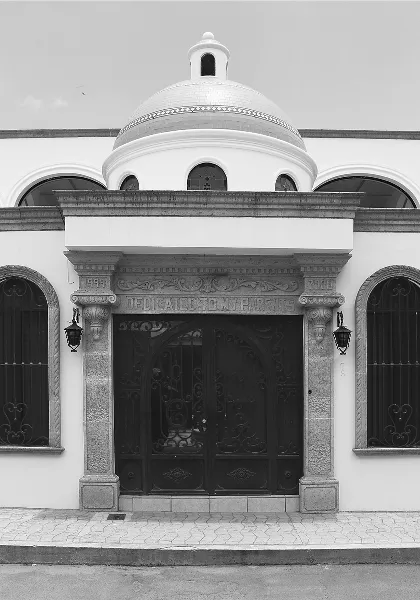
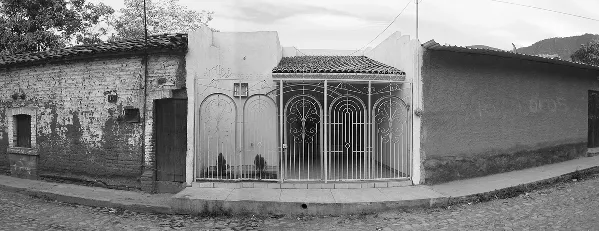
In the small town of Pegueros, in the region of Los Altos, Jalisco, Antonio Rodríguez built three new houses, each one an improvment on the last. The first incorporated several sculptural and ornamental features, including an inscription on the entryway lintel, beneath a miniature cupola. It reads (in English), “DEDICATED TO MY PARENTS.” On this house situated across the street from his childhood home, the inscription addresses his parents each day when they leave their house to buy food or spend time in the plaza. While they will not see Antonio, who lives and works in Los Angeles, his homage remains. All three houses remain vacant or occupied by a villager who guards and maintains the property. Daily, these arrangements, and the houses themselves, demonstrate Antonio’s gratitude to family and the pueblo in his absence.
Located on a rather drab street between two unadorned peso houses, this sculptural home is an exceptional example of what I call the remittance house. I use this term to refer to a house built with dollars earned by a Mexican migrant in the United States and sent—remitted—to Mexico for the construction of his or her dream house. More broadly, I use this term to emphasize remitting and migration as key components of contemporary long-distance building practices around the globe.1 While such houses exhibit similarities, every remittance house is unique and embodies the specific circumstances of the migrant who finances and builds it. Some migrants and their families build informally, adding rooms as the need arises, while others use architectural plans to construct entirely new houses on their land. Understated facades may blend in with the surrounding buildings, or highly ornamental designs may announce a migrant’s success abroad. In Mexico, dating back to at least the middle of the twentieth century, the remittance house has crystallized migrant narratives and desires amid shifting cultural milieus. As artifacts of complex relationships, these houses are also embedded in the macro processes of globalization and transnational migration.
For at least a century, American immigrants’ remittances have dramatically affected the vernacular rural landscapes of their hometowns. As early as 1913, the New York Times observed that Italian immigrant laborers “go back when they have accumulated American money, buy property and restore it,” with the result that “in squalid villages stand new, clean houses” built by “Italians who have come back from America.”2 Similarly, the Chinese built remittance houses in the late nineteenth century for family members who remained in China. Today, Turkish migrants in Germany, Portuguese migrants in France, and Central American migrants in the United States use hard-earned wages to build new houses in their hometowns.3
The current scale of remitting and the continuous movement of migrants between Mexico and the United States are unprecedented. This fast-growing sector of the economy is spearheading home building for migrants and their families throughout Mexico.4 However, the consequences of imagining, building, and living in these homes for local communities, family life, and local construction practices and markets have received scant attention.5
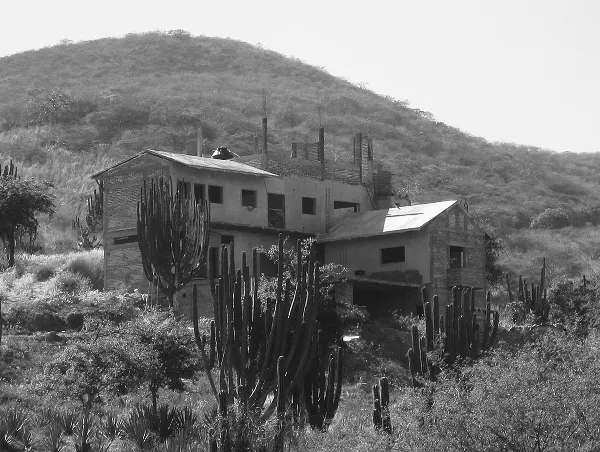
This chapter explores how the forms of remittance houses not only embed social meanings but also structure social life and relations between individuals, genders, classes, and groups and establish categories or descriptions fundamental to society.6 Houses—a critical space of migration—reflect and reproduce the social condition of migrants. I examine the meanings and implications of remittance houses through geographically and historically contextualized ethnographies of migrants and their families. Because remittance projects are often informal—paid for in cash without contracts or documentation—I rely on narrative accounts of migrants and migrant families as a primary source for understanding how they spend remittances, the motives that drive them, and the unique history of individual building projects. Architectural analysis of these houses defines the remittance house as a unit of analysis for larger social, political, and architectural discourses about migration and global building practices in rural places. Remittance houses are emblems of the rising social status of once impoverished rural farmers. Yet the houses and the specific forms they take also have unintended consequences that many migrants did not anticipate when building them. For example, the increased symbolic value of the house frequently corresponds to a diminished functional or use value, as migrants living in the United States are unable to occupy them. Similarly, architectural styles and spaces suggest lifestyles that remain unattainable for most. The remittance house can be read both architecturally and allegorically—it is both a house form and a crystallization of the inequities that underpin migrants’ lives.
The spaces of the remittance house are also indicators of a profound transformation in rural Mexican society.7 Perhaps the single most striking quality of remittance construction is the social distance embedded in its form. Scholars of the built environment can contribute to the study of how migration is transforming rural Mexican society by analyzing changes in spatial form at both migrants’ places of origin and their point of arrival.8 Social relations stretched across geographies and exacerbated by distance increasingly define local places. The price of improving the domestic dwelling is abandoning it, and investments in the community can end up producing new social and spatial divisions within it. Absence is a necessary precondition for migrants to realize their dream house.
The Village in Historical Context
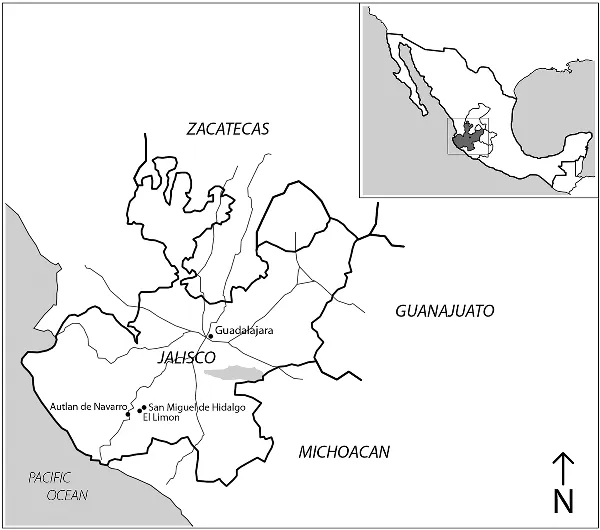
Jalisco, Mexico, is located about fifteen hundred miles south of the US-Mexico border along the Pacific Coast. It is one of the Mexican states with the highest rates of emigration.9 Migration to the United States from rural Jalisco dates back to the late nineteenth century. Even before the railroad connected the northern region of Jalisco to California at the turn of the twentieth century, people were heading north on foot.
At the turn of the twentieth century, large-scale agricultural production based on unequal power relations between hacendados (owners of hacienda plantations) and indebted campesinos (farmers) established agricultural communities. Campesinos in pueblos surrounding the hacienda often planted and harvested land that belonged to the hacendados or powerful families, known as caciques. In remote localities, very small subsistence-farming communities, known as ranchos, were composed of one or two extended families. In such places, in part due to the neglect of the federal government, most rural inhabitants built modest houses with local materials.
To study the remittance house I focus on San Miguel Hidalgo, a pueblo in the south of Jalisco established before the Spanish viceregal period. San Miguel’s range of building types (from adobe brick huts to lavish remittance houses), its location in a region of Jalisco that has a high emigration rate, and its proximity to the other sites examined in this book contributed to my selection of the site. San Miguel, a pueblo of approximately five hundred inhabitants, was entirely (and remains partially) owned by two caciques. As with many pueblos in Jalisco, San Miguel’s built environment reflects its migration history. The impact of emigration to the United States on the community dates to around 1960.10 Various remittance houses—the types range from one-story cement-block houses to large, ornate mansions—share party walls with preremittance-era adobe brick houses, some of which are hundreds of years old. Although San Miguel is a unique case, it provides information about the remittance house that can be applied across disparate remittance landscapes.11
This study is limited to rural places and to individuals who cross the US-Mexico border and work in jobs that are not related to the illegal drug market. However, remittance houses are not only in rural places. New homes built in midsized and large cities need to be analyzed. So do remittance homes built by migrants who have not necessarily crossed international boundaries. Rural Mexicans who have migrated to Guadalajara sometimes build homes in their pueblos of origin that reflect urban Mexican architectural styles. And finally, remittance capital does not result only from economic migrants working legal and ordinary jobs; remittance capital is also increasingly linked to illicit jobs related to Mexico’s narco-industry.12 Narco-architecture is also funded by capital embedded in distant markets and activities and tied to the political economy of both countries. While remittance architecture is being built in both rural and urban localities, and while distant markets support the production of both migrant remittance homes and narco-architecture, I focus on migrant homes in rural locations where the built fabric was relatively consistent before migration and where remittances mark a radical change in what is possible.
Traditional House Forms in Rural Mexico
In rural Mexico, building an adobe house has traditionally been a communal activity performed by men. Until recently, the principal building material in rural Jalisco was adobe brick—a mixture of earth, zacate (grass), and horse manure. To make adobe brick, laborers worked in complementary ways: one worker’s knowledge of where the tierra buena (good earth) was located was complemented by another worker’s knowledge of brick-drying techniques. Also, the vulnerability of adobe construction to the elements—notably water, wind, and pests—required a homeowner to continuously tend to his house and to rely on his neighbors to keep it in good condition. These processes reinforced ties between individuals and the immediate environment and created an interdependent community.
While most men in the village were known as albañiles (ordinary house builders), some possessed special craft skills: one was able to build roofs and another to craft wooden doors. These specialized skills allowed neighbors to strengthen their standing in the community by extending their help to other families. Similarly, barter produced systems of mutual interdependence in which farm produce could be exchanged for labor and expertise—one farmer’s honey would be traded for another’s time. This pattern of exchange allowed a seemingly homogenous community to articulate important social distinctions.
Traditional dwellings in San Miguel also exhibit a close fit between domestic space and an agrarian way of life. Typical houses consist of a courtyard (or a large enclosed yard) surrounded by inward-facing living quarters and an interior porch connecting private rooms with the communal space of the courtyard. The courtyard, a multifunctional space, is by far the most frequently used area in the house. In the courtyard a large outdoor comal, or wood-burning oven for stewing meat and making bread, a well, and a tub for washing clothes are situated among fruit trees and vegetable gardens. Corrals and stables for livestock, and sheds for tools to make honey or adobe bricks, often constitute an enclosure along one side of the yard. When taken together, these spaces of production allowed families to maintain a level of self-sufficiency.
The exterior wall that encloses the courtyard house also defines the edge of the street. This front wall is fully attached and continuous with neighboring structures, forming an uninterrupted facade. The wall supports a traditional roof known as dos aguas (two waters) covered with clay tile, with a ridge that parallels the street and extends seamlessly from one house to the next. The wall and roof create a continuous fabric that separates public from private space.13
Traditionally, people build and enlarge adobe homes in an incremental fashion. The Rodríguez house, built around 1930, exemplifies this incremental, informal approach to the construction of domestic space. Originally a one-room dwelling, the enclosed space consisted of a communal sleeping area attached to a large unfenced yard. Adults slept on the dirt floor, while wooden boards that rested on the wooden roof beams created a tiny (and dangerous) atticlike space for their seven children to sleep next to piles of corn. During the dry months their five boys slept outside. About twenty years later the family added two additional rooms to provide separate sleeping quarters for boys and girls. Shortly thereafter they extended and enclosed the long veranda or patio on the cour...