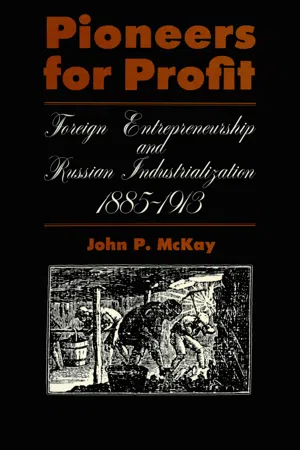
Foreign investment increased from 17 percent of the capital of industrial corporations in Imperial Russia in 1880 to 47 percent in 1914, coinciding with the rapid development of Russian industrialization before World War I. John McKay's study, based largely on intensive research in numerous archives and utilizing many previously unexplored private business records, is the first detailed analysis of the impact of foreign enterprise on Russian industry during this period. His conclusions are significant for historians, economists, and those interested in the development of modern industrial society.
eBook - ePub
Pioneers for Profit
Foreign Entrepreneurship and Russian Industrialization, 1885-1913
- English
- ePUB (mobile friendly)
- Available on iOS & Android
eBook - ePub
About this book
Information
Part I
Dimensions of Entrepreneurship
1
INTRODUCTION
1
In the latter part of the nineteenth century the ever widening waves of the Industrial Revolution launched in Great Britain a century earlier broke upon economically backward agrarian Russia with great force. Military defeats and economic stagnation in the 1850s had forced a hesitant feudal society to begin in earnest the arduous task of modernization and industrialization. Then in the 1860s and early 1870s a whole series of developments—such as the emancipation of the serfs, the real beginnings of a railroad system, an expanding internal market, and the creation of a considerable banking system—helped establish the preconditions of modern economic growth. The initial overall effect of these changes was limited, however, and it was a generation before the tempo of industrial progress quickened to revolutionary proportions in the 1890s. After the Russian industrial revolution of that decade (or “big spurt” or “take-off,” to use somewhat analogous current terminology), the pace of industrial development marked time during the serious depression from 1900 to about 1908. But it recovered impressively and was probably “self-sustaining” in the second surge, which lasted from 1909 to the outbreak of World War I. The pattern of two great booms broken by a long depression may be seen in table 1.
The rate of growth for Russian industrial production compares favorably with rates of industrial growth in other countries during both their respective industrial revolutions and the years at the turn of the century. Indeed, in the 1890s Russia’s rate of industrial growth was perhaps the highest in the world. Even after 1900 it was still higher than rates in the major European countries, as table 2 shows.
Table 1
ANNUAL GROWTH RATES OF RUSSIAN INDUSTRIAL PRODUCTION, 1885–1913
(In Percent)
ANNUAL GROWTH RATES OF RUSSIAN INDUSTRIAL PRODUCTION, 1885–1913
(In Percent)

SOURCE: Alexander Gerschenkron, “The Rate of Growth of Industrial Production in Russia Since 1885,” Journal of Economic History 7 Supplement (1947): 149.
NOTE: For the years 1894–99 the growth rate was approximately 9 percent; for 1910–13, approximately 7.5 percent.
At the same time the weight of the large and backward agrarian sector, the rapid rate of population increase, and the very low level of industrial development in 1860 (or 1890 for that matter) meant that Russia remained far behind other industrial nations in 1913 in all per capita comparisons of income or consumption in spite of its industrial achievement after 1885. In 1913 per capita income in Russia was only 101.4 rubles, as opposed to the equivalents of 300.4 rubles in Germany, 460.6 rubles in Great Britain, and 682.3 rubles in the United States.1 That rapid growth left Russia poor in absolute and comparative terms probably helps account for the great divergency of judgments concerning the nature of the Russian economy on the eve of the First World War and related historical what-might-have-beens. Those drawing an essentially optimistic interpretation stress (among other things) the relatively high and sustained rate of industrial growth as decisive, while pessimists cite the low level of development as symptomatic of fundamentally unaltered backwardness in 1913. Thus the arguments of optimists and pessimists often go past each other. They refer to two different sets of facts, and perhaps to different fundamental conceptions of what is important in history.
Table 2
GROWTH OF INDUSTRIAL PRODUCTION IN SELECTED COUNTRIES, 1860–1913
(In Index Numbers: 1913 = 100)
GROWTH OF INDUSTRIAL PRODUCTION IN SELECTED COUNTRIES, 1860–1913
(In Index Numbers: 1913 = 100)

SOURCE: Vierteljahrshefte zur Konjunkturforschung 31 (1933): 18.
NOTE: Industries included are mining, textiles, ferrous metallurgy, and food processing.
In analyzing this considerable Russian industrialization after 1885 many investigators have focused on the primary influence of the state. As Professor Gerschenkron puts it, “The strategic factor in the great industrial upsurge of the 1890s must be seen in the changed policy of the government. . . . Industrial development became an accepted and in fact the central goal.”2 The centrality of the state in Russian economic development in the last years of the nineteenth century almost seems, then, to connect the reforms of Peter the Great with the accomplishments of the commissars in a seamless pattern: Russian economic development was always directed by political authority for political goals.3 For another respected scholar in an expansive mood the finance minister, Count Witte, who was chief architect of Russian economic policy in the 1890s, even becomes basically “a forerunner of Stalin rather than a contemporary of Nicholas II” or, presumably, John D. Rockefeller. And Russia in the 1890s becomes “the pioneer of all modern experiments in deliberate economic development.”4
Certainly no one would deny the general importance of active governmental involvement in Russian industrial development in the 1890s. Yet on the basis of Professor Gindin’s marvelous study on the State Bank from 1861 to 1892, one might well argue that the decisive change in governmental attitudes really occurred in the late 1860s and early 1870s.5 Similarly, one may well question whether Witte was a civilized Stalin, and whether economic planning in today’s underdeveloped countries is derived from projects formulated by a tsarist finance minister. Indeed, one should. For the role of the state in Russian development in these years is actually quite subtle. And an understanding of that role is extremely important for any study on foreign entrepreneurship.
“What in fact did the state do? Three activities stand out. First, it provided high tariff protection for industry—very much like that associated with the contemporary governments of Méline in France, or McKinley in the United States. Second, it accounted for the greater part of new railroad construction, which almost doubled the Russian system from 1889 (18,600 miles) to 1901 (35,000 miles).6 The government simultaneously bought numerous private companies for top prices, so that by 1901 government roads constituted two-thirds of the total rail network.7 Third, the government engaged in a vast public relations campaign to enlist support for industrialization at home and abroad.
Of these three activities, only large-scale construction of railroads by the government might seem to be a radical departure from the earlier experience of industrializing countries. Yet, as every undergraduate has been taught for a long time, only Great Britain built its railroads without benefit of extensive state aid. And several continental railway systems, like those of Belgium or Imperial Germany, became essentially state-owned and state-operated by the end of the nineteenth century.8 At first glance the case for radical government experiment and novel intervention seems exaggerated.
With further investigation it becomes even more so. Surely the model for Stalin and future planners would have seen the state blazing some sort of trail as producer and industrial manager, complete with pilot plants, quotas, and ruthless elimination or control of possible competitors. The Russian state did nothing of the sort. In fact, with the exception of previously mentioned state-owned railroads, almost all of Russian industry remained in private hands. Almost all increase in industrial output came from private enterprise producing for profit within a relatively free market system. And when on occasion the state, as banker of last resort, came to hold an industrial enterprise, like the Putilov Works in the 1880s, or the Kerch Metallurgical Company in the first decade of the twentieth century, it did so reluctantly and returned such plants to private owners as quickly as possible.
One may argue of course that demand is almost always crucial in economic development: where it leads supply will follow. Accordingly, whether Russian demand came mainly from large state purchases, or from some state demand combined with propaganda and public relations adding up to an investment boom, the state would remain crucial. Different societies and their businessmen will invariably respond to increased demand and opportunities for large gain, since alleged differences in social attitudes influencing business activity are largely illusory or inconsequential.9 Yet even if one accepts this argument, it is clear that the state only bought goods; it did not produce them. At most, the state embarked upon an important program of public works in an attempt to create adequate effective demand, a demand that could be substituted for the weak private market.10
In reality, this alleged substitution by the state has also been exaggerated, at least among Western scholars. As a recent study of the period shows, “the specific criticism which can be brought against the Russian government is that only a minute part of its budget expenditures went directly for the purposes of developing the industrial sector.”11 Thus direct railroad construction and subsidizing of private railroad construction, by far the government’s most important economically productive activity, totaled little more than one billion rubles between 1880 and 1900, the period of greatest construction. This sum did not exceed government custom revenue from imports of tea, coffee, alcoholic beverages, salt, and herring in these years.12 Or, to put it another way, the state spent less than 5 percent of its budget during this period on railroad construction.13 Yet this was by far the largest item for industrialization purposes. Direct subsidies to industrialists were not even a close second.14
Nonetheless, I would argue that government did have a key role in the crucial 1890s. That role was, however, very largely one of public relations, propaganda, and radiation of enthusiasm. If “historians tend often to disregard the existing features of the reality of government policy and to pass judgment on the basis of general pronouncements,”15 their failure is understandable. The public relations campaign was well organized and resourceful. And it had real significance for development, as we shall see later. Yet even so, the Witte system emerges as a wager, though perhaps a safe one, on capitalists and private entrepreneurs.16 Such a strategy would seem to have much more in common with a market economy than with the command economy of Stalin, or the planned economies of parts of the underdeveloped world, where the state is an important or predominant producer.
The wager on private capital was of course anything but safe. The nearly automatic supply of creative entrepreneurship to increased opportunity in backward countries is all too rare. Many observers have noted, for example, that the price system often does not seem to work in such countries, in part because large groups of the population refuse to alter methods or outlook in the face of changing market conditions. Certainly Finance Minister Witte believed Russia lacked local businessmen who had the incentive and the know-how, not to mention the capital, necessary for accelerated development. He believed there was nothing automatic about the supply of entrepreneurship or knowledge, but that it could only grow gradually hand-in-hand with the growth of industry. And since industry itself was dependent upon entrepreneurship, industrial know-how, and capital, which were all insufficient, Russia was apparently caught in the vicious cycle of backwardness and slow change. Yet it was precisely in the context of this analysis that the entire Witte system bet on a massive response from private producers.
Or more precisely, it bet on private foreign entrepreneurship and its financial resources. Witte himself summed up the matter in 1899 in a secret memorandum for Tsar Nicholas II.17 “The inflow of foreign capital is, in the considered opinion of the Minister of Finance [i.e., Witte], the only way by which our industry will be able to supply our country quickly with abundant and cheap products. Each new wave of capital, rolling in from abroad, knocks down the excessively high level of profits to which our monopolistic businessmen are accustomed and forces them to seek equal profits through technical improvements which lead to price reductions.”18 This suggests that the state believed it could content itself with creating some real demand and great investment enthusiasm because, although the Russian market was very imperfect and its entrepreneurship inadequate, the international market system of capitalistic Europe and its businessmen was highly responsive to new opportunities. Not only would foreign capitalists enter Russia for high profits, but they would continue to do so even as profits fell through increased competition. Thus the sharp rise in demand would not result only in windfall profits for local monopolists. Rather it would elicit such a response and increase in productive facilities that eventual market equilibrium would give both lower prices and l...
Table of contents
- Cover
- Copyright
- Title Page
- Dedication
- Contents
- List of Maps
- Abbreviations
- Preface
- Part I. Dimensions of Entrepreneurship
- Part II. Case Studies and Conclusions
- Notes
- Appendix
- Bibliography
- Index
Trusted by 375,005 students
Access to over 1.5 million titles for a fair monthly price.
Study more efficiently using our study tools.
Frequently asked questions
Yes, you can cancel anytime from the Subscription tab in your account settings on the Perlego website. Your subscription will stay active until the end of your current billing period. Learn how to cancel your subscription
No, books cannot be downloaded as external files, such as PDFs, for use outside of Perlego. However, you can download books within the Perlego app for offline reading on mobile or tablet. Learn how to download books offline
We are an online textbook subscription service, where you can get access to an entire online library for less than the price of a single book per month. With over 1.5 million books across 990+ topics, we’ve got you covered! Learn about our mission
Look out for the read-aloud symbol on your next book to see if you can listen to it. The read-aloud tool reads text aloud for you, highlighting the text as it is being read. You can pause it, speed it up and slow it down. Learn more about Read Aloud
Yes! You can use the Perlego app on both iOS and Android devices to read anytime, anywhere — even offline. Perfect for commutes or when you’re on the go.
Please note we cannot support devices running on iOS 13 and Android 7 or earlier. Learn more about using the app
Please note we cannot support devices running on iOS 13 and Android 7 or earlier. Learn more about using the app
Yes, you can access Pioneers for Profit by John P. McKay in PDF and/or ePUB format, as well as other popular books in History & Investments & Securities. We have over 1.5 million books available in our catalogue for you to explore.