Lysaker examines the relationship between philosophical thought and the act of writing to explore how this dynamic shapes the field of philosophy.
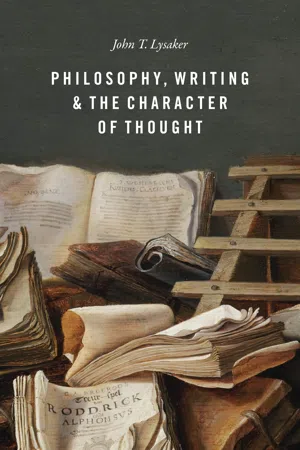
Philosophy's relation to the act of writing is John T. Lysaker's main concern in Philosophy, Writing, and the Character of Thought. Whether in Plato, Montaigne, Nietzsche, Wittgenstein, or Derrida, philosophy has come in many forms, and those forms—the concrete shape philosophizing takes in writing—matter. Much more than mere adornment, the style in which a given philosopher writes is often of crucial importance to the point he or she is making, part and parcel of the philosophy itself.
Considering how writing influences philosophy, Lysaker explores genres like aphorism, dialogue, and essay, as well as logical-rhetorical operations like the example, irony, and quotation. At the same time, he shows us the effects of these rhetorical devices through his own literary experimentation. In dialogue with such authors as Benjamin, Cavell, Emerson, and Lukács, he aims to revitalize philosophical writing, arguing that philosophy cannot fulfill its intellectual and cultural promise if it keeps to professional articles and academic prose. Instead, philosophy must embrace writing as an essential, creative activity, and deliberately reform how it approaches its subject matter, readership, and the evolving social practices of reading and reflection.
- English
- ePUB (mobile friendly)
- Available on iOS & Android
eBook - ePub
Philosophy, Writing, and the Character of Thought
About this book
Information
Publisher
University of Chicago PressYear
2018Print ISBN
9780226815855
9780226569567
eBook ISBN
9780226569734
Topic
PhilosophySubtopic
Literary CriticismIndex
Adorno, Theodor, 95, 109, 122, 162; art and, 41, 144; Habermas on, 107–8; writing and, 61, 126, 142, 182n63
aphorism, 1, 2, 7, 132; the address and, 55; Bacon and, 16, 17, 31, 34, 97–98, 170, 176n12; Benjamin and, 18, 128–29; the blog and, 150; the definition and, 99; the essay and, 37; genre and, 32, 169; Kraus and, 32–33; the manifesto and, 146; Nietzsche and, 17; philosophy and, 9, 21, 173; writing and, 112
Aristotle, 1, 156–57; conversation and, 56; Nicomachean Ethics, 20–21, 76, 149; Rhetoric, 21–23
Bacon, Francis, 7, 176n12; the aphorism and, 16–17, 128, 170; the essay and, 34–36, 152, 168; writing and, 31–32, 97–98
Baldwin, James, 65, 67
Barthes, Roland, 59, 92–93
Beauvoir, Simone de, 134–35, 158
Benjamin, Walter, 4, 57, 182n65; Cavell on, 66–67; conviction and, 18–19, 38, 125–28, 161–63, 168, 170, 176–77n16; One-Way Street, 18–19, 124–33, 160–66, 170, 176n16; Theses on the Philosophy of History, 81; writing and, 31
blog, 148–51
Butler, Judith, 61, 72, 77–80, 144, 179n43
Cavarero, Adriana, 61, 93–94
Cavell, Stanley, 3, 4, 91, 104, 122, 179n43; the address and, 72, 160; on deconstruction, 76; dialogue and, 114; on Emerson, 6–7; philosophy and, 143, 168; voice and, 94; writing and, 66–68, 94–95, 141
Celan, Paul, 38, 43, 54, 55
character, 1, 31, 137, 155, 158–66; Aristotle and, 20; of art, 41–43; Bacon and, 16; the blog and, 150; Cavell and, 7, 94; context of, 122; Emerson and, 10, 157; friendship and, 89; Heidegger and, 141; inquiry and, 40; Lukács and, 152–53, 181n59; the manifesto and, 146–47; Nietzsche and, 51; philosophy and, 2, 9, 55, 143; Platonic dialogues and, 14, 40, 112–13, 116–17; praxis and, 4, 21; of self, 47, 72; ...
Table of contents
- Cover
- Title Page
- Copyright Page
- Dedication
- Contents
- Gambits and Gambles
- Iron Filings
- Pardon the Interruption
- Content and Form
- Form and Content
- In the Beginning Was the Deed
- Reworking Making
- Deliberate Writing
- Mistaking Instrumental Reason
- Fits and Starts
- A Cultivar
- Quotation beyond Quotas
- For Examples
- In Nuce
- Irony
- Message in a Bottle
- The Hour of the Wolf
- It’s the Gesture That Counts
- Furnishing the Space of Reasons
- A Struggle with Ourselves
- Who’s on First
- Every One Is Everybody
- The Secret Addressee
- When We Undo Things with Words
- Unknown Friends
- Resoundingly Reticent
- Provocation/Demonstration
- Among the Pros (and Cons)
- A: “O my friend, there are no friends.” B: “At least we’ve got each other.”
- Then Came History
- Equal to the Moment
- Unequal to the Moment
- After Beauvoir
- Property Is Theft
- Strange Alchemy
- Public Commitment
- Propagation without Propaganda
- Bit by Bit
- Taking Stances
- Character Studies
- Where Do We Find Ourselves?
- Acknowledgments
- Notes
- References
- Index
Trusted by 375,005 students
Access to over 1.5 million titles for a fair monthly price.
Study more efficiently using our study tools.
Frequently asked questions
Yes, you can cancel anytime from the Subscription tab in your account settings on the Perlego website. Your subscription will stay active until the end of your current billing period. Learn how to cancel your subscription
No, books cannot be downloaded as external files, such as PDFs, for use outside of Perlego. However, you can download books within the Perlego app for offline reading on mobile or tablet. Learn how to download books offline
Perlego offers two plans: Essential and Complete
- Essential is ideal for learners and professionals who enjoy exploring a wide range of subjects. Access the Essential Library with 800,000+ trusted titles and best-sellers across business, personal growth, and the humanities. Includes unlimited reading time and Standard Read Aloud voice.
- Complete: Perfect for advanced learners and researchers needing full, unrestricted access. Unlock 1.5M+ books across hundreds of subjects, including academic and specialized titles. The Complete Plan also includes advanced features like Premium Read Aloud and Research Assistant.
We are an online textbook subscription service, where you can get access to an entire online library for less than the price of a single book per month. With over 1.5 million books across 990+ topics, we’ve got you covered! Learn about our mission
Look out for the read-aloud symbol on your next book to see if you can listen to it. The read-aloud tool reads text aloud for you, highlighting the text as it is being read. You can pause it, speed it up and slow it down. Learn more about Read Aloud
Yes! You can use the Perlego app on both iOS and Android devices to read anytime, anywhere — even offline. Perfect for commutes or when you’re on the go.
Please note we cannot support devices running on iOS 13 and Android 7 or earlier. Learn more about using the app
Please note we cannot support devices running on iOS 13 and Android 7 or earlier. Learn more about using the app
Yes, you can access Philosophy, Writing, and the Character of Thought by John T. Lysaker in PDF and/or ePUB format, as well as other popular books in Philosophy & Literary Criticism. We have over 1.5 million books available in our catalogue for you to explore.