![]()
PART ONE
Revising Collective Memories
“Those of us who grew up in the fifties believed in the permanence of our American-history textbooks. To us as children, those texts were the truth of things, they were American history,” wrote Frances FitzGerald (1979: 7) in her study, America Revised: History Schoolbooks in the Twentieth Century. Included in such texts were highly favorable characterizations of important figures from the American past, such as Christopher Columbus, Thomas Jefferson, and Abraham Lincoln. There may have been dissent by some, but little reason to doubt the acceptance of the traditional positive representations by much of the educated general public.
By the end of the twentieth century, however, these collective memories were being seriously questioned. Our first three chapters provide an account of earlier representations of these three figures, the challenges or changes the representations faced, and the present outcomes. We consider collective memories both as part of cultural history and as held by representative samples of Americans. The challenge to Columbus has been the greatest of all.
![]()
ONE
Collective Memories and Counter-Memories of Christopher Columbus
The first significant commemorations of Columbus’s landfall in 1492 occurred on its three hundredth anniversary in 1792, with the discovery of America called “the greatest event in the history of mankind since the death of our Savior” (de Lancey 1893). Columbus was seen as “the solitary individual who challenged the unknown sea . . . [and] was ultimately betrayed by royal perfidy [but] as a consequence of his vision and audacity, there was now a land free of kings, a vast continent for new beginnings” (Wilford 1991: 252). Although he had never reached the North American continent, nor indeed understood what it was he had come upon, the phrase “Columbus discovered America” increasingly merged the landing in the Bahamas in 1492 with the birth of the United States itself (Koch 1996).
Columbus continued to be idealized through the nineteenth and early twentieth centuries, as indicated by the installation in 1847 of the great John Vanderlyn painting, The Landing of Columbus on San Salvador, in the Rotunda of the U.S. Capitol, and the placement of other commemorative symbols in towns and cities across the nation (Groseclose 1992). A multivolume biography by the celebrated author Washington Irving ([1828] 1981) characterized Columbus in terms of “the grandeur of his views and the magnanimity of his spirit. . . . Instead of ravaging the new found countries . . . he sought . . . to civilize the natives” (565). The eminent historian William Prescott wrote that it would be “difficult to point to a single blemish in his moral character” (1874: 254), and the 1492 voyage resonated with divine purpose in Walt Whitman’s (1874) “Prayer of Columbus”: “a message from the Heavens . . . sped me on.”
The four hundredth anniversary of the landfall in October 1892 was celebrated over a yearlong period, starting with “a grand civic parade of more than eighty thousand participants led by the president of the United States and including the entire cabinet, the Supreme Court, and most of the Congress” (West and Kling 1989: 56–57)—a national commemoration almost inconceivable at present. The celebrations culminated in the spectacular World’s Columbian Exposition in Chicago, which drew over twenty-seven million visitors and “produced an unparalleled surge of creative energy that had an important influence . . . on the cultural values of the nation” (Columbia Encyclopedia 2000c: 3108). The inaugural oration spoke of “the crowning gift to humanity from Columbus . . . in search of a great land”—identified with the United States—and the official history of the Exposition declared Columbus “the greatest human benefactor of the human race” (Johnson 1897, vol. 1, p. 2). Such celebration and commemoration of Columbus illustrate Olick’s conception of collective memory as “public discourses about the past as wholes or . . . narratives and images of the past that speak in the name of collectivities” (2007: 33).
Having started as a symbol of American individualism and progress, Columbus then became an ethnic hero as well, with Italian Americans playing a major role in turning Columbus Day into a full federal holiday in 1968. But ironically, his enshrinement in the federal calendar occurred just as his reputation was caught “in a riptide of conflicting views of his life and his responsibility for almost everything” wrong that could be linked to 1492 (Wilford 1991: 247). The revolution in minority rights over the second half of the twentieth century not only changed the attitudes of the American public regarding race, gender, and other social divisions (Pinker 2011), but also led to revisions in beliefs about individuals and events from the past.
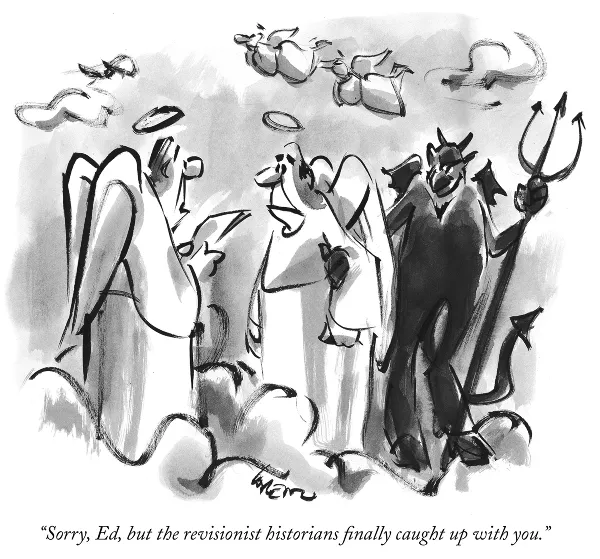
During the 1980s and 1990s, according to revised editions of the Columbia Encyclopedia, “the image of [Columbus] as a hero was tarnished by criticism from Native Americans and revisionist historians. . . . His voyages [came to] symbolize the more brutal aspects of European colonization and represent the beginning of the destruction of Native American people and culture” (1993: 605; 2000a: 629). The contestation of the meaning of Columbus’s landfall in 1492, especially as its five hundredth anniversary approached in 1992, was the starting point for our research on the relation between revisionist efforts, on the one hand, and the collective memories held by the wider public, on the other.
Christopher Columbus: Hero or Villain?
Countermemories (Foucault 1977) came from different sides. In 1973 the geographer and historian Alfred Crosby wrote of the havoc produced by diseases that Europeans brought to Native Americans. A broader critical book in 1975 by historian Francis Jennings bore its thesis in its title: The Invasion of America. Probably the most widely read early attack appeared in the opening chapter of Howard Zinn’s (1980) A People’s History of the United States, which spoke of 1492 from the standpoint of Indians and emphasized their oppression by Columbus and his successors. Zinn’s book sold more than a million copies (personal report by the author), is owned by more than four thousand libraries (Worldcat database), and has been translated into Spanish and at least eleven other languages. Also important in terms of popular impact was James Loewen’s The Truth about Columbus, a detailed summary of revisionist thinking for students, published in the Quincentenary year of 1992. Much of that short book then appeared three years later as a chapter in Loewen’s Lies My Teacher Told Me (1995), which has had sales of well over a million copies (author’s report). Moreover, in addition to the major focus on injustice toward Indians, Columbus was connected to the despoiling of the natural environment, “now threatening . . . the existence of the earth as we have known it and the greater proportion of the species, including the human” (Sale 1990: 4). There were counterattacks against revisionist critiques as well (e.g., Snow 1991; Royal 1992), but even such defenses of Columbus’s reputation showed that he was no longer an undisputed hero. He was now a divisive figure (Fine 2001: 8–9).
It is important to recognize that revisionist views of Columbus did not result mainly from the discovery of new facts, but from attention to and reappraisal of information already available. A hundred years earlier at the time of the four hundredth anniversary, Justin Winsor published a book that characterized Columbus quite negatively: for example, Columbus “had no pity for the misery of others . . . [consigning Indians] to the slave market” (Winsor 1891: 505–506). Moreover, much of Winsor’s information came from a manuscript written in the early sixteenth century by a close observer of the Spanish colonization of the Americas, Bartolomé de las Casas ([1965] 1974, 1992), who admired Columbus as a navigator but was highly critical of his and other Spaniards’ treatment of the Indians. Even Samuel Eliot Morison’s (1942) widely acclaimed biography includes such negative information, though the criticisms are overshadowed by the book’s focus on Columbus as a great mariner.
Even earlier than the main revisionist writings and at least as important was the influence of the civil rights movement during the 1960s. With the growing emphasis on Black Power and black identity, other minorities with long-held grievances against the white majority came to the fore (Rhea 1997). In particular, the rise of Red Power ideology at the end of the 1960s (Nagel 1995) challenged white views broadly, and one effect was to question the assumption that Columbus Day is an occasion for celebration. Instead, Columbus’s destruction of native peoples and culture was said to call for condemnation. Then, as Indian and scholarly critiques came together, reinforced by the anticolonial sentiments that had developed in the wake of World War II, major white organizations with a much wider reach began to express guilt over what Columbus represented. For example, the National Council of Churches, which includes thirty-six denominations with more than fifty million members, passed a lengthy resolution in 1990 that included among other similar statements: “For the indigenous people of the Caribbean islands, Christopher Columbus’s invasion marked the beginning of slavery and their eventual genocide. . . . For the Church this is not a time for celebration” (National Council of the Churches of Christ in the USA 1990). Criticism of Columbus also made its way into the mainstream media, for example, appearing prominently in an episode in 2003 of the popular television drama The Sopranos.
College campuses were major sites for protests against positive commemoration of Columbus. We located six college newspapers from October 1992: those at Bowdoin College, the University of Georgia, the University of Illinois in Chicago, the University of Michigan, the University of Oregon, and San Francisco State College. Each contained at least one article damning Columbus or reporting a local protest. Although not a random or large sample, the six were diverse enough to suggest that something similar probably occurred on many nationally known campuses at the time of the Quincentenary. In the years since 1992, occasional campus demonstrations against Columbus Day have continued, some led by American Indians and others by interested non-Indian students. It is difficult for us today even to imagine the glorification of Columbus that occurred in 1892, as in the nineteenth century generally.
The fact that the Columbia Encyclopedia included in its final paragraph the words quoted above about “tarnishing” indicates that revisionist ideas made an impact we...