Chicago is celebrated for its rich diversity, but, even more than most US cities, it is also plagued by segregation and extreme inequality. More than ever, Chicago is a "dual city," a condition taken for granted by many residents. In this book, Joel Rast reveals that today's tacit acceptance of rising urban inequality is a marked departure from the past. For much of the twentieth century, a key goal for civic leaders was the total elimination of slums and blight. Yet over time, as anti-slum efforts faltered, leaders shifted the focus of their initiatives away from low-income areas and toward the upgrading of neighborhoods with greater economic promise. As misguided as postwar public housing and urban renewal programs were, they were born of a long-standing reformist impulse aimed at improving living conditions for people of all classes and colors across the city—something that can't be said to be a true priority for many policymakers today. The Origins of the Dual City illuminates how we normalized and became resigned to living amid stark racial and economic divides.
eBook - ePub
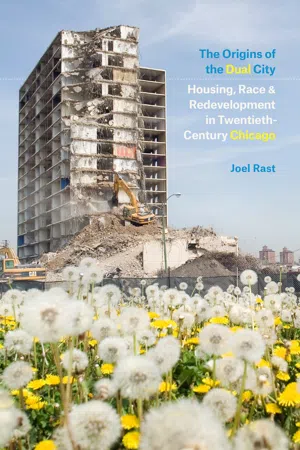
The Origins of the Dual City
Housing, Race, and Redevelopment in Twentieth-Century Chicago
- English
- ePUB (mobile friendly)
- Available on iOS & Android
eBook - ePub
About this book
Information
Publisher
University of Chicago PressYear
2019Print ISBN
9780226661582
9780226661445
eBook ISBN
9780226661612
CHAPTER ONE
How Policy Paradigms Change
Not ideas, but material and ideal interests, directly govern men’s conduct. Yet very frequently the “world images” that have been created by “ideas” have, like switchmen, determined the tracks along which action has been pushed by the dynamic of interest.—Max Weber1
It was getting on toward 2:00 p.m. and I was hungry. I got up from my desk at the nonprofit organization where I worked in the Wicker Park neighborhood of Chicago and walked outside, running through the options for a quick sandwich. It was early May and the weather was glorious, the sky a deep aqua blue and the temperature in the mid-seventies. As I stepped out the door, I felt the warmth of the sun on my face. Everybody seemed to be outside, as if determined to soak up the few short weeks of pleasant temperatures before spring gave way to the heat and humidity of Chicago summer. The sidewalk was teeming with passersby, and North Avenue was jammed with idling vehicles waiting for the red light ahead to change.
As I began to walk down the street I noticed something peculiar. The driver of an SUV sitting in traffic directly in front of me suddenly got out of his vehicle. Seconds later, one of his passengers also got out. Both were men in their early twenties, tough-looking guys with serious faces. One of them was holding a baseball bat. What happened next seemed to unfold in slow motion. The two men said nothing; they simply turned and walked straight to the car behind them. Suddenly the one with the baseball bat raised his arms and began smashing out the car’s front windshield. The sound of glass shattering and hitting the street was jarring. In that car were four other young men. They began shouting threats and obscenities, but the guy with the bat moved wordlessly from one window to the next, methodically smashing all of them. When he was done, he and his companion returned to their SUV, got in, and drove off, the traffic light having changed to green by this point. The whole incident lasted perhaps thirty seconds.
As the scene played out in front of me, I was so shocked that all I could do was to stand there like a fool and watch. Only afterward did it dawn on me what a mistake that had been. Most likely this had been a gang altercation of some kind, one that could have turned into something far more consequential than the breaking of a few windows. Shots might have been fired. I could have become one of those stories Chicagoans see on the news too often—the passerby in the wrong place at the wrong time, hit by a stray bullet. As soon as I recognized what was happening I should have bolted. Instead I stood there transfixed, a sitting duck for someone’s poorly aimed gunshot had the situation escalated to that point.
Of course altercations such as this one occur on a regular basis in Chicago and other major cities, often with tragic consequences. As everyone knows, violence is a part of big-city life. But violent encounters are not randomly distributed throughout the city. Geographic data on violent crime show that such activity is far more likely to occur in some neighborhoods than others, and that in certain neighborhoods the chances of being the victim of a violent crime are actually quite small. For example, Chicago had a total of 561 homicides during 2018, yet two-thirds of them were committed in just fifteen of Chicago’s seventy-seven community areas. The largest number of murders, fifty, took place in the West Side neighborhood of Austin, while fourteen community areas experienced no homicides and another fourteen had only one. Data on other violent crime reveal similar patterns. City residents may not have the statistics at their fingertips, but most have a decent idea of which areas pose the fewest safety risks. As a result, many Chicagoans, residents of a city teeming with violent crime, can go about their business on a daily basis confident that the violence taking place in certain areas of the city—of which, thanks to relentless media coverage, they are well aware—is unlikely to personally affect them.2
Which brings me to my point. The incident I observed that afternoon in Wicker Park was jarring in part because it was not “supposed” to happen there. Located just northwest of downtown, Wicker Park has transitioned during the past several decades from a low- and moderate-income, mostly Latino community to a far whiter, far more affluent neighborhood bearing all the markings of a gentrified community in its maturity. As the demographics shifted in favor of middle- and upper-income whites, the gangs moved out and street crime decreased. To be sure, trouble was not far away; immediately west of Wicker Park is Humboldt Park, a neighborhood where gentrification—at least at that time—had made few inroads. Residents of Wicker Park were routinely reminded of this fact by the periodic sounds of gunfire coming from the west. But that was over there, and this was over here, and most of us who lived or worked in Wicker Park believed that Western Avenue, the street that divides the two neighborhoods, would somehow keep trouble out, as if it were a wall or a barbed-wire fence instead of a simple thoroughfare.
While my experience that afternoon momentarily disrupted this perception of safety and security, any anxiety I felt quickly dissipated. It was, after all, only one incident—the exception that proved the rule. Wicker Park, I understood deep down, was basically a safe community. Nothing bad had happened to me, and better still, I now had an entertaining story to tell. The real violence—the kind that sent people routinely to hospitals and morgues and made residents fearful to walk the streets after dark, or even during broad daylight—was still over there, across Western Avenue and beyond. Wicker Park was not Kansas, but neither was it Lawndale, or Austin, or one of any number of other Chicago neighborhoods where people had good reason to fear for their safety. If anything, what I saw that afternoon reinforced that understanding and the belief that any risks I was taking by living and working in this diverse urban community were minor ones.
Big cities like Chicago, as countless observers have pointed out, are in a sense two cities—one consisting of downtown and privileged, gentrified neighborhoods like Wicker Park, the other being the distressed and visibly decayed communities where low-income, predominantly minority residents live. There are, of course, areas that fall somewhere in between, but those areas are losing ground.3 The trend, which is both pronounced and unmistakable, is toward increasingly stark divides between two distinct kinds of places with radically different prospects. That these two “cities” can exist alongside one another remains one of the major conundrums of urban America. The arrangement works because to a great extent, residents of these places occupy separate worlds. The account executive living in a Lincoln Park condominium knows about the stray bullets that have caused the senseless deaths of innocent children playing in parks, walking home from school, or even sitting in their living rooms on the city’s South and West Sides. Yet she does not worry when she takes her own children to the park, or when she walks them to school, or when she sees them pass by the front window. Secure in the knowledge that such random violence is a fixture of certain neighborhoods and not others, she goes about her daily routine confident that the dangers lurking elsewhere in the city will not harm her or her family.
Somewhere along the line, political leaders in Chicago and other major cities discovered that chronic poverty, slums, and blight are not necessarily harbingers of a city in decline. After decades of white flight to the suburbs, Chicago’s population, like that of many cities, has begun to stabilize, and certain areas—especially near-downtown neighborhoods such as the South Loop and the Near South Side—have undergone explosive population growth. Many of the new residents are former suburban dwellers whose parents and grandparents fled the city during the postwar years, frightened away by racial change and other perceived threats. Now cities have become desirable, even trendy locations—for members of the so-called creative class, new college graduates, retirees, and others who find the buzz of urban life a welcome change from the tedium of the suburbs.
Importantly, this demographic shift has been taking place even as poverty and joblessness in certain Chicago neighborhoods have reached epic proportions. The message for the city’s political leaders is clear: urban decline in one city location is not incompatible with growth and affluence elsewhere. Increasingly city officials have come to terms with poverty and blight, treating it as a chronic condition of urban life that is best managed rather than attacked head on. This does not mean that Chicago and other cities have given up on their most economically distressed neighborhoods. There are programs in place to improve conditions in such areas, and in some cases they have had a tangible impact. But experience shows that poverty is stubborn; the high-poverty neighborhoods of fifty years ago remain, for the most part, high-poverty neighborhoods today, and few officials seem to believe their programs are likely to change that.4 More than ever, Chicago is a dual city, where the rich and the poor traverse the city and move through their daily lives in spatial patterns that intersect, for the most part, in only the most superficial ways. The arrangement is not perfect—far from it. But on some level it works, and city officials seem resigned to it.
It was not always this way. For much of the twentieth century, slums (the common term for such areas until recent decades) were viewed as an urgent problem that demanded attention and resources, a problem that threatened the city’s very survival. As early as 1911, business and civic leaders, fearful that Chicago’s blighted areas would make the vision for the city laid out in Daniel Burnham’s famous 1909 Plan of Chicago unrealizable, teamed with Progressive Era housing reformers to strengthen housing and building regulations in an all-out effort to eliminate slums.5 The anti-slum crusade continued for decades, producing a series of policy initiatives and experiments that fell short of their goals but demonstrated the seriousness with which policymakers and civic leaders viewed the problem. By midcentury, slums had become a near obsession among the city’s movers and shakers. Blight was often likened to a cancerous growth that would “infect more and more areas” unless it was completely removed.6 This meant that the attack on the slums required a citywide strategy. Just as no cancerous tumor can be safely ignored, no blighted neighborhood could be neglected indefinitely, since inaction would allow the disease to spread to healthy areas of the city.
In addition to the threat they posed to healthy neighborhoods, slums were seen as a weighty financial burden, using far more in city services than they generated in tax revenues and forcing more prosperous areas to make up the difference. This condition, which sparked far more outrage during the 1940s and 1950s than it generally does today, also led to the conclusion that slums anywhere in the city could not long be tolerated.7 It was no good to simply rearrange slum districts—to clean up one slum and have another one crop up somewhere else. Such places had to be eliminated altogether. The designers of anti-slum initiatives were passionate about abolishing slums, and any such program that fell short of this goal would have been judged a failure by their standards.
Of course, as we now know, the strategies pursued by the leaders of Chicago’s anti-slum campaigns of the early and mid-twentieth century were flawed on multiple accounts. Eventually urban planners would come to realize that eliminating slums and blight was not a simple matter of providing new and better housing. Slums were a social as well as a physical condition, meaning that programs to combat poverty and racism were necessary as well. Moreover, history would not judge kindly the slash-and-burn tactics endorsed by Chicago’s urban renewal pioneers of the 1950s and 1960s. As activist and social critic Jane Jacobs would argue convincingly, such practices undermined the vitality of city neighborhoods, replacing bustling, diverse city streets with dead zones and menacing “towers in the park.”8 And even if the outcome had been more favorable, few planners today would excuse the aggressive use of eminent-domain powers to clear entire neighborhoods, including homes in good repair, so that redevelopment could begin with a clean slate.
These sins were not minor ones, and there is no apologizing for them. Still, as misguided as their actions and ideas often were, the leaders of anti-slum initiatives held visions that were in at least some respects admirable. The city they imagined was one in which every citizen would have access to decent housing (although for African Americans and other minorities, not always in neighborhoods of their choosing). Slums would be abolished, replaced by attractive, healthy neighborhoods served by parks, transportation facilities, conveniently located shopping centers, and well-maintained schools with adequate playground space and facilities. Fears of rampant crime, disease, and other urban problems would be things of the past. Had this vision for Chicago’s future remained embedded in the city’s governing agenda, it is hard to imagine how contemporary civic and political leaders could perceive today’s dual city as anything other than a catastrophic failure.
How did Chicago’s approach to addressing the problems of the city’s blighted areas change so dramatically—from a decades-long focus on eliminating slums altogether to a new orientation in which reaching an accommodation with such areas seems to be, for all intents and purposes, the long-term goal? It is this question, above all, which guides this book. Answering it convincingly will require us to move beyond the factors urban scholars have traditionally emphasized in explanations of urban policy outcomes—interests, coalition building, and structural economic change. While such factors are unquestionably important, taken together they can provide only a partial explanation for the policy shifts detailed in the chapters that follow. It is my contention that to understand how Chicago’s engagement with its economically distressed areas changed so fundamentally over time, we need to move beyond material interests and the historical conditions they confronted to consider the ideas about the slums held by powerful actors in the city, how those ideas evolved, and how closely they were aligned with the city’s institutional arrangements.
Why this emphasis on ideas—factors that urbanists and social scientists more generally have often dismissed as either epiphenomenal or impossible to observe and therefore measure—as opposed to more conventional variables? Put simply, ideas in the case described here are neither epiphenomenal—in the sense that they can be read off one or more sets of material interests—nor do they present insurmountable measurement problems. As I will argue in the chapters ahead, from the time that slums were identified as a pressing societal problem in early twentieth-century Chicago, powerful actors mobilizing around this issue had multiple options available to respond in ways seemingly consistent with their material interests. Actions were shaped not by simple calculations of interest but by the conventional wisdom of the time about how blighted areas should best be attacked or, short of that, managed. Solutions that were aligned with such beliefs and assumptions were more likely to win support than those that were not. To be sure, policy proposals were debated, oftentimes vigorously. But aside from exceptional periods when the conventional wisdom itself became the object of scrutiny, such debates generally took place within well-defined parameters.
What was this “conventional wisdom,” and how did it shape perceptions and, ultimately, behavior? The dual city of today, with its tacit acknowledgment that blighted neighborhoods are here to stay and must therefore be managed in some way, is an example of what Peter A. Hall and others have termed a policy paradigm.9 By Hall’s definition, a policy paradigm is a kind of gestalt or interpretive framework through which actors understand societal problems and develop solutions. As John Campbell explains, such ideas may be “visible to actors yet taken for granted in the milder sense that they remain largely accepted and unquestioned, almost as principles of faith.”10 Paradigms both enable and circumscribe political activity. Ideas can be assembled and reassembled in different ways, but there are limits to what constitutes an acceptable course of action, and paradigms are powerful in part because such limits are rarely discussed or even acknowledged. Instead paradigms operate in the background, outside public debates over specific policy proposals. They are “common sense.” As Campbell suggests, such ideas “constitute broad cognitive constraints on the range of solutions that actors perceive and deem useful for solving problems. . . . When [solutions] fit the dominant paradigm they appear natural and familiar and, as a result, are more likely to appeal to policy makers than alternatives that do not.”11
Arguments that the behavior of political actors may be shaped by paradigmatic assumptions are supported most convincingly by e...
Table of contents
- Cover
- Title Page
- Copyright Page
- Dedication
- Contents
- Preface
- 1. How Policy Paradigms Change
- 2. Housing Reform in the Private City
- 3. A Formula for Urban Redevelopment
- 4. Creating a Unified Business Elite
- 5. New Institutions for a New Governing Agenda
- 6. The Attack on the Slums
- 7. The New Convergence of Power
- 8. Learning to Live with the Slums
- Conclusion
- Epilogue
- Notes
- Index
Trusted by 375,005 students
Access to over 1.5 million titles for a fair monthly price.
Study more efficiently using our study tools.
Frequently asked questions
Yes, you can cancel anytime from the Subscription tab in your account settings on the Perlego website. Your subscription will stay active until the end of your current billing period. Learn how to cancel your subscription
No, books cannot be downloaded as external files, such as PDFs, for use outside of Perlego. However, you can download books within the Perlego app for offline reading on mobile or tablet. Learn how to download books offline
Perlego offers two plans: Essential and Complete
- Essential is ideal for learners and professionals who enjoy exploring a wide range of subjects. Access the Essential Library with 800,000+ trusted titles and best-sellers across business, personal growth, and the humanities. Includes unlimited reading time and Standard Read Aloud voice.
- Complete: Perfect for advanced learners and researchers needing full, unrestricted access. Unlock 1.5M+ books across hundreds of subjects, including academic and specialized titles. The Complete Plan also includes advanced features like Premium Read Aloud and Research Assistant.
We are an online textbook subscription service, where you can get access to an entire online library for less than the price of a single book per month. With over 1.5 million books across 990+ topics, we’ve got you covered! Learn about our mission
Look out for the read-aloud symbol on your next book to see if you can listen to it. The read-aloud tool reads text aloud for you, highlighting the text as it is being read. You can pause it, speed it up and slow it down. Learn more about Read Aloud
Yes! You can use the Perlego app on both iOS and Android devices to read anytime, anywhere — even offline. Perfect for commutes or when you’re on the go.
Please note we cannot support devices running on iOS 13 and Android 7 or earlier. Learn more about using the app
Please note we cannot support devices running on iOS 13 and Android 7 or earlier. Learn more about using the app
Yes, you can access The Origins of the Dual City by Joel Rast in PDF and/or ePUB format, as well as other popular books in Politics & International Relations & North American History. We have over 1.5 million books available in our catalogue for you to explore.