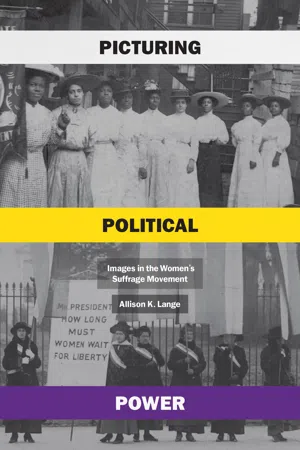
Lange's examination of the fights that led to the ratification of the Nineteenth Amendment in 1920 reveals the power of images to change history.
For as long as women have battled for equitable political representation in America, those battles have been defined by images—whether illustrations, engravings, photographs, or colorful chromolithograph posters. Some of these pictures have been flattering, many have been condescending, and others downright incendiary. They have drawn upon prevailing cultural ideas of women's perceived roles and abilities and often have been circulated with pointedly political objectives.
Picturing Political Power offers perhaps the most comprehensive analysis yet of the connection between images, gender, and power. In this examination of the fights that led to the ratification of the Nineteenth Amendment in 1920, Allison K. Lange explores how suffragists pioneered one of the first extensive visual campaigns in modern American history. She shows how pictures, from early engravings and photographs to colorful posters, proved central to suffragists' efforts to change expectations for women, fighting back against the accepted norms of their times. In seeking to transform notions of womanhood and win the right to vote, white suffragists emphasized the compatibility of voting and motherhood, while Sojourner Truth and other leading suffragists of color employed pictures to secure respect and authority. Picturing Political Power demonstrates the centrality of visual politics to American women's campaigns throughout the nineteenth and early twentieth centuries, revealing the power of images to change history.
- English
- ePUB (mobile friendly)
- Available on iOS & Android
eBook - ePub
About this book
Information
Publisher
University of Chicago PressYear
2020Print ISBN
9780226815848
9780226703244
eBook ISBN
9780226703381
1
SETTING THE STANDARDS
Poet Phillis Wheatley was the first female author in the American colonies whose portrait appeared in her book (figure 1.1).1 Wheatley arrived in Boston in 1761 around the age of seven or eight. John and Susannah Wheatley purchased and named her after the ship that had carried her from Africa. The Wheatleys gave her an unusually good education for a woman, especially an enslaved one. As a teenager, the poet published for audiences on both sides of the Atlantic and interacted with leaders like George Washington and Benjamin Franklin.2

1.1: Phillis Wheatley, Negro Servant to Mr. John Wheatley, of Boston, 1773, engraving on paper, published as the frontispiece in Phillis Wheatley, Poems on Various Subjects, Religious and Moral (1773). National Portrait Gallery, Smithsonian Institution.
As a representation of an enslaved woman, Wheatley’s public portrait was especially rare and necessary. The patrons of her 1773 book, Poems on Various Subjects, Religious and Moral, paid for the engraving to prove that an African woman had written it. One of Wheatley’s supporters, the Countess of Huntingdon, Selina Hastings, wrote to the Wheatleys that she “desir’d . . . to have Phillis’ picture in the frontispiece” because it would contribute to “the Sale of the Book.”3 In the oval portrait, Wheatley pens a few lines with her quill at a desk. She contemplates her next phrases with her chin in her hand. The pose and profile view make her resemble a classical thinker. The book by her side references Wheatley’s education and engagement with elite intellectual circles, while the text around the portrait’s frame—“PHYLLIS WHEATLEY, NEGRO SERVANT TO MR. JOHN WHEATLEY, OF BOSTON”—reminds viewers that she is enslaved.4 The publisher chose a metal plate, likely copper, for the portrait because it could produce five hundred to a thousand fine impressions. An artist engraved a reverse of the image on the plate before inking it and pressing it onto paper. Looking closely, one can see the fine, dense lines that form the poet’s dark face.
Wheatley’s famous face matters because few women—and even fewer black women—had portraits that reached wide audiences. To modern eyes, public portraits of women may seem unremarkable. This chapter reminds us that living, individual women lacked public visibility in early America, which reflected and reinforced their lack of political power. An individual’s visibility signaled their power. Late eighteenth-century public portraits often asserted the political power of elite white men.5 Portraits of Queen Elizabeth, the biblical Mary, and Joan of Arc also circulated, but the powerful, divine, and dead statuses of these women meant that no one accused them of selling their portraits to promote themselves, an unwomanly act. Men designed most of the pictures that Americans encountered, and they preferred to produce pictures of generic, idealized white female figures who represented abstract ideas, like liberty or genius. Furthermore, women held few public positions, so profit-driven printers knew their individual portraits would never sell.
Early American popular pictures defined the conventions for representing political power that lasted through the nineteenth century and still influence modern ones. Wheatley, Martha Washington, and Mary Wollstonecraft—an enslaved female poet, a first presidential spouse, and a female intellectual—had very different social statuses, but these exceptional women won an exceptional degree of visibility. Their portraits demonstrate the rare examples of living women in public imagery that later female leaders could model. These three women did not design their portraits to win political power. Owners, patrons, and printers—nearly all male—employed their portraits to sell books, share ideas, and secure respect for a new nation. In the late nineteenth century, when suffragists designed their own imagery and portraits, they challenged these long-standing norms by claiming visibility and power that had once almost solely belonged to men.
Improvements in technology and the appeal of inexpensive pictures facilitated the beginnings of a shared visual language. Standards for depicting power were rooted in European—especially British—imagery and dependent on its artists for decades after the American Revolution. Americans especially desired printed portraits because they wanted to see the faces of their favorite public figures.6 Because of the expense, only an estimated 1 percent of the colonial population ever had their likenesses painted.7 Even fewer had portraits engraved and sold. Shipped throughout the Atlantic world, printed portraits often reproduced paintings of elite, white Europeans by prominent artists. These engraved pictures replicated the conventions for depicting race, class, gender, and religion for a wide audience. Most considered paintings of elite white women to be best suited for private family parlors. Women had some control over their own painted portraits, but since they rarely acted as publishers and printers, they had little influence over which pictures were most visible.
Wheatley had little choice about her portrait, but she might have approved of it because it challenged social hierarchies.8 The portrait marked her as different because most authors did not print their portraits in their books at that time; even white female authors did not regularly include their portraits until the mid-nineteenth century.9 Wheatley’s portrait aimed to convince a skeptical audience that a black woman was a refined intellectual and a virtuous woman.10 Likely for the first time, the Boston Gazette called the portrait of a black woman “elegant.”11 Wheatley’s elegance stands out because even antislavery pictures often reflected racist stereotypes. For example, the popular 1787 Wedgwood medallion Am I Not a Man and Brother? features a kneeling, half-clad enslaved man (for a version featuring a woman, see figure 3.3 on p. 57).12 Wheatley’s patrons also called her “an uncultivated Barbarian from Africa.”13 They worked to assure readers of Wheatley’s modesty, writing that she “had no Intention” to publish her work, but she did so because of her “best, and most generous Friends; to whom she considers herself, as under the greatest obligations.”14 The portrait and book won her unprecedented visibility but also threatened any claim she might have had to feminine virtue.
Unlike Wheatley’s exceptional engraving, portraits of George and Martha Washington exemplify the era’s popular pictures. George’s likeness often accompanied Martha’s to remind viewers that he was the reason for her prominence. Joseph Hiller Sr. published mezzotints, fine and expensive prints, of the pair around 1777 (figure 1.2). Lady Washington may be Martha’s earliest public portrait. These pictures decorated the homes of the revolution’s elite supporters. To create a mezzotint, an artist covers a metal plate with thousands of tiny dots before engraving the picture. The dots produce rich tonal variations—like the folds in Martha Washington’s dress—that make mezzotints look more like paintings than line drawings.

1.2: Joseph Hiller Sr., Lady Washington and His Excellency George Washington Esqr., ca. 1777, mezzotints. New York Public Library.
Portraits of George and Martha Washington announced gendered republican virtues that defined norms for generations.15 Though not everyone could or wanted to achieve these idealized visions, all were measured against them. In this portrait, Martha leans against a window ledge and stands in a contrapposto pose, similar to classical statues. She is supported by elaborate columns wrapped with flowering vines that allude to her fertility, a common symbol in women’s portraits.16 The interior space and view of a domesticated landscape through the arched window contrast with the smoke billowing from the fires behind George. Martha is sheltered from war, but George must face it. Hiller copied the stance, uniform, and background from portraits of military leaders to affirm his power for colonial and European audiences alike.
After the American Revolution, American artists incorporated European visual conventions even as they sought to define their own. In 1796, seven years into Washington’s presidency, Gilbert Stuart painted a portrait later copied by many engravers (figure 1.3).17 Stuart based the composition, Washington’s pose, and luxurious setting on Allan Ramsay’s 1762 coronation portrait of King George III. Unlike the monarch with an ermine robe and jewels, Washington wears an elegant, plain black velvet suit.18 Glowing light bathes George III, suggesting his divine right to rule. In contrast, Washington gestures to a gilded desk with a few books titled American Revolution, Constitution of the United States, and Journal of Congress. The president derives his power from his knowledge and the nation’s founding documents. His authoritative pose suggests his physical strength, and his sword symbolizes his military leadership. Washington’s wealth and power needed to be legible to American citizens and foreign officials.

1.3: Gilbert Stuart, portrait of George Washington, 1796, oil on canvas. National Portrait Gallery, Smithsonian Institution; acquired as a gift to the nation through the generosity of the Donald W. Reynolds Foundation.
Washington’s portraits connected elite American political power to white manhood.19 Citizens purchased printed portraits, ranging from expensive mezzotints to cheap woodcuts, to display their own republican virtue.20 Americans associated Washington’s face with his achievements and with abstract virtues like honor and sacrifice.21 By the late eighteenth century, displaying George and Martha Washington’s portraits in one’s home became a component...
Table of contents
- Cover
- Title Page
- Copyright Page
- CONTENTS
- Introduction
- 1 Setting the Standards
- 2 Dominant Images of Gender and Power in Antebellum America
- 3 Portraits as Politics
- 4 A “Fine Looking Body of Women”: Female Political Leaders on the Rise
- 5 Competing Visual Campaigns
- 6 White Public Mothers and Militant Suffragists Win the Vote
- Epilogue
- Acknowledgments
- Notes
- Bibliography
- Index
Trusted by 375,005 students
Access to over 1.5 million titles for a fair monthly price.
Study more efficiently using our study tools.
Frequently asked questions
Yes, you can cancel anytime from the Subscription tab in your account settings on the Perlego website. Your subscription will stay active until the end of your current billing period. Learn how to cancel your subscription
No, books cannot be downloaded as external files, such as PDFs, for use outside of Perlego. However, you can download books within the Perlego app for offline reading on mobile or tablet. Learn how to download books offline
Perlego offers two plans: Essential and Complete
- Essential is ideal for learners and professionals who enjoy exploring a wide range of subjects. Access the Essential Library with 800,000+ trusted titles and best-sellers across business, personal growth, and the humanities. Includes unlimited reading time and Standard Read Aloud voice.
- Complete: Perfect for advanced learners and researchers needing full, unrestricted access. Unlock 1.5M+ books across hundreds of subjects, including academic and specialized titles. The Complete Plan also includes advanced features like Premium Read Aloud and Research Assistant.
We are an online textbook subscription service, where you can get access to an entire online library for less than the price of a single book per month. With over 1.5 million books across 990+ topics, we’ve got you covered! Learn about our mission
Look out for the read-aloud symbol on your next book to see if you can listen to it. The read-aloud tool reads text aloud for you, highlighting the text as it is being read. You can pause it, speed it up and slow it down. Learn more about Read Aloud
Yes! You can use the Perlego app on both iOS and Android devices to read anytime, anywhere — even offline. Perfect for commutes or when you’re on the go.
Please note we cannot support devices running on iOS 13 and Android 7 or earlier. Learn more about using the app
Please note we cannot support devices running on iOS 13 and Android 7 or earlier. Learn more about using the app
Yes, you can access Picturing Political Power by Allison K. Lange in PDF and/or ePUB format, as well as other popular books in History & North American History. We have over 1.5 million books available in our catalogue for you to explore.