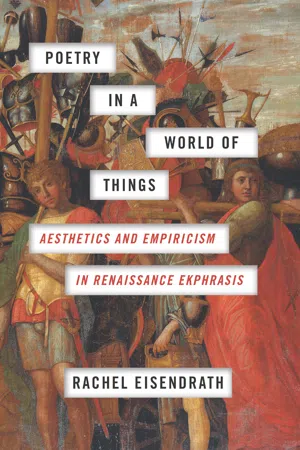
We have become used to looking at art from a stance of detachment. In order to be objective, we create a "mental space" between ourselves and the objects of our investigation, separating internal and external worlds. This detachment dates back to the early modern period, when researchers in a wide variety of fields tried to describe material objects as "things in themselves"—things, that is, without the admixture of imagination. Generations of scholars have heralded this shift as the Renaissance "discovery" of the observable world.
In Poetry in a World of Things, Rachel Eisendrath explores how poetry responded to this new detachment by becoming a repository for a more complex experience of the world. The book focuses on ekphrasis, the elaborate literary description of a thing, as a mode of resistance to this new empirical objectivity. Poets like Petrarch, Spenser, Marlowe, and Shakespeare crafted highly artful descriptions that recovered the threatened subjective experience of the material world. In so doing, these poets reflected on the emergence of objectivity itself as a process that was often darker and more painful than otherwise acknowledged. This highly original book reclaims subjectivity as a decidedly poetic and human way of experiencing the material world and, at the same time, makes a case for understanding art objects as fundamentally unlike any other kind of objects.
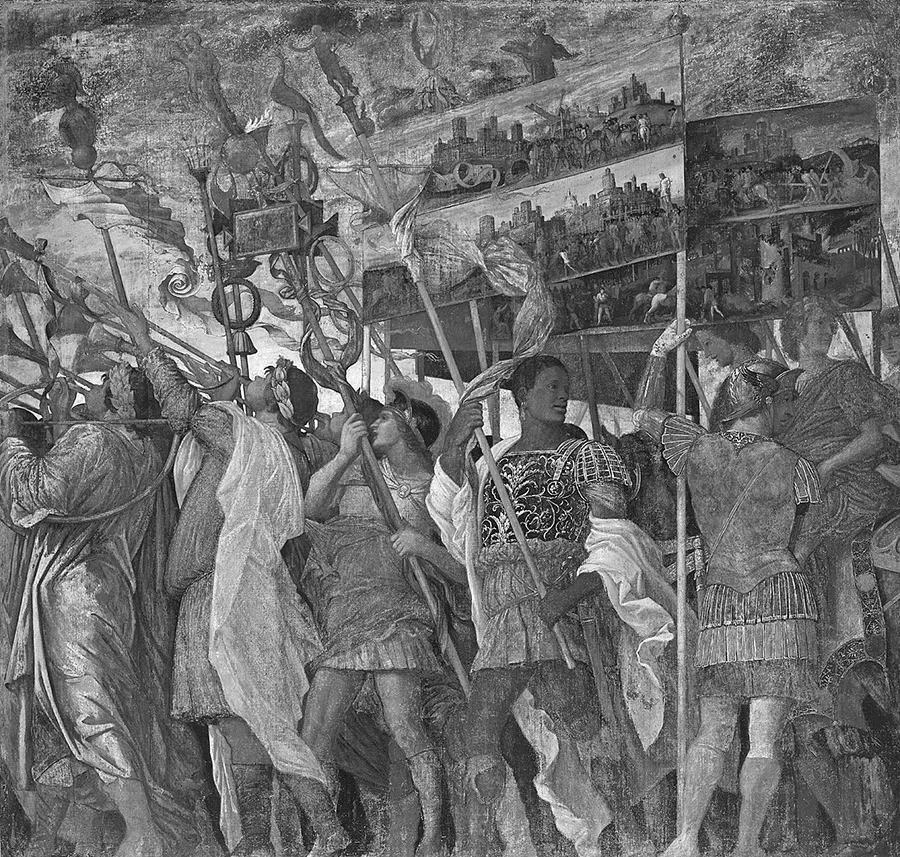
The weather seems to be changing. In the first painting of Andrea Mantegna’s 1484–92 series The Triumphs of Caesar, the sky gleams where the dark underpainting shows through, as though a storm were moving in, casting an ominous glow on the procession. In the collapsed frieze-like space, the soldiers appear both commandingly volumetric and almost ghostly. In the very act of asserting the power of their physical beings (and of imperialist force more generally), the men’s bodies seem to be in the process of fading, vaporizing, sinking back into the clouds that swirl behind and above them. The left arm of the soldier in green has become semi-transparent, and his right arm is missing. Like Prospero’s pageant in The Tempest, this procession threatens to dissolve “into air, into thin air” (4.1.150).
This ghostliness can be understood not only as an effect of time on paint1 but also as a prompt for critical thinking about representation. Notice the paintings held aloft on the banners. Mantegna’s early modern contemporaries were increasingly turning to the study of material objects to learn about the facts of the past, and Mantegna had conducted his own antiquarian research into Roman triumphs.2 Scholars have long believed that Romans did indeed carry such paintings, which portrayed victorious battles as well as the suicides of conquered generals.3 But while these ancient paintings may have offered for the ancient Romans a kind of second-order conquest and possession, Mantegna’s painting does more than this, creating a space for viewers to reflect critically on this earlier aim. The soldiers he paints appear lost in a spectacle of objects. Some look forward at where they are going, others backward at what is behind them. None seems fully cognizant of what is actually going on. The motion of the pennants, whipped around by a wind, suggests relentless change. At one moment, the conqueror is perched at the pinnacle of worldly achievement; at the next, he will be flung to the ground by the downward turn of fortune’s wheel. To put this point historically: parading now in glory in around 46 BCE, Julius Caesar will be assassinated less than two years later. Any sustained examination of this painting thus raises questions about the victory of men and empire that it is ostensibly celebrating.4 Viewers soon find themselves staring past the putatively solid objects into the desire for possession that underlies them: the Romans’ desire for power and the early modern antiquarians’ desire for a history that is graspable, objective, literal, and contained.
This painting embodies a central issue for Poetry in a World of Things, namely, the complex relationship between aesthetic experience and the empirical objects of history. Even as antiquarianism and other empiricist methodologies began in the Renaissance to teach thinkers to bracket off their subjectivities in the hope of producing a more detached account of the objects of the world, art was becoming the complex repository of that partially renounced subjectivity. In consequence, the poets on whom I focus—Francesco Petrarch, Edmund Spenser, Christopher Marlowe, and William Shakespeare—actively and reactively developed a new, modern aesthetics in part by emphasizing the dynamic interplay of objective and subjective modes of thought. In tracing this historical reaction, my book also pushes back against the emphatic empiricism of a dominant trend in current literary-historical scholarship, which can tend to treat art as an artifact or mere thing. Drawing on the aesthetics of Theodor W. Adorno, I argue that this empiricist tendency undermines the complexity of aesthetic experience, by falsely conflating empiricist factuality and aesthetic experience, when what is crucial is the dialectical tension between them.
My exploration of these elusive issues focuses on one poetic and literary form, ekphrasis, which I understand, most simply, as an elaborate literary description of a thing. As I will discuss later, the term dates to the late-antique Greek rhetorical manuals known as the progymnasmata, which were subsequently translated into Latin and, importantly for this project, were widely used in Elizabethan classrooms.5 According to these manuals, ekphrasis could be a vivid description of art objects as well as of other things; Aelius Theon’s Progymnasmata in the first century CE lists as examples Homer’s shield of Achilles, as well as descriptions of cities, meadows, and battles.6 Indeed, Renaissance literature offers ekphrases of just about everything: of tapestries, boots, cities, helmets, belts, coins, fountains, forests, shields, cathedrals, paintings, sculptures, and ruins.
I select this form for attention because, as critics have long recognized, ekphrasis provides a model in miniature of aesthetic experience as such.7 An ekphrasis is a literary showpiece where a poem, in describing an object in an emphatically aesthetic way, raises questions about the nature of art and artmaking. Generations of critics have thus situated this form in the tradition of Horace’s famous phrase ut pictura poesis (as is painting, so is poetry). In so doing, they have narrated how poetry has defined itself by comparing itself to visual art. This tradition of defining poetry in relation to sculpture or painting is a story that has been well developed and well told.8 Rather than reiterating it, I want to emphasize in these pages how when an ekphrasis describes an object, the experience of that object is not reducible to its mere existence as object. My interest lies in the difference not between two kinds of art (poetry vs. visual art) but between a fully complex art object and any other kind of object. To take the example of the Roman triumph with which I began, there is an important difference between, on the one hand, Mantegna’s own painting and, on the other hand, the paintings and other objects that he represents the Romans as carrying and that, to them, are yet more spoil. If a fully complex art object both is and is not an object like any other, then this book explores wherein the difference lies.
ALIENATEDMODERNOBJECTS
In the early modern period, aesthetic experience came into conflict with a new worldview. In order to account accurately for things of the world, empiricists began to try to observe without subjective projections. “For God forbid,” Francis Bacon writes, “that we should give out a dream of our own imagination for a pattern of the world.”9 In the prefatory materials (1620) of his Great Instauration, Bacon explains that the researcher must keep “the eye steadily fixed upon the facts of nature” in order to grasp the image of things “simply as they are.”10 By turning to the world for knowledge, and by relying on physical evidence, sensory perceptions, and experiments, Bacon aimed to provide an account of things without literary embellishment, an account of “things themselves,”11 an expression that Joanna Picciotto calls “a signature phrase of experimentalist discourse.”12
Empiricist description was often opposed to literary or imaginative production. “Poetry is as a dream of learning,” Bacon writes. “But now it is time for me to awake, and rising above the earth, to wing my way through the clear air of [natural] Philosophy and the Sciences.”13 What matters, Bacon explains, is to leave behind the “dream of our own imagination,” and instead to take hold of things “simply as they are,” that is, in their physical actuality apart from the cultural fantasies about them that we have inherited through textual authorities. To use rhetorical ornaments for literary effect and color in a scientific presentation is to hinder the clear view of an object of study or, in the words of Robert Boyle, “to paint the Eye-glasses of a Telescope.”14 Facts should be presented straightforwardly.15 This idol-breaking reflected a Reformation sentiment, but also an empiricist one. In Italy, Galileo Galilei turned his gaze from books to his telescope, mocking any person who “thinks that [natural] philosophy is a sort of book like the Aeneid and Odyssey, and that truth is to be found not in the world or in nature but in the collation of texts.”16
This push away from the literary and the textual tout court was, needless to say, neither complete nor fully coherent.17 Recent scholarship has emphasized the reciprocity of the arts and sciences in the Renaissance: how poets and painters of that time increasingly incorporated into their imaginary worlds factually based references to recent antiquarian and scientific discoveries. Many scientists had a background in the arts, or even practiced these two crafts simultaneously; recall, for example, Galileo’s 1609 wash drawings of the moon’s pocky surface in his Sidereus nuncius.18 Scientists sometimes adopted into their discourses the strategies of poets; Bacon, for example, used metaphorical language to make arguments against literariness.19 Yet, as I will emphasize, these areas of overlap were also becoming areas of tension between tendencies of thought that were increasingly understood as contradictory. Even Galileo and Bacon, whose lives and work can be seen as exemplifying the mutual imbrication of the arts and sciences, were the very same thinkers who also drew new lines in the sand, asserting that poetry was an imaginative (and subjective) dream but that the physical world was a real (and objective) thing. Fiction, they insisted, was not fact.20
Scholars from Jacob Burckhardt to Anthony Grafton have heralded this shift as the Renaissance “discovery” of the observable world. Objective descriptions of things were no longer preludes to philosophy as they had been in medieval scholasticism. Instead, in this newly emergent empiricism of the Renaissance, they were becoming the very keystones of knowledge.21 To take one example, observationes, which had been readerly additions in the margins of canonical texts, evolved into a recognizable scholarly genre in fields like astronomy and medicine. The very word observatio, as Gianna Pomata has shown, straddles the shift from textual authorities to a direct encounter with physical evidence: the word is connected on the one hand to observance (conformity to authority), and on the other hand to observation (attention to individual phenomena in the physical world).22 Alongside the humanists’ bookshelves soon appeared their cabinets of curiosities, or Wunderkammern.23 Similarly, ancient statues were being unearthed that, as Leonard Barkan has explored, evoked a new tension between the imaginary and the real, between fantasies of lost bygone worlds and the actuality of recovered material fragments.24 In the domain of science, Bacon set out a plan for a vast compendium of descriptions of all perceptible things, to be divided into a list of 130 categories that descend from the heavenly (#1 “History of the Heavens; or Astronomy”) to the earthly (#46 “History of the Excrements: Saliva, Urine, Sweat, Stools, Head-hair, Body-hair, Hang-nails, Nails and so-on”).25 Bacon refers to this planned compendium as a “warehouse or storage space” for descriptions of “the world as it is found to be.”26 The warehouse will hold uninterpreted and objective versions of things, versions stripped of “everything that makes for ornament of speech, and similes, and the whole repertoire of eloquence, and such vanities.”27 Accordingly, this warehouse is “not a place in which one is to stay or live with pleasure”; rather, “one enters only when necessary, when something has to be taken out for use in the work of the Interpreter which follows.”28 Through such complexly organized collections of knowledge, Bacon wanted to construct an empiricism that could mitigate the distortions of individual perceptions.29
A new empiricist “art of describing” started to become everywhere apparent: in early modern painting and science,30 and in historiographical theory and practice.31 Antiquarians of the Renaissance were increasingly examining and describing history’s physical remains: the things of the historical record—coins, urns, fragments of statues, tombs, and ruins, what Bacon called “the spars” of “the shipwreck of time.”32 This emerging use of material evidence constitutes one of the fundamental changes in the Renaissance “sense of the past” and was a departure from an earlier mode of historiography that relied exclusively on ancient literary versions of history.33 Peter Burke points out, for example, that the medieval English monk Bede lived near Hadrian’s Wall but quoted a passage by Vegetius when he wanted to describe it.34
In sixteenth-century England, where the physical dissolution of the monasteries haunted many writers with a disturbing awareness of historical loss, antiquarian description gained extraordinary momentum.35 By the end of the 1530s, John Leland was traveling through England and Wales to research his Itinerary, which was to be based on topographical and antiquarian descriptions.36 Antiquarians like William Harrison, John Stow, and William Camden soon followed with highly descriptive accounts of the material remains of English history. In some cases, this antiquarian work was imaginative.37 In other cases, antiquarians attempted to produce something like Bacon’s distinction between things in themselves and interpreted things. For example, Stow called his 1598 Survey of London the “outward view” of the city’s historical sites, appending an anonymous Londoner’s more obviously interpretive discourse, which Stow called the “insight.”38 In short, across a range of fields, description acquired status as a new form of objec...
Table of contents
Cover
Title Page
Copyright Page
Contents
Acknowledgments
1 Introduction
2 Subjectivity and the Antiquarian Object: Petrarch among the Ruins of Rome
3 Here Comes Objectivity: Spenser’s 1590 The Faerie Queene, Book 3
4 Playing with Things: Reification in Marlowe’s Hero and Leander
5 Feeling like a Fragment: Shakespeare’s The Rape of Lucrece
6 Coda: Make Me Not Object
Bibliography
Index
Footnotes
Trusted by 375,005 students
Access to over 1.5 million titles for a fair monthly price.
Study more efficiently using our study tools.
Frequently asked questions
Yes, you can cancel anytime from the Subscription tab in your account settings on the Perlego website. Your subscription will stay active until the end of your current billing period. Learn how to cancel your subscription
No, books cannot be downloaded as external files, such as PDFs, for use outside of Perlego. However, you can download books within the Perlego app for offline reading on mobile or tablet. Learn how to download books offline
Perlego offers two plans: Essential and Complete
Essential is ideal for learners and professionals who enjoy exploring a wide range of subjects. Access the Essential Library with 800,000+ trusted titles and best-sellers across business, personal growth, and the humanities. Includes unlimited reading time and Standard Read Aloud voice.
Complete: Perfect for advanced learners and researchers needing full, unrestricted access. Unlock 1.5M+ books across hundreds of subjects, including academic and specialized titles. The Complete Plan also includes advanced features like Premium Read Aloud and Research Assistant.
Both plans are available with monthly, semester, or annual billing cycles.
We are an online textbook subscription service, where you can get access to an entire online library for less than the price of a single book per month. With over 1.5 million books across 990+ topics, we’ve got you covered! Learn about our mission
Look out for the read-aloud symbol on your next book to see if you can listen to it. The read-aloud tool reads text aloud for you, highlighting the text as it is being read. You can pause it, speed it up and slow it down. Learn more about Read Aloud
Yes! You can use the Perlego app on both iOS and Android devices to read anytime, anywhere — even offline. Perfect for commutes or when you’re on the go. Please note we cannot support devices running on iOS 13 and Android 7 or earlier. Learn more about using the app
Yes, you can access Poetry in a World of Things by Rachel Eisendrath in PDF and/or ePUB format, as well as other popular books in Literature & History of Renaissance Art. We have over 1.5 million books available in our catalogue for you to explore.