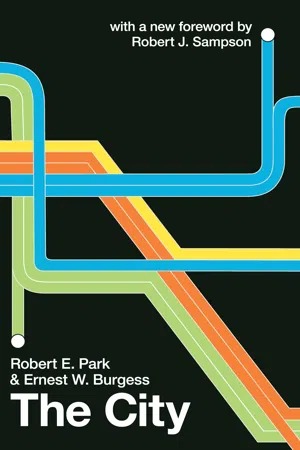
First published in 1925, The City is a trailblazing text in urban history, urban sociology, and urban studies. Its innovative combination of ethnographic observation and social science theory epitomized the Chicago school of sociology. Robert E. Park, Ernest W. Burgess, and their collaborators were among the first to document the interplay between urban individuals and larger social structures and institutions, seeking patterns within the city's riot of people, events, and influences. As sociologist Robert J. Sampson notes in his new foreword, though much has changed since The City was first published, we can still benefit from its charge to explain where and why individuals and social groups live as they do.
- English
- ePUB (mobile friendly)
- Available on iOS & Android
eBook - ePub
The City
About this book
Information
Topic
Ciencias socialesSubtopic
Historia de NorteaméricaCHAPTER X
A BIBLIOGRAPHY OF THE URBAN COMMUNITY
The task of compiling a bibliography on the city which is to be of use to the sociologist involves many difficulties. The materials are scattered over many fields of investigation ranging all the way from the various branches of the natural and social sciences to the practical arts and crafts. Much of the material is highly technical and abstract, while the rest is popular and full of human interest. If one attempts to survey the whole field he is likely to be led into tempting bypaths which lead far afield and in the end arrive nowhere. Moreover, the bibliographer has neither chart nor compass to guide him in his search, for the sociologist himself is not yet certain of the meaning of the concept “city” and of the relationship of his science to the phenomenon.
Specialization has gone so far that no one can hope to become an expert in more than one field in a lifetime. The sanitary engineer, interested in urban sanitation, is mainly concerned with drainage systems, pumps, sewer pipes, and incinerators; but the accountant, the political scientist, and the sociologist are not primarily interested in these matters. At first glance the sociologist might be tempted to pass over such material as lying outside his province, while he would be less likely to pass over materials relating to parks, playgrounds, schools, infant mortality, city-planning, and non-voting, because these institutions and processes have traditionally held the sociologist’s interest. And yet it is within the realm of possibility that such a question as that of the type of sewer pipe that is to be employed in a city drainage system may become one with which the sociologist is as legitimately concerned as the question of city-planning or juvenile delinquency.
The problem of deciding what is pertinent and what is extraneous is, then, obviously an important one. While the sociologist may be intensely interested in a subject matter pertaining to another science or craft, he has his own distinctive point of view, methodology, and objective, and since he cannot be an expert engineer, city manager, and sociologist all at the same time, he must accept the data of these other specialists when they happen to form the subject matter of his investigation. The sociologist is no more a housing specialist or a zoning specialist or a social case worker in a metropolitan social agency than he is an urban engineer or health officer, but he may have an important contribution to make to all of these activities, and may in turn acquire from these technicians a body of materials which shed light on his own problems and yield to sociological analysis. What is to be included or excluded from a sociological bibliography of the city depends upon the sociological definition of the city.
Although the literature on the city extends as far back as the city itself, the subject is now being studied with renewed interest and with a new point of view. If we were compiling a complete bibliography we would most likely begin with the classical discussion of Socrates in the second book of Plato’s Republic and follow the increasingly complex and scattered writings up to the present day, when we can scarcely find a science that does not have something to contribute to the subject. But this is not the aim of this bibliography. The attempt is here made to note just that part of the literature which has something to offer to the sociologist in the way of source material, point of view, method, and interpretation. A great deal, no doubt, has been included which is of little value. At the same time much has been necessarily omitted which is important. Some effort was made to avoid excessive duplication, but this attempt has not been wholly successful. The list of books and articles includes many works which were inaccessible at the time the bibliography was compiled, and whose contents could therefore not be examined. They are included because either the titles were suggestive or else the reputation of the authors merited attention.
The contribution which a bibliography is able to make to the study of any subject lies probably as much in the viewpoint it incorporates and the method of presentation it uses as in the references it presents. The scheme of classification here employed may lay claim to offering a rather new approach to the study of the city. It will probably have to be modified as new material is discovered and as the sociologists themselves continue to make their own distinctive contributions. It ought to offer an index to the aspects of the city that promise most in the way of results from research. At the same time it may be of assistance in organizing and funding the rapidly increasing body of knowledge concerning the sociology of the city.
A TENTATIVE SCHEME FOR THE CLASSIFICATION OF THE LITERATURE OF THE SOCIOLOGY OF THE CITY1
I. The City Defined
1. Geographically: by site, situation, topography, density
2. Historically: by political status, title, law
3. Statistically: by census
4. As an economic unit
5. Sociologically
II. The Natural History of the City
1. Ancient cities: Asia, Egypt, Greece, Rome
2. The medieval city
3. The modern city
III. Types of Cities
1. Historical types
2. Location types: sea coast, inland, river, lake
3. Site types: plain, valley, mountain, hill, harbor, island
4. Functional types: capital, railroad, port, commercial, industrial, resort, cultural
5. The town, the city, and the metropolis
6. Structural types: the natural city and the planned city
IV. The City and Its Hinterland
1. The trade area
2. The commuting area: the metropolitan area
3. The administrative city
4. The city and its satellites
5. The city and its cultural periphery
6. The city and world economy
V. The Ecological Organization of the City
1. Natural areas
2. The neighborhood
3. The local community
4. Zones and zoning
5. The city plan
VI. The City as a Physical Mechanism
1. Public utilities: water, gas, electricity
2. Means of communication: telephone, mails, telegraph, street-car, busses, automobile
3. Streets and sewers
4. Public safety and welfare: fire, police, health departments, social agencies
5. Schools, theaters, museums, parks, churches, settlements
6. Recreation
7. City government: the city manager, the boss
8. Food supply, stores (department and chain stores)
9. Steel construction: the skyscraper
10. Housing and land values
VII. The Growth of the City
1. Expansion
2. Allocation and distribution of population: “city building”
3. Population statistics: natural growth and migration
4. Mobility and metabolism in city life
5. Social organization and disorganization and city growth
VIII. Eugenics of the City
1. Birth, death, and marriage rates: the span of life
2. Sex and age groups
3. Fecundity
IX. Human Nature and City Life
1. The division of labor: professions and specialization of occupations
2. The mentality of city life
3. Communication: contacts, public opinion, morale, ésprit de corps
4. City types
X. The City and the Country
1. Conflicts of interest
2. Comparison of social organization and social processes
3. Differences in personality types
XI. The Study of the City
1. Systematic studies of cities
2. The technique of the community survey
3. Periodicals on the city
I. THE CITY DEFINED
Differences in standpoint and method in the various sciences show graphically in the definitions that each formulates of the same object. This is strikingly illustrated by a comparison of the definitions held by various scientific groups of the phenomenon of the city.
1. The city has been regarded by geographers as an integral part of the landscape. From this standpoint the city is an elevation, rising from the ground like a mountain. Such observations as changes in wind velocity and atmospheric conditions produced by the city regarded as an obstruction of the landscape have been noted. Human geography has lately come to regard the city as the most significant human transformation of the natural environment, and as part of the general product arising out of man’s relation with the natural environment. Urban geography has recently been gaining ground as a phase of regional geography. The location, physical structure, size, density, and economic function of cities are the chief factors emphasized. A substantial literature has grown up which has a direct bearing on the sociological study of the city.
Aurousseau, M. “Recent Contributions to Urban Geography,” Geog. Rev., XIV (July, 1924), 444–55.
A concise statement of the geographical approach to the city, with a bibliography of the most authoritative and recent literature. Points out the recency of the study of urban geography and the difficulties involved in the methods. (II, 3; III.)
Barrows, Harlan H. “Geography as Human Ecology,” Annals of the Association of American Geographers, Vol. XIII (March, 1923), No. 1.
While not specifically concerned with the city, defines the viewpoint and method of the geographer.
Blanchard, Raoul. “Une méthode de géographie urbaine,” La Vie Urbaine, IV (1922) 301–19.
An exposition of the principles and methods of urban geography by one of the leading authorities. (III, 2, 3, 4, 6.)
Chisholm, G. G. “Generalizations in Geography, Especially in Human Geography,” Scott. Geog. Mag., XXXII (1916), 507–19. (III, 2, 3, 4.)
Hassert, Kurt. Die Städte geographisch betrachtet (Leipzig, 1907). One of the early outlines of urban geography. (III, 2, 3, 4...
Table of contents
- Cover
- Copyright
- Title Page
- Series Page
- Contents
- Foreword: The City for the Twenty-First Century
- I. The City: Suggestions for the Investigation of Human Behavior in the Urban Environment
- II. The Growth of the City: An Introduction to a Research Project
- III. The Ecological Approach to the Study of the Human Community
- IV. The Natural History of the Newspaper
- V. Community Organization and Juvenile Delinquency
- VI. Community Organization and the Romantic Temper
- VII. Magic, Mentality, and City Life
- VIII. Can Neighborhood Work Have a Scientific Basis?
- IX. The Mind of the Hobo: Reflections upon the Relation between Mentality and Locomotion
- X. A Bibliography of the Urban Community
- Notes
- Indexes
Trusted by 375,005 students
Access to over 1.5 million titles for a fair monthly price.
Study more efficiently using our study tools.
Frequently asked questions
Yes, you can cancel anytime from the Subscription tab in your account settings on the Perlego website. Your subscription will stay active until the end of your current billing period. Learn how to cancel your subscription
No, books cannot be downloaded as external files, such as PDFs, for use outside of Perlego. However, you can download books within the Perlego app for offline reading on mobile or tablet. Learn how to download books offline
Perlego offers two plans: Essential and Complete
- Essential is ideal for learners and professionals who enjoy exploring a wide range of subjects. Access the Essential Library with 800,000+ trusted titles and best-sellers across business, personal growth, and the humanities. Includes unlimited reading time and Standard Read Aloud voice.
- Complete: Perfect for advanced learners and researchers needing full, unrestricted access. Unlock 1.5M+ books across hundreds of subjects, including academic and specialized titles. The Complete Plan also includes advanced features like Premium Read Aloud and Research Assistant.
We are an online textbook subscription service, where you can get access to an entire online library for less than the price of a single book per month. With over 1.5 million books across 990+ topics, we’ve got you covered! Learn about our mission
Look out for the read-aloud symbol on your next book to see if you can listen to it. The read-aloud tool reads text aloud for you, highlighting the text as it is being read. You can pause it, speed it up and slow it down. Learn more about Read Aloud
Yes! You can use the Perlego app on both iOS and Android devices to read anytime, anywhere — even offline. Perfect for commutes or when you’re on the go.
Please note we cannot support devices running on iOS 13 and Android 7 or earlier. Learn more about using the app
Please note we cannot support devices running on iOS 13 and Android 7 or earlier. Learn more about using the app
Yes, you can access The City by Robert E. Park,Ernest W. Burgess in PDF and/or ePUB format, as well as other popular books in Ciencias sociales & Historia de Norteamérica. We have over 1.5 million books available in our catalogue for you to explore.