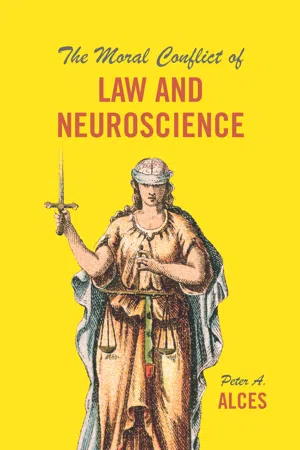
The Moral Conflict of Law and Neuroscience
eBook - ePub

The Moral Conflict of Law and Neuroscience

  1. English
  2. ePUB (mobile friendly)
  3. Available on iOS & Android
eBook - ePub

The Moral Conflict of Law and Neuroscience

About this book

Law relies on a conception of human agency, the idea that humans are capable of making their own choices and are morally responsible for the consequences. But what if that is not the case? Over the past half century, the story of the law has been one of increased acuity concerning the human condition, especially the workings of the brain. The law already considers select cognitive realities in evaluating questions of agency and responsibility, such as age, sanity, and emotional distress. As new neuroscientific research comprehensively calls into question the very idea of free will, how should the law respond to this revised understanding?
           
Peter A. Alces considers where and how the law currently fails to appreciate the neuroscientific revelation that humans may in key ways lack normative free will—and therefore moral responsibility. The most accessible setting in which to consider the potential impact of neuroscience is criminal law, as certain aspects of criminal law already reveal the naiveté of most normative reasoning, such as the inconsistent treatment of people with equally disadvantageous cognitive deficits, whether congenital or acquired. But tort and contract law also assume a flawed conception of human agency and responsibility. Alces reveals the internal contradictions of extant legal doctrine and concludes by considering what would be involved in constructing novel legal regimes based on emerging neuroscientific insights.

Frequently asked questions

Yes, you can cancel anytime from the Subscription tab in your account settings on the Perlego website. Your subscription will stay active until the end of your current billing period. Learn how to cancel your subscription.
At the moment all of our mobile-responsive ePub books are available to download via the app. Most of our PDFs are also available to download and we're working on making the final remaining ones downloadable now. Learn more here.
Perlego offers two plans: Essential and Complete
  • Essential is ideal for learners and professionals who enjoy exploring a wide range of subjects. Access the Essential Library with 800,000+ trusted titles and best-sellers across business, personal growth, and the humanities. Includes unlimited reading time and Standard Read Aloud voice.
  • Complete: Perfect for advanced learners and researchers needing full, unrestricted access. Unlock 1.4M+ books across hundreds of subjects, including academic and specialized titles. The Complete Plan also includes advanced features like Premium Read Aloud and Research Assistant.
Both plans are available with monthly, semester, or annual billing cycles.
We are an online textbook subscription service, where you can get access to an entire online library for less than the price of a single book per month. With over 1 million books across 1000+ topics, we’ve got you covered! Learn more here.
Look out for the read-aloud symbol on your next book to see if you can listen to it. The read-aloud tool reads text aloud for you, highlighting the text as it is being read. You can pause it, speed it up and slow it down. Learn more here.
Yes! You can use the Perlego app on both iOS or Android devices to read anytime, anywhere — even offline. Perfect for commutes or when you’re on the go.
Please note we cannot support devices running on iOS 13 and Android 7 or earlier. Learn more about using the app.
Yes, you can access The Moral Conflict of Law and Neuroscience by Peter A. Alces in PDF and/or ePUB format, as well as other popular books in Law & Law Theory & Practice. We have over one million books available in our catalogue for you to explore.

Table of contents

  1. Cover
  2. Title Page
  3. Copyright Page
  4. Dedication
  5. Contents
  6. Acknowledgments, Debts, and Admiration
  7. Preface, Premises, and Progress of the Argument
  8. chapter 1.  Contours of the Conflict
  9. chapter 2.  Neuroscience and Criminal Law Doctrine
  10. chapter 3.  Neuroscience and Criminal Law Theory
  11. chapter 4.  Neuroscience and Tort Law Doctrine
  12. chapter 5.  Neuroscience and Tort Law Theory
  13. chapter 6.  Neuroscience and Contract Law Doctrine
  14. chapter 7.  Neuroscience and Contract Law Theory
  15. chapter 8.  An Age of Realization
  16. Notes
  17. Bibliography
  18. Index