![]()
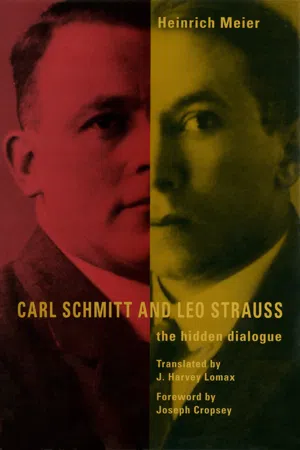
CARL SCHMITT AND LEO STRAUSS: THE HIDDEN DIALOGUE
But about what would a disagreement be, which we could not settle and which would cause us to be enemies and be angry with each other? Perhaps you cannot give an answer offhand; but let me suggest it. Is it not about right and wrong, and noble and disgraceful, and good and bad? Are not these the questions about which you and I and other people become enemies, when we do become enemies, because we differ about them and cannot reach any satisfactory agreement?
Plato, Euthyphro 7c-d (trans. Harold North Fowler, 1926)
Carl Schmitt became more famous and more infamous through the Concept of the Political than through all his other works. That slim treatise1 not only has connected the name of the author as closely as possible to the “distinction between friend and enemy” but has itself, unlike any other of Schmitt’s writings, kindled such a distinction. The work has sown enmity and reaped enmity. Notwithstanding all his learned self-fashioning and his apologetic detoxification of his own remarks,2 that result undoubtedly conformed to the political intention that determined Carl Schmitt’s course in his Concept of the Political: Schmitt confronts a world that seeks to escape the distinction between friend and enemy with the unavoidability of a radical Either-Or, in order to make keener the “consciousness of the dire emergency” (30)TN1 and to promote or reawaken the faculty that proves itself in “moments in which the enemy is seen in concrete clarity as an enemy” (67); in an age in which “nothing is more modern than the battle against the political,”3 his purpose is to bring to bear the “inescapability” of the political, the “inevitability” of enmity, even if he should be the one who must face as their enemy all those who want to know of no more enemies. The theoretician of the political must be a political theoretician. A treatise about the political can only be—of this conclusion Schmitt is convinced—a political treatise, determined by enmity and exposing itself to enmity.
How an essentially “political” discussion of the political can be answered philosophically has been shown by Leo Strauss. The answer does not involve withdrawing into the unpolitical, screening out battle and decision, ignoring friendship and enmity. The path Strauss takes in his “Notes”4 to Schmitt’s Concept of the Political is that of radical probing, going ever deeper, and bringing things to a climax, with the goal of driving the discussion to a confrontation over the very foundations of the political. The philosophical perspective does not prevent Strauss from grasping the “polemical meaning” that Schmitt’s treatise, according to its own principles of understanding, is bound to have. On the contrary, this perspective enables Strauss to express the political-polemical intention of the text more clearly than Schmitt himself had done. At the same time, however, it protects Strauss from relying on what Schmitt presupposes as compelling and in need of no further foundation, namely, that every concept of the political must have a “concrete opposition in view” and be “bound to a concrete situation, the final consequence of which is a grouping into friends and enemies (which expresses itself in war or revolution)” (31). It is not apparent how this presupposition, or even the unquestioned acceptance of it as true, can be harmonized with a “pure and whole knowledge.” Yet Schmitt puts the greatest hope in such knowledge—if indeed he does not claim it for himself. “From the power of a pure and whole knowledge,” reads the solemn promise in which he has the book culminate, “arises the order of the human things” (95). Whatever the import of this order might be and wherever Schmitt’s promise might find its final foundation, a pure and whole knowledge is, as Strauss rejoins to Schmitt, “never, unless by accident, polemical” (N34), and if it is to be whole and pure, and if it is to be knowledge, considered in human terms it can be achieved only by means of pure and whole questioning. Pure and whole questioning is radical questioning; radical questioning requires rigorously consistent thought. Resoluteness and rigorous consistency of thought are successfully proven in thinking through the fundamental alternatives to the end, in uncovering the presuppositions of those alternatives, and in clarifying the problems involved. It is by radicalizing the questioning, by pondering philosophically the enigmatic appeal to a “pure and whole knowledge,” that the “Notes on Carl Schmitt, The Concept of the Political” gain their superior argumentative power and their intellectual keenness.
Just as the Concept of the Political has an exceptional position among the works of Carl Schmitt, so are the “Notes” of Leo Strauss exceptional among the texts about Schmitt. Let us disregard what is most obvious and adhere to the authority of Schmitt. Taking a closer look, we find that the Concept of the Political holds its special position within Schmitt’s oeuvre not only with respect to its object, to the way in which this object is treated, and to its influence. In yet another sense we are dealing with an exception. The Concept of the Political is the only text that Schmitt issued in three different editions.5 It is the only text in which the changes are not limited to polishing style, introducing minor shifts in emphasis, and making opportunistic corrections, but reveal conceptual interventions and important clarifications of content.6 And it is the only text in which, by means of significant deletions, elaborations, and reformulations, Schmitt reacts to a critique. Only in the case of the Concept of the Political does Schmitt engage in a dialogue, both open and hidden, with an interpreter, a dialogue that follows the path of a careful revision of Schmitt’s own text. The partner in the dialogue is the author of the “Notes,” Leo Strauss. He is the only one among Schmitt’s critics whose interpretation Schmitt would include, decades later, in a publication under Schmitt’s name,7 and Strauss is the only one Schmitt would publicly call an “important philosopher.”8 With these facts in mind, we need hardly evoke the judgment that Schmitt repeatedly expressed in conversations, that he knew of no one who understood him better than Strauss did with respect to the primary intention of the Concept of the Political. If we want to adhere to the authority of Schmitt, the judgment he indicated by his action, “by deed,” is far more informative.
The dialogue that Schmitt and Strauss held with one another in 1932–33 speaks a clear language. One must, of course, listen closely, for the second part of the dialogue is already a silent dialogue. A member of the Prussian State Council speaks to a “Jewish man of learning.”9 A Catholic teacher of constitutional law, whose political ambition has reached its zenith in Berlin and who has achieved the summit of his career, answers a still almost unknown young philosopher, who, in pursuit of intensive research on Hobbes, was driven in late 1932 by “a (in certain ways) gracious destiny”10 to Paris and, several months later, to England, thanks in large part to benevolent support from the Berlin professor of law.11 Who could be surprised, considering these circumstances, that in the 1933 edition of the Concept of the Political Schmitt never once mentions the name of his partner in dialogue, to whose published interpretation and privately reported questions12 he replies? The political constellation in which the dialogue took place, the theoretical positions that collide here, the fundamental alternatives that become visible and are in question in this dialogue, the weight of the participants, their actions, and their mutual esteem—everything should command the reader’s alert and patient attention to the dialogue between Schmitt and Strauss. Here is reason enough to follow the dialogue carefully and to enlist its aid in analyzing the Concept of the Political. Schmitt’s eloquent silence in 1933 (about Strauss) and in 1963 (about the 1933 edition) speaks as little against such an approach as does the fact that the dialogue went altogether unnoticed in the literature on Schmitt that has long become extensive. L’essence de la critique, c’est l’attention.
![]()
I
Leo Strauss writes little about his contemporaries. With few does he expressly argue. He devotes detailed studies to only three theoreticians during their lifetimes; with only three does he enter into a public discourse or attempt to begin such a discourse—Alexandre Kojève, Martin Heidegger, and Carl Schmitt. Why Carl Schmitt? Why The Concept of the Political? What awakens, what kindles Strauss’s special interest? Above all else, it is “the radical critique of liberalism that Schmitt strives for” (N26). It is a critique that Schmitt strives for, yet does not himself bring to a close. For the critique of liberalism that Schmitt undertakes is carried out and remains “in the horizon of liberalism.” “His unliberal tendency” is obstructed “by the still unvanquished ‘systematics of liberal thought’” (N35)—a systematics that, in Schmitt’s own judgment, “despite all setbacks,” has “still not been replaced by any other system in Europe today” (70). Put more precisely, what primarily interests Strauss in writing on the Concept of the Political is to complete the critique of liberalism.
This objective interest in the issue, which determines his entire confrontation with Schmitt’s thought, leads Strauss not only to place himself into the orbit of Schmitt’s strength but to make Schmitt’s argument stronger at decisive points—and thus taken as a whole—than it really is. In face of the fundamental difficulty that besets Schmitt’s undertaking in a liberal world, Strauss is glad to perform “the critic’s duty to pay more attention to what distinguishes Schmitt from the prevailing view than to the respects in which he merely follows the prevailing view” (N6).
How strong Strauss makes Schmitt’s position, and in what manner and with what intention he strengthens it, can be inferred from his interpreting Schmitt’s theoretical approach as a whole and from the very beginning as an attempt to depart, in an original, logically rigorous, internally consistent way, from the liberal “philosophy of culture.” Strauss explains Schmitt’s point of departure—his understanding the question of the “essence of the political” (20, 45) from the outset as the question of what is specific to the political, and his demand for a characteristic trait, a criterion—not as resulting from indifference on Schmitt’s part to the question of the genus within which the peculiarity of the political must be ascertained, but as deriving from a “deep suspicion of what is today the most obvious answer.” Schmitt “pioneers a path to an original answer” “by using the phenomenon of the political to push the most obvious answer ad absurdum.” But “what is still today, despite all challenges, the most obvious, genuinely liberal answer” tells us that this genus is “the ‘culture,’ that is, the totality of ‘human thought and action,’ which is divided into various, relatively independent domains’ [26], into ‘provinces of culture’ (Natorp)” (N7). The criterion of the political Schmitt specifies as the distinction between friend and enemy, whereby he expressly denies the homogeneity or analogy of that distinction to the “ultimate” distinctions of good and evil “in the domain of the moral,” of beautiful and ugly “in the aesthetic domain,” of useful and harmful “in the economic domain” (26). Thus his break with the conception of the liberal “philosophy of culture” is by no means limited to a particular “region.” By conceiving the political as “independent” but “not in the sense of having its own new domain” (27), he is calling into question, if we are to understand him rightly, the doctrine of autonomous “provinces of culture” or “relatively independent domains.” What is implied here, as Strauss emphasizes, is “a fundamental critique of at least the prevailing concept of culture” (N7). It must be granted that Schmitt “does not express” this criticism “everywhere. He too, using the terminology of a whole literature, occasionally speaks of the ‘various, relatively independent domains of human thought and action’ [26].” Because Strauss literally cited Schmitt’s “occasionally” occurring expression only a few lines before in his elucidation of the liberal concept of culture, the seemingly casual indication of a logical inconsistency in the “expression” calls the reader’s—and primarily Schmitt’s own—attention to Schmitt’s lack of clarity on an important point regarding the extent of his undertaking. In the 1933 edition of the Concept of the Political, the “relatively independent domains” are no longer anywhere to be found. Instead, Schmitt emphasizes by means of italics that the distinction between friend and enemy is independent. And, already in the opening section, the political opposition is now expressly contrasted to the oppositions between good and evil, beautiful and ugly, etc., as the “far deeper opposition.”13
Strauss protects Schmitt from being misunderstood as “wanting, after liberalism has brought to recognition the autonomy of aesthetics, of morality, of science, of the economy, etc.,” “now on his part to bring the autonomy of the political into recognition—in opposition to liberalism but nonetheless in continuation of the liberal aspirations for autonomy—the autonomy of the political.” Although Schmitt expresses himself “in one passage” (71) in such a way “that a superficial reader” could get this impression, “the quotation marks that he places around the word ‘autonomy’ in the expression ‘autonomy of the various domains of human life’ already show how little the foregoing is Schmitt’s opinion.” “Schmitt’s aloofness from the prevailing concept of culture becomes fully clear,” according to Strauss, “in the following indirect characterization of the aesthetic: ‘the path from the metaphysical and the moral to the economic traverses the aesthetic, and the path across aesthetic consumption and enjoyment, be they ever so sublime, is the surest and most comfortable path to the universal economization of spiritual life . . .’ [83]; for the prevailing concept of culture surely includes recognition of the autonomous value of the aesthetic—assuming that this concept is not altogether constituted precisely by that recognition” (N8). Schmitt answers this interpretation with slight alterations in the text, alterations that, slight as they are, signal assent no less clearly to his critic. In analogous fashion Schmitt immediately repeats five times, in the sentence that immediately follows the cited passage, the quotation marks that Strauss stressed at the beginning of his interpretation. Moreover, he adds a brief supplement that discernibly refers back to the statement with which Strauss closes: To liberalism it seems “altogether self-evident,” Schmitt says in 1933, “that art is a ‘daughter of freedom,’ that aesthetic value-judgment is ‘autonomous,’ that artistic genius is ‘sovereign,’ and that the work of art, ‘being unbiased,’ has its ‘purpose in itself.’”14
One can speak of the sovereignty of artistic genius, and of the autonomy of the moral, the aesthetic, and the economic, as something self-evident only as long as the reality of the political is misunderstood, the opposition between friend and enemy is detoxified, and the exceptional case—which “here, as elsewhere,” has a “significance that reveals the core of things” (35)—is made to fade from view. The peaceful coexistence of the “domains of human thought and action” is confounded by the “real possibility” of armed battle, a possibility that “belongs to the concept of the enemy” and constitutes the political (33). Though the individual may move in the various “provinces of culture” as a “free decision-maker,” though he may seek or flee binding commitments there, consent to or disavow obligations, in the “sphere of the political” he encounters an objective, external force that affects him existentially,...