![]()
The Negro in Antebellum
New Orleans:
Background for Reconstruction
1
More than one hundred years of slavery and oppression left Negroes in New Orleans with such a heavy burden of sexual immorality, ignorance, broken families, fear, and improvidence that it was difficult for them to build the foundations for a meaningful social and economic life during Reconstruction. As a result of antebellum conditions, the patterns of life in the black community in New Orleans during the Reconstruction period were more varied and more complex than those in any other city in the United States. Composed of a large number of antebellum free Negroes, urbanized former slaves, and freedmen who came directly from Louisiana’s plantations, the Negro population contained the highly skilled and the unskilled, the educated and the densely ignorant, the religious and the superstitious, and mulattoes and blacks, all trying to survive in a society which denied their manhood and sometimes their humanity. It was not a static population: the number of Negroes in New Orleans increased from 25,423 in 1860 to 57,617 in 1880 (the white population rose from 144,601 in 1860 to 158,859 in 1880).
The typical black migrant who came to New Orleans between 1860 and 1880 had been counted among the 331,726 slaves in Louisiana in 1860. While most of the plantation slaves had been field hands, many of them had worked as engineers, drivers, overseers, bricklayers, coopers, carpenters, wagon makers, blacksmiths, harnessmakers, nurses, tanners, woodworkers, and sugarmakers. Although these skills would help the migrants to survive economically, in practically every other area of life the plantation was a poor school.1 When the freedmen arrived in New Orleans they were generally uneducated, disease-wracked, slovenly, hardened to cruelty and deprivation, and had little understanding of religion, politics, and family obligations.2 Had it not been for the pattern set by the thousands of urbanized former slaves and free Negroes in New Orleans, the migrants from the plantations could not have survived urban life.3
One of the principal reasons for the successful adjustment of the New Orleans Negro to freedom was the radical difference between the treatment of slaves on the plantations and their treatment in New Orleans.4 The anonymity available in a large seaport and the sizeable number of free Negroes made it impossible for New Orleans slaveholders to maintain the same kind of rigid control over their 14,484 bondsmen as did planters who had a readily identifiable and largely immobile labor force. New Orleans slaves were generally better fed, housed, and clothed than slaves in the countryside. They also received better medical attention because it was easier to obtain in New Orleans. Warren Stone’s infirmary, for instance, had 418 Negroes among its 692 patients in 1860.5
While most city slaves were domestic servants, there were also many who were highly skilled. In fact, the return on skilled labor was so high that many masters paid white artisans to train their slaves and then hired them out; often the slave had to furnish his own food and give his employer a portion of his wages. Many of the city slaves worked as draymen, porters, carpenters, masons, bricklayers, painters, plasterers, tinners, coopers, wheelwrights, cabinetmakers, blacksmiths, shoemakers, millers, bakers, and barbers. Most, however, were unskilled laborers often owned by brickyards, iron foundries, hospitals, distilleries, railroad companies, and Catholic convents. Slaves also worked as stevedores on the city’s docks, and as flower girls, seamstresses, nurses, municipal laborers, jockeys, prostitutes, and street vendors.
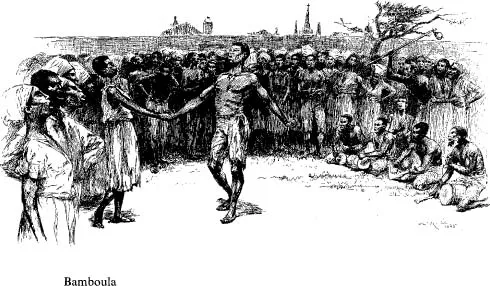
Because of their mobility and anonymity, the slaves in New Orleans had a richer social life than their counterparts on the plantation; sometimes the slaves were even allowed to hold balls in their masters’ homes. Lavishly dressed, the bondsmen frequently ate cakes, fruits, and candies and drank freely of wines and liquors at dances, where they performed the bamboula and the polka to drums and violins played by slave musicians. Their dances also included the “carabine” and the “pile chactas.” In the former, the man twirled the woman around while she waved a handkerchief over her head. During the “pile chactas,” the woman stood motionless while the male danced around her, kneeling, making faces, and writhing like a serpent. Sunday was a holiday for the slaves; they gambled, got drunk, watched cock fights, gathered in restaurants and barbershops, or congregated in Congo Square to sing and dance.6
Drawing on his own reminiscences and old manuscripts, the novelist George Washington Cable described many of the activities which took place in Congo Square. Among the dances performed to a frenzied African beat were the bamboula (New Orleans-born composer Louis Gottschalk used this as the inspiration for one of his pieces), babouille, counjaille, and the calinda.7 According to Cable, the calinda was “a dance of multitude, a sort of vehement cotillion. The contortions of the encircling crowd were strange and terrible, the din ·was hideous. One calinda is still familiar to all Creole ears;…for generations the man of municipal politics was fortunate who escaped entirely a lampooning set to its air.”8 Among these satirical songs was one about a judge who gave a ball for his slaves:
It was in a stable that they had this
gala night
The horses they were greatly astonished.
Préval was captain;
His coachman, Louis, was master of ceremonies
There were Negresses made prettier than their
mistresses,
By adornments stolen from the ladies’
wardrobes.
But the jailer found it all so funny,
That he proposed to himself to take an unexpected
part. 9
Quite frequently the songs accompanying dances in Congo Square were amorous ones. For example, during the counjaille the slaves often sang “Belle Layotte”:
I done hunt all dis settlement
All de way ‘roun fum Pierre Soniat;
Never see yalla gal w’at kin
‘Gin to lay ‘longside sweet Layotte
I been meet up wid John Bayou,
Say to him. “fohn Bayou, my son,
Yalla gal nevva meet yo’
view Got a face lak dat chahmin one. 10
Many of the instruments seen in Congo Square were similar to those used in Africa. A comparison of drawings of these instruments with those illustrations by African musicologists clearly shows the transfer of forms. As in many African tribes, for example, New Orleans blacks carved figures on their stringed instruments and used hollowed-out pieces of wood with animal skins stretched over them as drums.11
There were several other distinctly African features of the slave’s culture. In Louisiana many African religious rites were fused into one—voodoo, the worship of Damballa or the snake god. The king and queen of the voodoo sect in New Orleans were “Dr. John” and Marie Laveau, who exacted blind obedience from their followers. Claiming a knowledge of the future and the ability to heal the body and to read the mind, Dr. John and Laveau exercised great control over the blacks. Slaves bought charms and amulets in order to control their masters, obtain money, gain success in love, insure good health, and to harm their enemies. At their annual celebration on the shores of Lake Pontchartrain on St. John’s Eve, the devotees of voodoo sacrificed animals and engaged in feverish dances and sexual orgies.12 At such ceremonies, reported the New Orleans Delta on November 3, 1854, the participants often “strip[ped] themselves stark naked and then commence[d] a strange, wild sort of Indian dance.”
The sect penetrated into practically every level of society. One scholar reported that Dr. John’s “control over the credulous and superstitious element of society was incredible.”13 Many whites, probably influenced by their servants, also believed in voodoo. Henry C. Castellanos, a local historian, wrote that Marie Laveau had great influence over whites as well as blacks: “Ladies of high social position would frequently pay her high prices for amulets supposed to bring good luck. “14 Some of these same ladies even participated in the wild orgies of the sect; on occasion the police found them dancing naked with the black devotees. A New Orleans newspaper described one of these ceremonies in the 1850s which was raided by the police: “Blacks and whites were circling around promiscuously, writhing in muscular contractions, panting, raving and frothing at the mouth. But the most degrading and infamous feature of this scene was the presence of a very large number of ladies (?), moving in the highest walks of society, rich and hitherto supposed respectable, that were caught in the dragnet. “15
While voodoo held sway over a large part of the black population, many of the slaves received conventional religious instruction from their masters or sat in the galleries of their churches. There were also some churches exclusively for slaves: in 1860 the slaves’ Methodist church had a six-hundred-member congregation which worshipped in a building worth $3,000, and the slaves’ Baptist church had 500 members and a building worth $2,500. The authorities, however, were suspicious of separate churches for slaves; police frequently broke up meetings of the Baptist church between 1826 and 1844. After the latter date, the slaves were permitted to meet for two hours on Sundays as long as a police officer was present.
In their own churches the slaves could pour out all of their anguish, socialize with their friends, and find some release for their pent-up emotions. The church provided hope of release from earthly bondage and promised satisfaction in the hereafter for the earthly burdens the slave bore.16 When the European traveler Fredrika Bremer attended the slaves’ Methodist church, she was so impressed by the service that she concluded: “The children of Africa may yet give us a form of divine worship in which invocation, supplication, and songs of praise may respond to the inner life of the fervent soul!” During the service, Bremer reported, the audience talked back to the exhorter and then began crying aloud, shouting, having convulsions, groaning, and rolling on the floor. “The whole church seemed transformed into a regular Bedlam, and the noise and the tumult was horrible.” One woman, who fainted upon her conversion, began talking quietly to herself when she revived, and, said Bremer, “such a beautiful, blissful expression was portrayed in her countenance, that I would willingly experience that which she then experienced, saw, or perceived. It was no ordinary, no earthly scene. Her countenance was as it were transfigured.” After the shouting subsided and the service ended, people talked, laughed, and shook hands with each other “with such cordial warmth and goodwill, that it was a pleasure to behold. Of the whole raging, exciting scene there remained merely a feeling of satisfaction and pleasure, as if they had been together at some joyful feast. “17
In contrast to the pleasure the slave found in religion, he encountered many problems in his efforts to build a stable family. The slave family in New Orleans suffered most of the disabilities of the plantation family, although it also had some advantages not available in the countryside. The greatest of these advantages was that a slave could often set up a household with little interference from his master. On January 31, 1859, for example, the New Orleans Picayune charged that there were “hundreds” of places “in which the slave is the keeper of the house—a slave over whom the master pretends to exercise no control.” Since so many of the slaves were house servants, a number of them adopted the mores of their masters in regard to the family. As a result, a higher percentage of urban than of rural slaves were married in churches. In spite of these advantages, however, the city slave family was a fragile institution. In the first place, the number of slave women far exceeded the number of slave men (in 1860 there were only 78 males to every 100 female slaves in Orleans parish). Secondly, a severe strain was put on the slave family by the loose morality frequently characteristic of ports such as New Orleans, and by the fact that the number of white males far exceeded the number of white females.18
According to the English traveler Harriet Martineau, few slave women in New Orleans were chaste, because their masters were generally indifferent to promoting slave morality. “None but a virtuous mistress,” she wrote, “can fully protect a female slave, and that too seldom. “19 Those slaves who lived with their owners frequently had a difficult time developing normal conjugal or filial relations: they were often prohibited from even using the ordinary names which indicate family relationships.
In spite of restrictions on the development of stable families, and in spite of a few cruel and sadistic slaveholders, prohibitions against slaves mingling with free Negroes, and city regulations requiring slaves to wear badges indicating their status, the New Orleans slaves were so much more sophisticated and enjoyed so much more freedom from the surveillance of their masters than did plantation slaves that they emerged from bondage with relatively few psychological scars. The slave in New Orleans was generally cautious, but he could be insolent. In fact, there are numerous accounts of slaves’ having insulted or struck whites; and sometimes slaves stole, drank, and caroused almost at will. The penalties, when they were caught, were usually light.20
The white man was the enemy from whom it was justified to steal and with whom one dissembled. The Englishman S. A. O’Ferrall declared that the slaves in New Orleans “steal, cheat, and hate their masters! They justly consider whatever they take to be but a portion of their own labor.”21 The New Orleans slaves’ acceptance of white supremacy was only superficial—too many blacks danced, gambled, drank, and copulated with whites to be cowed by them. The historian Joseph Tregle concluded from his study of antebellum New Orleans that the behavior of the slaves was “singularly free of that deference and circumspection which might have been expected in a slave community.”22 The New Orleans Picayune would have agreed emphatically. On January 27, 1859, it complained that the slaves “have become intemperate, disorderly, and have lost the respect which the servant should entertain for the master.”
Inevitably, there were hundreds of slaves who refused to give any account to their masters. The English traveler Robert Everest reported that there were 108 fugitive slaves arrested in New Orleans in December 1853, and he estimated that one percent of the slaves were always absent from their owners. A number of slaves must also have thought of rebelling. According to an English visitor named J. E. Alexander, in the 1830s New Orleans whites were startled to find handbills
telling the slaves to rise and massacre the whites; that Hannibal was a negro, and why should not they also get great leaders among their number to lead them on to revenge? that in the eyes of God all men were equal; that they ought instantly to rouse themselves, break their chains and not leave one white slave proprietor alive; and, in short, that they ought to retaliate by murder for the bondage in which they were held.23
Although few slaves rose up to break their chains, many of them did obtain their freedom. The first free Negroes appeared in New Orleans in the 1720s; by 1860 the number had increased to 10,939. While a majority of them were probably the manumitted children of white men, many gained their freedom by meritorious or faithful service, by fighting in the colonial French or Spanish militia, or by purchase. Hundreds of other free Negroes came from Maine, Massachusetts, New York, Ohio, and Pennsylvania, or from Haiti during the revolution on that island. In fact, the most distinctive feature of the free Negro population was the large number of foreign-born blacks. For example, in 1850 the...