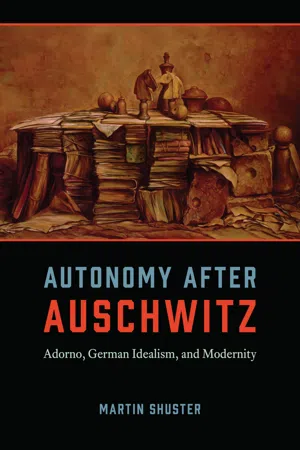
Autonomy After Auschwitz
eBook - ePub

Autonomy After Auschwitz

Adorno, German Idealism, and Modernity

  1. English
  2. ePUB (mobile friendly)
  3. Available on iOS & Android
eBook - ePub

Autonomy After Auschwitz

Adorno, German Idealism, and Modernity

About this book

Ever since Kant and Hegel, the notion of autonomy—the idea that we are beholden to no law except one we impose upon ourselves—has been considered the truest philosophical expression of human freedom. But could our commitment to autonomy, as Theodor Adorno asked, be related to the extreme evils that we have witnessed in modernity? In Autonomy after Auschwitz, Martin Shuster explores this difficult question with astonishing theoretical acumen, examining the precise ways autonomy can lead us down a path of evil and how it might be prevented from doing so.

Shuster uncovers dangers in the notion of autonomy as it was originally conceived by Kant. Putting Adorno into dialogue with a range of European philosophers, notably Kant, Hegel, Horkheimer, and Habermas—as well as with a variety of contemporary Anglo-American thinkers such as Richard Rorty, Stanley Cavell, John McDowell, and Robert Pippin—he illuminates Adorno's important revisions to this fraught concept and how his different understanding of autonomous agency, fully articulated, might open up new and positive social and political possibilities. Altogether, Autonomy after Auschwitz is a meditation on modern evil and human agency, one that demonstrates the tremendous ethical stakes at the heart of philosophy. 

Frequently asked questions

Yes, you can cancel anytime from the Subscription tab in your account settings on the Perlego website. Your subscription will stay active until the end of your current billing period. Learn how to cancel your subscription.
At the moment all of our mobile-responsive ePub books are available to download via the app. Most of our PDFs are also available to download and we're working on making the final remaining ones downloadable now. Learn more here.
Perlego offers two plans: Essential and Complete
  • Essential is ideal for learners and professionals who enjoy exploring a wide range of subjects. Access the Essential Library with 800,000+ trusted titles and best-sellers across business, personal growth, and the humanities. Includes unlimited reading time and Standard Read Aloud voice.
  • Complete: Perfect for advanced learners and researchers needing full, unrestricted access. Unlock 1.4M+ books across hundreds of subjects, including academic and specialized titles. The Complete Plan also includes advanced features like Premium Read Aloud and Research Assistant.
Both plans are available with monthly, semester, or annual billing cycles.
We are an online textbook subscription service, where you can get access to an entire online library for less than the price of a single book per month. With over 1 million books across 1000+ topics, we’ve got you covered! Learn more here.
Look out for the read-aloud symbol on your next book to see if you can listen to it. The read-aloud tool reads text aloud for you, highlighting the text as it is being read. You can pause it, speed it up and slow it down. Learn more here.
Yes! You can use the Perlego app on both iOS or Android devices to read anytime, anywhere — even offline. Perfect for commutes or when you’re on the go.
Please note we cannot support devices running on iOS 13 and Android 7 or earlier. Learn more about using the app.
Yes, you can access Autonomy After Auschwitz by Martin Shuster in PDF and/or ePUB format, as well as other popular books in Philosophy & Ethics & Moral Philosophy. We have over one million books available in our catalogue for you to explore.

Table of contents

  1. Title Page
  2. Copyright Page
  3. Dedication
  4. Contents
  5. Acknowledgments
  6. Abbreviations
  7. Introduction
  8. 1. I Against I: Stressing the Dialectic in the Dialectic of Enlightenment
  9. 2. Beyond the Bounds of Sense: Kant and the Highest Good
  10. 3. Adorno’s Negative Dialectic as a Form of Life: Expression, Suffering, and Freedom
  11. 4. Reflections on Universal Reason: Adorno, Hegel, and the Wounds of Spirit
  12. Model: Conclusion
  13. Works Cited
  14. Index