![]()
Part 1:
Madagascar in Perspective:
Past and Present
![]()
Introduction
General
It is important to mention at the onset that this book is not intended to be a technical summary of what we know about ecological change and animal extinction on Madagascar in recent geological history. Instead, given our own fascination in trying to understand and perhaps partially answer the question as to what happened to an extraordinary assortment of endemic Malagasy animals that no longer roam the Earth, we decided to bring to a general audience an overview of these subjects. Our own particular research interests, which accent different aspects of these questions, are presented in the text. While enormous strides have been made in the past decades to understand different facets of “what happened,” we still lack many of the critical details to properly weigh and put in balance factors induced by natural climate change versus those due to human modifications of the landscape. Critical for the latter “anthropogenic” aspect is the incomplete archaeological record of Madagascar, so that questions such as when humans originally arrived on the island remain controversial and uncertain. The complete story is like a puzzle, but several linking pieces are missing or insufficiently known to provide the complete window into what transpired. After the general opening sections in Part 1 to set the stage, Part 2 has twenty plates created by Velizar Simeonovski as centerpieces for reasonably well-known paleontological and archaeological localities. Discussing each individual plate, we unfold different pieces of the puzzle for a variety of sites and extinct species based on different sources of information. His plates, each of which acts as a separate “window into the past,” bring our narratives to life.
As we learn more about the island of Madagascar, which covers nearly 600,000 square kilometers—the size of California with a good portion of Oregon—it becomes clear that a single, unequivocal response to the question of what happened is a fleeting possibility. No panacea exists for several reasons. Given the ecological, geological, topographical, meteorological, and cultural complexities and variation found across this massive landscape, multiple and different factors at the regional level have to be invoked to explain dramatic change during short periods of geological time, that is, on a scale of a few thousand years. As suggested by the late Robert Dewar some years back, if scientists working on Madagascar have come to understand one aspect, “it seems less and less appropriate to expect a single, uniform cause for the extinctions will be found” (83). Hence, in following this point, we suggest that an island-wide response as to what happened to the ecosystems and their constituent animals is inappropriate and implausible; there simply is no single “silver bullet.” The different biological regions and cultural aspects in various cases need to be examined individually. Many debates remain to be resolved concerning what factors are responsible for these changes. Our intent with this book has been to summarize and provide a glimpse into decades of detailed scientific studies for a general audience in order to help them discover the extraordinary island of Madagascar and appreciate all of the recent changes that have taken place.
Aspects of Format
We have tried to write this book in a relatively nontechnical style. Words and expressions are occasionally used that might not be familiar to a general audience, but at first use and sometimes deeper into the text, we have tried to explain such terms. Further, while it is important to provide a certain number of bibliographic references for critical points and information presented in the text, particularly for documentary purposes and for those wanting additional details, we have done this in a light-handed fashion. Rather than congesting the text with such citations, we have used a number system, with complete reference information at the end of the book. Finally, we have included two indexes, one to the scientific names and another of Malagasy locality names used in the text.
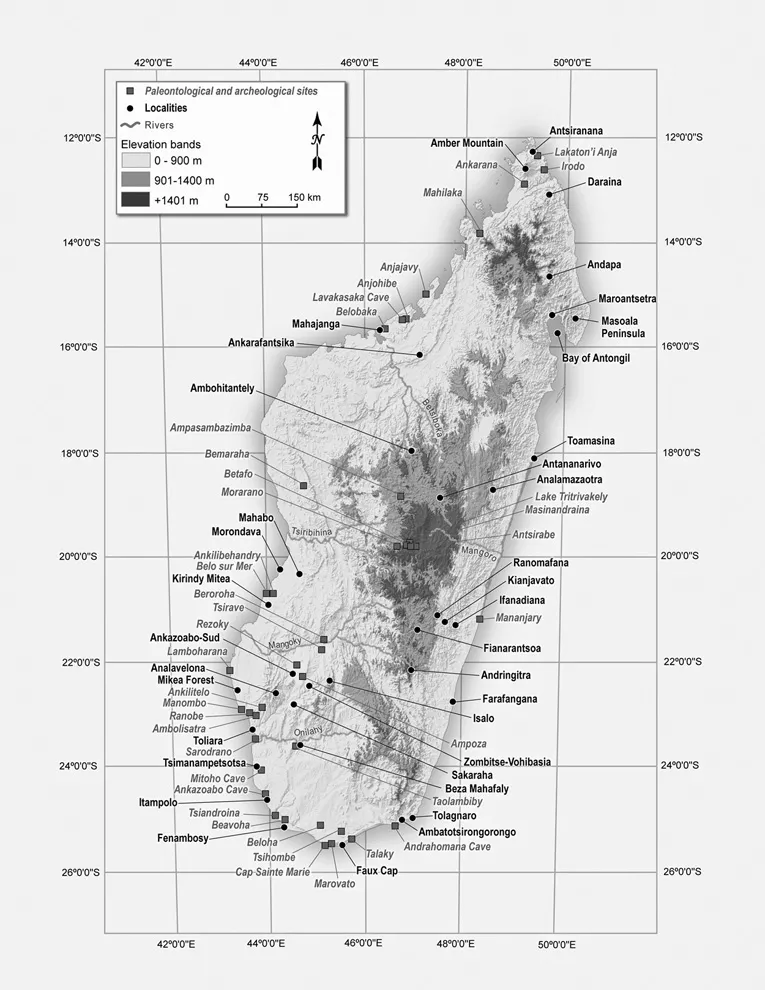
Figure 1. Map of different localities mentioned in the text, overlaid on elevational zonation of Madagascar. The zone below 900 m forms the divide between the lowlands and the Central Highlands. Important mountain zones are found in a north-south-oriented zone in the easterly portion, as well as the northwest. Some of the major rivers of the island are also indicated. (Map by Herivololona Mbola Rakotondratsimba and Luci Betti-Nash.)
We differentiate between two different types of illustrations used in this book. The term “plate” specifically refers to paintings by Velizar Simeonovski that are presented in Part 2; these twenty plates capture the different site-specific ecosystems and animals that occurred or still occur on the island. On the inside front cover is a map of the different localities for the twenty plates, providing the reader a key to their geographical position. In the text associated with these plates, different themes are discussed and considerable cross-references are made between them. In several cases, a small black-and-white figure and associated text are presented adjacent to a plate to provide a key to the identification of the animals depicted. The term “figure” refers to all of the other illustrations presented in this book. Associated with their often-complex names and considerable number of syllables, Malagasy locality names can be difficult for the non-initiated. In Figure 1, we present the placement for most localities mentioned in the text and distinguish between paleontological and archaeological sites.
Major advances have been made in the past few decades in our understanding of extinct and living animals of Madagascar. New insights are now available on their distribution, ecology, and classification (taxonomy). Given these diverse studies, various scientists maintain differing interpretations of certain types of data and, naturally, opinions vary. Hence, the systematics or classifications for different organisms presented in this book are in some cases in a state of flux. As a case in point, the giant extinct tortoises of Madagascar were classically placed in the genus Geochelone, with two recognized species: Geochelone abrupta and Geochelone grandidieri. Subsequently, it was proposed that these species should be placed in the genus Dipsochelys, and this in turn created more debate. Accordingly, a petition supported by numerous scientists working on reptiles has been sent to the International Commission on Zoological Nomenclature in an effort to stabilize the taxonomy of these animals; in this case, for certain living and extinct giant tortoises, the generic name would be Aldabrachelys. Herein, we use this genus for the two extinct species of Madagascar, Aldabrachelys abrupta and Aldabrachelys grandidieri, as well as the extant Aldabra tortoise, Aldabrachelys gigantea. We have used the abbreviation “sp.” for species and “spp.” in its plural form.
The Artist
Velizar Simeonovski is a native of Bulgaria. In 1987 he graduated from the Professional Art School of Applied Arts in Sofia, and in 1995 he r...