- English
- PDF
- Available on iOS & Android
eBook - PDF
About this book
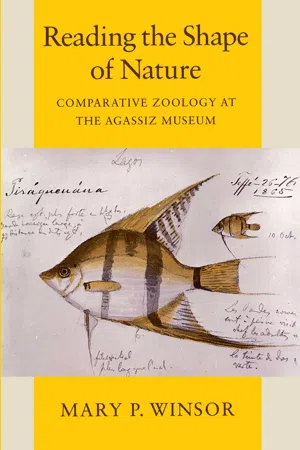
Reading the Shape of Nature vividly recounts the turbulent early history of the Museum of Comparative Zoology at Harvard and the contrasting careers of its founder Louis Agassiz and his son Alexander. Through the story of this institution and the individuals who formed it, Mary P. Winsor explores the conflicting forces that shaped systematics in the second half of the nineteenth century. Debates over the philosophical foundations of classification, details of taxonomic research, the young institution's financial struggles, and the personalities of the men most deeply involved are all brought to life.
In 1859, Louis Agassiz established the Museum of Comparative Zoology to house research on the ideal types that he believed were embodied in all living forms. Agassiz's vision arose from his insistence that the order inherent in the diversity of life reflected divine creation, not organic evolution. But the mortar of the new museum had scarcely dried when Darwin's Origin was published. By Louis Agassiz's death in 1873, even his former students, including his son Alexander, had defected to the evolutionist camp. Alexander, a self-made millionaire, succeeded his father as director and introduced a significantly different agenda for the museum.
To trace Louis and Alexander's arguments and the style of science they established at the museum, Winsor uses many fascinating examples that even zoologists may find unfamiliar. The locus of all this activity, the museum building itself, tells its own story through a wonderful series of archival photographs.
In 1859, Louis Agassiz established the Museum of Comparative Zoology to house research on the ideal types that he believed were embodied in all living forms. Agassiz's vision arose from his insistence that the order inherent in the diversity of life reflected divine creation, not organic evolution. But the mortar of the new museum had scarcely dried when Darwin's Origin was published. By Louis Agassiz's death in 1873, even his former students, including his son Alexander, had defected to the evolutionist camp. Alexander, a self-made millionaire, succeeded his father as director and introduced a significantly different agenda for the museum.
To trace Louis and Alexander's arguments and the style of science they established at the museum, Winsor uses many fascinating examples that even zoologists may find unfamiliar. The locus of all this activity, the museum building itself, tells its own story through a wonderful series of archival photographs.
Frequently asked questions
Yes, you can cancel anytime from the Subscription tab in your account settings on the Perlego website. Your subscription will stay active until the end of your current billing period. Learn how to cancel your subscription.
No, books cannot be downloaded as external files, such as PDFs, for use outside of Perlego. However, you can download books within the Perlego app for offline reading on mobile or tablet. Learn more here.
Perlego offers two plans: Essential and Complete
- Essential is ideal for learners and professionals who enjoy exploring a wide range of subjects. Access the Essential Library with 800,000+ trusted titles and best-sellers across business, personal growth, and the humanities. Includes unlimited reading time and Standard Read Aloud voice.
- Complete: Perfect for advanced learners and researchers needing full, unrestricted access. Unlock 1.4M+ books across hundreds of subjects, including academic and specialized titles. The Complete Plan also includes advanced features like Premium Read Aloud and Research Assistant.
We are an online textbook subscription service, where you can get access to an entire online library for less than the price of a single book per month. With over 1 million books across 1000+ topics, we’ve got you covered! Learn more here.
Look out for the read-aloud symbol on your next book to see if you can listen to it. The read-aloud tool reads text aloud for you, highlighting the text as it is being read. You can pause it, speed it up and slow it down. Learn more here.
Yes! You can use the Perlego app on both iOS or Android devices to read anytime, anywhere — even offline. Perfect for commutes or when you’re on the go.
Please note we cannot support devices running on iOS 13 and Android 7 or earlier. Learn more about using the app.
Yes, you can access Reading the Shape of Nature by Mary P. Winsor in PDF and/or ePUB format, as well as other popular books in Biological Sciences & Biology. We have over one million books available in our catalogue for you to explore.
Information
Publisher
University of Chicago PressYear
2011Print ISBN
9780226902159, 9780226902142eBook ISBN
9780226902081Table of contents
- Contents
- Illustrations
- Preface
- Acknowledgments
- 1. "In the Prime of His Admirable Manhood"
- 2. "I Have Been Disappointed in My Collaboration"
- 3. "Our Work Must Be Done with Much More Precision"
- 4. "An Object Worthy of a Life's Devotion"
- 5. "The Many Plans Started by My Father"
- 6. "Shall We Say 'Ignorabimus,' or Chase a Phantom?"
- 7. "The Slender Threas is Practically Severed"
- 8. "Results Unattainable by Museum Study Alone"
- 9. "Collections Never of Use to Anyone"
- 10. "Dependent on the Personal Feelings of the Authors"
- 11. "I Made Up My Mind That Very Day to Be Director"
- Concluding Remarks
- Notes
- Bibliography
- Index