Michael Polanyi and His Generation
eBook - ePub

Michael Polanyi and His Generation

Origins of the Social Construction of Science

  1. English
  2. ePUB (mobile friendly)
  3. Available on iOS & Android
eBook - ePub

Michael Polanyi and His Generation

Origins of the Social Construction of Science

About this book

In Michael Polanyi and His Generation, Mary Jo Nye investigates the role that Michael Polanyi and several of his contemporaries played in the emergence of the social turn in the philosophy of science. This turn involved seeing science as a socially based enterprise that does not rely on empiricism and reason alone but on social communities, behavioral norms, and personal commitments. Nye argues that the roots of the social turn are to be found in the scientific culture and political events of Europe in the 1930s, when scientific intellectuals struggled to defend the universal status of scientific knowledge and to justify public support for science in an era of economic catastrophe, Stalinism and Fascism, and increased demands for applications of science to industry and social welfare.
 
At the center of this struggle was Polanyi, who Nye contends was one of the first advocates of this new conception of science. Nye reconstructs Polanyi's scientific and political milieus in Budapest, Berlin, and Manchester from the 1910s to the 1950s and explains how he and other natural scientists and social scientists of his generation—including J. D. Bernal, Ludwik Fleck, Karl Mannheim, and Robert K. Merton—and the next, such as Thomas Kuhn, forged a politically charged philosophy of science, one that newly emphasized the social construction of science.

Frequently asked questions

Yes, you can cancel anytime from the Subscription tab in your account settings on the Perlego website. Your subscription will stay active until the end of your current billing period. Learn how to cancel your subscription.
No, books cannot be downloaded as external files, such as PDFs, for use outside of Perlego. However, you can download books within the Perlego app for offline reading on mobile or tablet. Learn more here.
Perlego offers two plans: Essential and Complete
  • Essential is ideal for learners and professionals who enjoy exploring a wide range of subjects. Access the Essential Library with 800,000+ trusted titles and best-sellers across business, personal growth, and the humanities. Includes unlimited reading time and Standard Read Aloud voice.
  • Complete: Perfect for advanced learners and researchers needing full, unrestricted access. Unlock 1.4M+ books across hundreds of subjects, including academic and specialized titles. The Complete Plan also includes advanced features like Premium Read Aloud and Research Assistant.
Both plans are available with monthly, semester, or annual billing cycles.
We are an online textbook subscription service, where you can get access to an entire online library for less than the price of a single book per month. With over 1 million books across 1000+ topics, we’ve got you covered! Learn more here.
Look out for the read-aloud symbol on your next book to see if you can listen to it. The read-aloud tool reads text aloud for you, highlighting the text as it is being read. You can pause it, speed it up and slow it down. Learn more here.
Yes! You can use the Perlego app on both iOS or Android devices to read anytime, anywhere — even offline. Perfect for commutes or when you’re on the go.
Please note we cannot support devices running on iOS 13 and Android 7 or earlier. Learn more about using the app.
Yes, you can access Michael Polanyi and His Generation by Mary Jo Nye in PDF and/or ePUB format, as well as other popular books in Philosophy & Epistemology in Philosophy. We have over one million books available in our catalogue for you to explore.

NOTES

INTRODUCTION

1. Forman 1967, 1971. See also Forman 2010.
2. Unguru 1975.
3. Barnes and Shapin 1977, 61–62. See also Zammito 2004, 141–42.
4. Goldman 2006; Fuller 2002, 2009; Bloor 1991, 7.
5. Shapin 2010b.
6. Kuhn 1962, 44n1.
7. For histories of social studies of science and its various subspecialties, including SSK and constructivism, see Bucchi 2004; Sismondo 2004; and Yearley 2005. These books have little to say about events or ideas before Kuhn. Stephen Turner (2008) writes about earlier discussions of the social character of science in historical periods from Bacon to Kuhn.
8. Wigner and Hodgkin 1977; Scott and Moleski 2005.
9. Useful guides to Personal Knowledge are Polanyi 1959b; Grene 1958; and Jha 2002.
10. On the post-Kantian and early-nineteenth-century origins of modern notions of objectivity and subjectivity, see Galison and Daston 2007, 30–31.
11. On the prayerful search for God, Polanyi 1964, 34–35.
12. In a notice of the 2009 reissue by the University of Chicago Press of Polanyi’s 1966 collection of essays The Tacit Dimension, Steven French voices mystification at Polanyi’s “cosmic panorama” and references to a fateful conflict between the “moral skepticism of science and the moral demands of modern man.” French notes how far distant Polanyi’s work lies from mainstream philosophy (French 2010, 157–58, quoting from Polanyi 2009, 57).
13. Golinski 1998, 7.

CHAPTER ONE

* In this chapter alone, Hungarian accent marks are used in the spelling of Hungarian names, with the exceptions of the names of Michael Polanyi (Mihály Polányi), Karl Polanyi (Károly Polányi), and their immediate family members. In later chapters, Anglicized spellings are used for the most part for Hungarians who settled elsewhere.
1. On the “Hungarian phenomenon,” see Palló 1990, 319, 320; 1991, 85. Further, see Frank 2009; Congdon 1991; Somlyody and Somlyody 2003. Quoted material is from Mannheim 1936, 154–55.
2. Hacohen 1999, 2000. Knepper (2005, 285–86) suggests that Polanyi, unlike Popper, drew upon religious spirituality and Protestant social forms of organization in the development of philosophy of science.
3. Quoted in Marton 2006, 11. On Hungarian scientists and patterns of creativity, see Palló 2005. See also Fermi 1968, 53–59.
4. See Scott 1998–1999, 11; Lukacs 1993, 151.
5. Scott 1998–1999, 11; Szapor, 1997, 1. On Paul Polanyi, see Scott and Moleski 2005, 12.
6. Scott and Moleski 2005, 6–10.
7. Knepper 2005, 265; and Kovács 2003, 311.
8. Knepper 2005, 266.
9. On Germanization of names, see Lukacs 1993, 96. On the great-grandfather, see Scott and Moleski 2005, 3.
10. Scott and Moleski 2005, 3–6.
11. Knepper 2005, 265.
12. Ibid.; Lukacs, 1993, 96.
13. Gábor Palló, e-mail correspondence with the author, December 30, 2009.
14. On the successes of Jews in Budapest, see Marton 2006, 17.
15. Knepper 2005, 271.
16. Lukacs 1993, 57–58.
17. Wigner 1992, 77.
18. Scott and Moleski 2005, 15; Szapor 1997, 2. On the schools in Budapest, see Palló 2005, 223; Frank 2009, 55–78.
19. Scott and Moleski 2005, 16; Kovács 2003, 334–35.
20. Litván 2006, 25–26. See also Lukacs 1993, 196–97.
21. Quoted in Lukacs 1993, 199.
22. Mucsi 1990, 27.
23. Quoted in Lukacs 1993, 199.
24. Litván 2006, 25–26.
25. Scott and Moleski 2005, 21–22.
26. Mucsi, 1990, 28; Scott and Moleski 2005, 22.
27. Duczynska, n.d.
28. On Pólya’s memories, see Scott 1998–1999, 13; and on Einstein’s remark, see Kovács 2003, 312.
29. Sco...
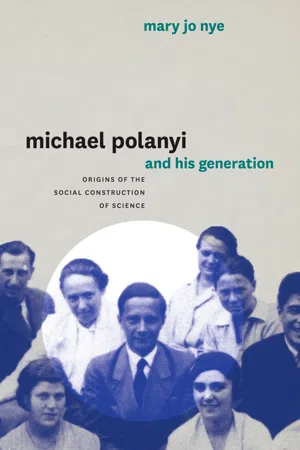
Table of contents

  1. Cover
  2. Copyright
  3. Title Page
  4. Dedication
  5. Contents
  6. Acknowledgments
  7. Introduction
  8. One: Scientific Culture in Europe and the Refugee Generation
  9. Two: Germany and Weimar Berlin as the City of Science
  10. Three: Origins of a Social Perspective: Doing Physical Chemistry in Weimar Berlin
  11. Four: Chemical Dynamics and Social Dynamics in Berlin and Manchester
  12. Five: Liberalism and the Economic Foundations of the “Republic of Science”
  13. Six: Scientific Freedom and the Social Functions of Science
  14. Seven: Political Foundations of the Philosophies of Science of Popper, Kuhn, and Polanyi
  15. Eight: Personal Knowledge: Argument, Audiences, and Sociological Engagement
  16. Epilogue: SSK, Constructivism, and the Paradoxical Legacy of Polanyi and the 1930s Generation
  17. List of Abbreviations
  18. Notes
  19. References
  20. Index