Time capsules offer unexpected insights into how people view their own time, place, and culture, as well as their duties to future generations. Remembrance of Things Present traces the birth of this device to the Gilded Age, when growing urban volatility prompted doubts about how the period would be remembered—or if it would be remembered at all. Yablon details how diverse Americans – from presidents and mayors to advocates for the rights of women, blacks, and workers – constructed prospective memories of their present. They did so by contributing not just written testimony to time capsules but also sources that historians and archivists considered illegitimate, such as photographs, phonograph records, films, and everyday artifacts.
By offering a direct line to posterity, time capsules stimulated various hopes for the future. Remembrance of Things Present delves into these treasure chests to unearth those forgotten futures.
Safeguarding the Nation: Photographic Offerings to the Bicentennial, 1876–1889
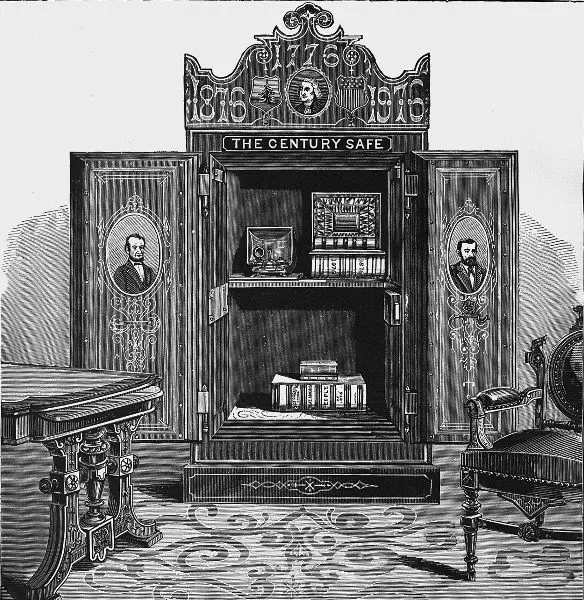
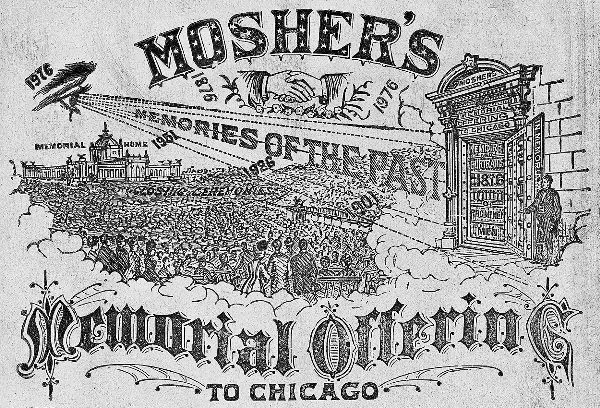
The bells that rang out across a rainy, windswept Philadelphia to signal the Centennial Exposition’s opening on May 10, 1876, also heralded the dawn of a cultural innovation. Most of the 186,272 visitors who inundated the fair on opening day elbowed their way toward the chief sights, above all President Ulysses Grant and Brazilian Emperor Dom Pedro II pulling the levers of the mammoth Corliss steam engine to breathe life into thousands of electrical exhibits throughout Machinery Hall. But elsewhere at the exhibition, and with less fanfare, a smaller, quieter invention was revealed to the public. In a corner of the Art Gallery, the New York magazine publisher Anna Deihm displayed her Century Safe, a five-foot, four-inch iron safe containing a collection of photographs, autographs, and other mementos for the year 1976 (fig. 1.1), while next door in Photographic Hall, the Chicago portrait photographer Charles Mosher unveiled his own embryonic collection of photographs, which he later deposited in his Memorial Safe, also for the bicentennial (fig. 1.2). Although Deihm’s and Mosher’s exhibits would barely have stood out from the more than thirty thousand other businesses flaunting their wares to nearly ten million visitors to Fairmount Park that summer, they can retrospectively be identified as pioneers of a distinct practice.1
Fig. 1.1 Anna Deihm’s Century Safe, showing autograph and photograph albums, framed photographs, and other items. From C. F. Deihm, ed., President James A. Garfield’s Memorial Journal (New York: C. F. Deihm 1882), 196.
Fig. 1.2 Unknown designer, “Mosher’s Memorial Offering to Chicago.” Detail from backmark of one of Charles D. Mosher’s “memorial photographs,” Chicago, n.d. Chicago History Museum.
What was it about the political, social, cultural, or technological circumstances of the American Gilded Age—and, more specifically, the year 1876—that generated this idiosyncratic, invented tradition? How did the nation’s cultural legacy, conventionally entrusted openly to posterity via public monuments, museums, and libraries, come to be condensed into representative samples locked up in small metal boxes? We will first examine the immediate catalysts of the centennial and its attendant world’s fair, which stimulated not only compendia of the present but also anticipations of the future, anticipations that—given the social, economic, and political problems of that year—were not entirely optimistic despite assumptions about Victorian Americans’ confidence in progress. We will then consider the time vessel as an outgrowth of the communications revolution; a response to a crisis of posterity stemming from concerns about the inadequacy of paper-based records, archives, monuments, and the built environment; and a symptom of a larger democratization of fame. In each instance, the time vessel appears part of a broadening interest in communicating directly and self-consciously with posterity.
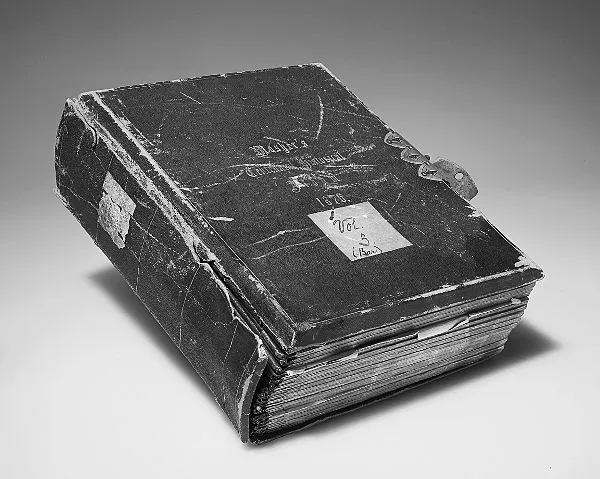
Particularly crucial to the emergence of the time vessel was photography. The centennial vessels were, first and foremost, troves of photographic portraits. Deihm originally conceived her Century Safe as a collection of autographs, but she subsequently assembled a vast album containing photographs of the president and his cabinet, Supreme Court justices, and every member of Congress while also soliciting photographs from the nation’s leading figures in “Science, Literature, and the Fine and Mechanical Arts.”2 Mosher, a photographer by profession, was even more ambitious. Growing out of his exhibit at the Philadelphia exposition of 590 portraits of leading Chicagoans, the Memorial Safe expanded to include politicians, generals, entrepreneurs, inventors, literary figures, and other “notables” (and their wives) from across the nation and ultimately any middle-class American willing to pay. He eventually deposited almost ten thousand portraits, some inserted in mammoth photographic albums (fig. 1.3).3
Fig. 1.3 “Mosher’s Centennial Historical Album 1876,” one of five albums deposited in Mosher’s Memorial Safe. Chicago History Museum.
As photographic collections intended for future viewers, Mosher’s and Deihm’s vessels pose a challenge to the emphasis in recent decades on the circulation of images. The social-historical approach to this medium has foregrounded the networks through which photographs, as material artifacts, were distributed, viewed, and interpreted. We are now familiar with how they were exhibited in galleries, studios, and eventually museums; distributed from vending machines and cigarette packs; exchanged by collectors and salesmen; projected as slides for lectures and travelogues; reproduced as engravings and halftones in magazines and newspapers; disseminated across and beyond the nation as postcards; and, in our own era, emailed, texted, shared, and (re)tweeted. This unfettered, promiscuous circulation—what Allan Sekula called the traffic in photographs—has been posited as a defining feature of the medium, central to its reputation both as a tool of political and commercial persuasion and as an instrument of ideology and power.4
The emphasis on contemporaneous circulation, however, occludes photographs’ orientation to the future, which has often entailed their temporary withdrawal from circulation. From its very conception, writers have imagined a special relationship between photography and posterity. Photography, wrote the Athenaeum in 1845, has “enabled us to hand down to future ages a picture of the sunshine of yesterday, or a memorial of the haze of to-day.”5 This focus on future generations was especially central to projects that sought to record cultures or structures that seemed about to disappear, such as the Smithsonian’s mid-nineteenth-century collection of portraits of American Indians or Britain’s early twentieth-century surveys of old buildings. We thus need to augment the social-historical approach by attending to how photographs are earmarked for various futures.
In addition to exploring the social and cultural forces that prompted Deihm and Mosher to take several thousand photographs out of circulation, we will consider their projects’ political significance. Despite the rhetoric of altruism and impartiality that often accompanies photographic preservation (and archival practices in general), Mosher’s and Deihm’s collections were closely allied to specific political movements. That allegiance appears to have shifted over time. Initially, their vessels hinted at a conservative faith in the continued dominance of the capitalist elite, the Republican Party, and republican institutions more generally. Mosher and Deihm intended them to serve as ritual objects inculcating a sense of belonging to a nation, understood as an entity extending not just across vast spaces but also into a remote future. Yet by the time they were sealed in the aftermath of the Great Railroad Strike of 1877, they assumed a more ambivalent stance and even expressed social democratic hopes for a future characterized by gender, racial, and class equality.
Exhibiting the Present
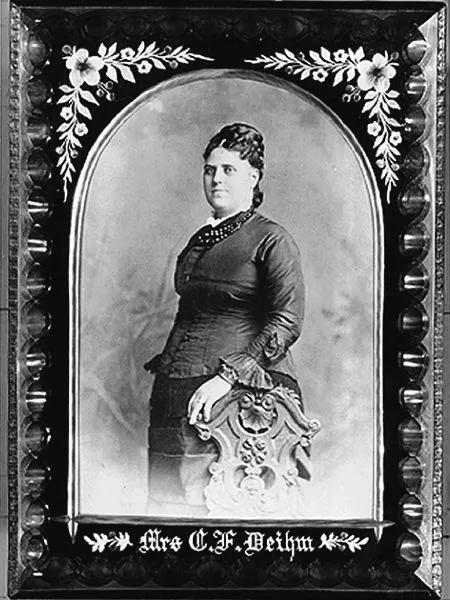
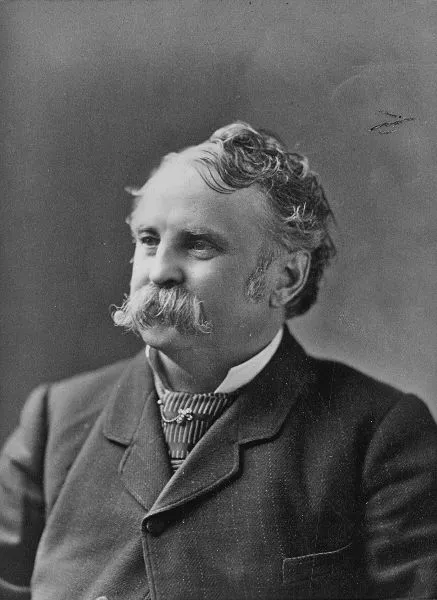
While the Century and Memorial safes were remarkably similar in format and content, their creators appear to have invented the time vessel independently, arriving at it from different motives and career paths. Anna Mary Deihm was a forty-seven-year-old Civil War widow and magazine publisher from New York City (fig. 1.4).6 Five years younger, Charles Delevan Mosher was one of Chicago’s leading photographers, with a gallery on State Street and the honor of having taken Abraham Lincoln’s portrait (fig. 1.5).7
Fig. 1.4 Unknown photographer, Mrs. C. F. Deihm. Silver-framed photograph, deposited in Anna Deihm’s Century Safe. Records of the Architect of the Capitol.
Fig. 1.5 Charles D. Mosher, C. D. Mosher Photographer 125 State St. Albumen print on cabinet card, n.d. Chicago History Museum.
It would be tempting to characterize these early vessels—as some contemporaries did—as mere publicity stunts. The Century Safe certainly advertised Deihm’s publishing business by showcasing her magazine, Centennial Welcome, and her newspaper, Our Second Century. Mosher similarly promoted his gallery and studio by offering the bait of a complimentary photograph for his memorial safe, thus luring customers to purchase duplicates for themselves at five dollars per dozen—a scheme he appears to have devised after the exposition.8 Even amid the profusion of exhibitors, both won praise at the Centennial. Deihm reputedly “attracted . . . much attention,” and Mosher won first prize for “excellence in art photography.”9 Mosher proclaimed the exposition a “golden opportunity” for photographers to attract customers, the “best cash investment” they could make.10 His idea of photographing customers for posterity, moreover, promised to elevate portraiture, traditionally subordinated to other genres of art, to the prestige of a civic deed.
To dismiss them as self-promotional schemes, however, would be to overlook the deeper cultural forces that engendered the time vessel. It is no coincidence that both were introduced at the Centennial Exposition. Just as a world’s fair was, in the words of contemporaries, a “world in miniature” or a three-dimensional “illustrated encyclopedia of civilization,” so did a time vessel represent a microcosm of a larger whole.11 Mosher’s and Deihm’s drive to assemble a “complete” set of photographs and autographs of a city’s or nation’s “representative men” mirrored the world’s fair organizers’ efforts to gather a sample of artifacts representing the technological, aesthetic, and material accomplishments of all nations. Informed by a broader Victorian obsession with collecting, the exposition also imposed a complex taxonomy on its exhibits.12 Mosher similarly classified his photographs by profession, with sixteen separate categories for politicians, doctors, clergymen, lawyers, journalists, businessmen, teachers, and so forth. These categories were inscribed on the safe’s inner door and on a printed catalog deposited within.13 In imposing this internal order on its contents, the time vessel departed from the older, more indiscriminate depositing of token objects in building cornerstones.
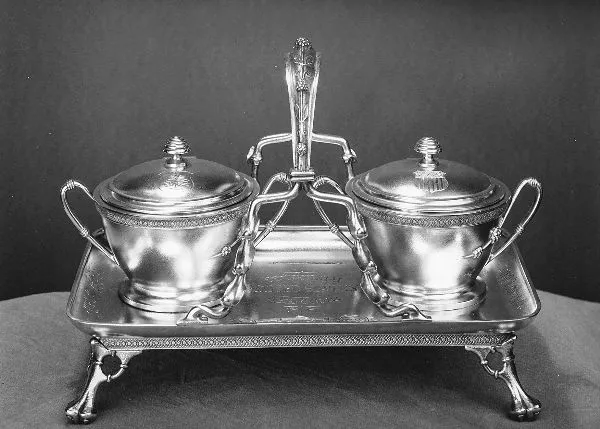
The two projects also exemplified the exposition’s role as an “exhibitionary complex,” a laboratory for new strategies of display. Like subsequent fairs, Philadelphia’s elaborated an aesthetic of the commodity by drawing on (and, in turn, refining) department stores’ and museums’ display techniques.14 Deihm’s safe—whose iron doors were to remain open while its inner, plate-glass door remained sealed so that its contents would always remain visible—particularly resembled display cabinets or vitrines in the fair’s main building that fetishistically enshrined commodities.15 By the time it was sealed, the safe showcased a silver inkstand and two gold pens specially made and engraved by Tiffany and Company (fig. 1.6) along with a patented photograph album bound in rosewood, ebony, and cut-glass by the luxury stationers W. W. Harding.16 The safe was itself an object of display, richly decorated with presidential portraits and gilt lettering, lined with royal purple velvet, and topped with an ornate pediment. It thus served as an advertising tie-in for the Marvin Safe Company, which Deihm commended for the “perfection” of its products.17
Fig. 1.6 Silver inkstand specially made and engraved by Tiffany and Company for Deihm’s Century Safe, to accompany two gold pens. Future officials were to use the pens and inkstand to sign Deihm’s autograph album. Records of the Architect of the Capitol.
Although conceived as centennial commemorations, Deihm’s and Mosher’s exhibits preserved no relics from the nation’s birth but instead confined themselves to contemporary materials. This narrowing of temporal focus—a feature that distinguishes time capsules from older collections such as cabinets of curiosities—again echoed the exposition. Despite evidence of growing nostalgia in Victorian culture, there were surprisingly few historical relics on display there. Restricted to a two-dimensional spatial grid and indexed by “type of object” or “country of origin,” architectural historian Bruno Giberti writes, the Centennial had “literally no space for the past. . . . [It] was a statement of now; history was an insubstantial sideshow in comparison to the great spectacle of the present condition.”18
This emphasis on the contemporaneous, however, did not imply an indifference to the future, as some have suggested.19 The vessels were clearly galvanized by thoughts of the bicentennial. “A century hence,” Deihm’s Centennial Welcome declared, copies of the magazine will have become a “relic memorial” of our “civilization.”20 Placing these and other items behind glass, she enabled fairgoers to view them as relics in the making. Her and Mosher’s safes were not the only centennial-inspired efforts to communicate with those living a hundred years hence. During the year 1876, a lead box containing stamps, coins, and local products and deposited in a granite vault under a sapling in the town of Ramapo, New York; a copper box containing family records in a Presbyterian Church in Rahway, New Jersey; and a tin box containing a centennial album in the bank vault of Ohio’s state treasury in Columbus were each addressed to celebrants of the bicentennial.21 A year earlier, a group of North Carolinians, believing their Mecklenburg Resolves of May 20, 1775, constituted the first declaration of American independence, planned to deposit a copper box containing similar items, which would make them the true originators of the time vessel were there evidence the plan was actually carried out.22 Such efforts were not limited to material deposits. Throughout the spring and summer of 1876, there was an extensive, nationwide campaign to collect “[historical] facts for future historians of the country,” prompted by a joint resolution of Congress requesting that every town and county “assemble” its history and deliver it to their county clerk and to the Librarian of Congress, thus ensuring “a complete record . . . of the progress of our institutions during the first centennial of their existence.”23 Some even envisaged the permanent buildings of the Philadelphia exposition as a kind of cumulative time vessel to be bequeathed to their successors. One centennial commissi...
Table of contents
Cover
Title Page
Copyright Page
Contents
Introduction: Memory, History, Posterity
1 Safeguarding the Nation: Photographic Offerings to the Bicentennial, 1876–1889
2 “P.O. Box to the Future”: Temperance, Insurgence, and Memory in San Francisco, 1879
3 Annals of the Present, the Local, and the Everyday: The Centurial Time Vessels as Heterodox History, 1900–1901
4 Seeds of Hope: “Posteritism” and the Political Uses of the Future, 1900–1901
5 “A Living History of the Times”: The Modern Historic Records Association, 1911–1914
6 Mausoleums of Civilization: Techno-Corporate Appropriations of the Time Vessel, 1925–1940
7 Breaking the Seal: The Vicissitudes of Transtemporal Communication
Epilogue: The Time Capsule’s Futures
Acknowledgments
List of Abbreviations
Notes
Index
Trusted by 375,005 students
Access to over 1.5 million titles for a fair monthly price.
Study more efficiently using our study tools.
Frequently asked questions
Yes, you can cancel anytime from the Subscription tab in your account settings on the Perlego website. Your subscription will stay active until the end of your current billing period. Learn how to cancel your subscription
No, books cannot be downloaded as external files, such as PDFs, for use outside of Perlego. However, you can download books within the Perlego app for offline reading on mobile or tablet. Learn how to download books offline
Perlego offers two plans: Essential and Complete
Essential is ideal for learners and professionals who enjoy exploring a wide range of subjects. Access the Essential Library with 800,000+ trusted titles and best-sellers across business, personal growth, and the humanities. Includes unlimited reading time and Standard Read Aloud voice.
Complete: Perfect for advanced learners and researchers needing full, unrestricted access. Unlock 1.5M+ books across hundreds of subjects, including academic and specialized titles. The Complete Plan also includes advanced features like Premium Read Aloud and Research Assistant.
Both plans are available with monthly, semester, or annual billing cycles.
We are an online textbook subscription service, where you can get access to an entire online library for less than the price of a single book per month. With over 1.5 million books across 990+ topics, we’ve got you covered! Learn about our mission
Look out for the read-aloud symbol on your next book to see if you can listen to it. The read-aloud tool reads text aloud for you, highlighting the text as it is being read. You can pause it, speed it up and slow it down. Learn more about Read Aloud
Yes! You can use the Perlego app on both iOS and Android devices to read anytime, anywhere — even offline. Perfect for commutes or when you’re on the go. Please note we cannot support devices running on iOS 13 and Android 7 or earlier. Learn more about using the app
Yes, you can access Remembrance of Things Present by Nick Yablon in PDF and/or ePUB format, as well as other popular books in Histoire & Histoire de l'Amérique du Nord. We have over 1.5 million books available in our catalogue for you to explore.