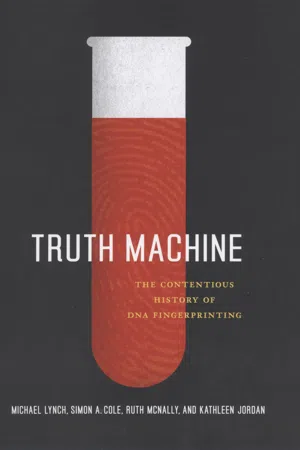
DNA profiling—commonly known as DNA fingerprinting—is often heralded as unassailable criminal evidence, a veritable "truth machine" that can overturn convictions based on eyewitness testimony, confessions, and other forms of forensic evidence. But DNA evidence is far from infallible. Truth Machine traces the controversial history of DNA fingerprinting by looking at court cases in the United States and United Kingdom beginning in the mid-1980s, when the practice was invented, and continuing until the present. Ultimately, Truth Machine presents compelling evidence of the obstacles and opportunities at the intersection of science, technology, sociology, and law.
eBook - ePub
Truth Machine
The Contentious History of DNA Fingerprinting
- English
- ePUB (mobile friendly)
- Available on iOS & Android
eBook - ePub
Truth Machine
The Contentious History of DNA Fingerprinting
About this book
Information
Publisher
University of Chicago PressYear
2010Print ISBN
9780226498072
9780226498065
eBook ISBN
9780226498089
CHAPTER ONE
A Revolution in Forensic Science?
This book is about a “scientific revolution” in forensic science. As with the scientific revolution of the seventeenth century, there may be some reason to doubt that it actually was a revolution or even that it ever occurred, but nevertheless it remains a compelling subject to write about (Shapin, 1996: 1). The revolution we chronicle has been widely heralded, and its banner is “DNA.” In the context of forensic science, “DNA” is shorthand for a family of techniques and their analytical products. Common names for these techniques include DNA fingerprinting, DNA profiling, DNA typing, and DNA testing.1 Technical names include multilocus probe (MLP), single-locus probe (SLP), and short tandem repeat (STR) systems. DNA fingerprinting, like its traditional namesake and other forensic identification techniques,2 is used for comparing trace evidence found at crime scenes with a suspect’s (or sometimes a victim’s) evidence. But unlike comparisons of fingerprints, handwriting samples, threads, hairs, or bite marks, DNA profile comparisons use laboratory methods and equipment that have widespread use in biological research and clinical testing. In public discourse about DNA evidence, laboratory science is associated with truth. In recent years “DNA” has become emblematic of a level of objectivity and certainty unmatched by any other mode of criminal evidence. In this book, we chronicle how forensic DNA testing attained such extraordinary status, and work out some of its implications for criminal justice. Of primary concern for us is how the attribution of scientific status to DNA evidence seems to have lifted it above and beyond the contestable status of other forms of expert and nonexpert evidence. By paying close attention to arguments by scientist-critics and lines of attack used by savvy defense lawyers during key controversies and legal disputes, we show that the credibility of DNA evidence largely rests on a fallible combination of technical, administrative, and legal practices. We argue that, in many respects, its credibility, as well as its occasional vulnerability to attack, arises from institutional practices that support or undermine the credibility of less glamorous forms of criminal evidence.
Although we focus on legal matters, our orientation largely draws from the field of science and technology studies. Sometimes called “science studies” or “science, technology and society,” S&TS is a transdisciplinary field that combines the history, social study, and philosophy of science. In recent decades, research in the field has become notorious for its critical, often skeptical, approach to the “construction” of scientific facts, laws, and entities. Constructionist S&TS is frequently caricatured as a form of philosophical relativism that holds that everything under the sun (and, for that matter, the sun itself) is a figment of cultural imagination, not essentially different from fairies and goblins. Without going into the frequently rehashed arguments on the subject,3 we can say, simply, that our orientation to the “deconstruction” of scientific evidence follows paths that have been blazed by scientists and lawyers who have had prominent roles in disputes about DNA evidence. In this respect, we pursue an ethnomethodological line of research (Garfinkel, 1967; 2002), meaning literally a line of research that investigates the varieties of “people’s practices” (ethno-methods) that establish facts on the ground. Rather than seeking to establish that DNA evidence is, in the final analysis, a social construction, we examine the interactional and administrative practices through which lawyers, experts, and nonexperts build up and break down its credibility. In this introductory chapter we set up our chronicle of the recent history of forensic science by critically discussing a prominent conception of a “paradigm” shift in that field. This allows us to introduce a distinct view of the construction and deconstruction of expert knowledge in criminal justice systems.
A Paradigm Shift?
DNA fingerprinting has been said to mark a “paradigm shift” in forensic science. Though misleading in many respects, the analogy with a new scientific paradigm is interesting for those of us in the field of science and technology studies who grew up with Thomas Kuhn’s (1970 [1962]) Structure of Scientific Revolutions as our canonical text. Kuhn’s historicophilosophical account of scientific revolutions itself had historic, revolutionary significance for the S&TS field. Especially significant was his conception of paradigm shifts in the basic or “pure” natural sciences: grand conceptual sea changes in astronomy, physics, and chemistry. According to Kuhn, a new paradigm is no mere novelty: discoveries that cumulatively build upon prior discoveries are emblematic of “normal science,” whereas a new paradigm requires a much more radical rupture with the past—a level of novelty that is at first resisted, because it defies conventional wisdom. A new paradigm overthrows the old: heliocentrism overthrows geocentrism; chemical theory overthrows phlogiston and caloric; relativity replaces classical mechanics. Importantly, and controversially, Kuhn (1970 [1962]) argued that competing paradigms were “incommensurable.” Referring to the much-abused alternating figure of the duck-rabbit in gestalt psychology (also see Hanson [1961] for a similar argument using an antelope-bird alternating figure), Kuhn suggests that a scientist’s alignment with one paradigm rather than another is not a rational choice; instead, it is more like the way a viewer sees the alternating figure as a duck or as a rabbit. But, unlike a viewer who can freely alternate between seeing the figure as a duck and then as a rabbit, scientists tend to have their feet firmly planted in a single paradigm. The nexus of theoretical commitments and the communal networks that make up and support the paradigm commit subscribers to a standpoint from which they simply cannot see the sense of the alternative universe. The transition between paradigms is not a sudden “switch,” but more of a gradual migration or generational change within a fractiously divided community of practitioners. Once established, a new paradigm generates its own “normal science” tradition, in which novelty is framed by no-longer-questioned presumptions that were controversial during the prior period of revolutionary change.
To speak of DNA profiling in forensic science as a new paradigm is hyperbolic. For all its advantages as a method of criminal identification, it does not represent a new paradigm in Kuhn’s sense of a grand conceptual shift that overthrows existing theory and normal science. It does not surpass a prior normal science tradition with something completely different. Instead, as Saks and Koehler (2005: 893) would have it, the revolution is a matter of rising to, rather than rising above, normal scientific status. Speaking of pre-existing craft traditions of forensic science, they observe,
In normal science, academically gifted students receive four or more years of doctoral training where much of the socialization into the culture of science takes place. This culture emphasizes methodological rigor, openness, and cautious interpretation of data. In forensic science, 96% of positions are held by persons with bachelor’s degrees (or less), 3% master’s degrees, and 1% Ph.D.s. . . . When individuals who are not steeped in the culture of science work in an adversarial, crime-fighting culture, there is a substantial risk that a different set of norms will prevail. (Saks & Koehler, 2005: 893)
By treating normal scientific status as a positive historical goal, Saks and Koehler imply that, until now, forensic science has been a subnormal science.4 It has subnormal status, not so much in comparison with Kuhn’s normal science, but with an idealized conception of “real” science according to which some forensic disciplines appear to be a loose array of police crafts graced with an aura of science.5 According to a conventional (and rather whiggish) history,6 for more than a century practitioners of various criminological crafts for identifying individuals (commonly called forensic sciences today) have called themselves “scientists,” and novel techniques such as fingerprinting and tool mark and bite mark analysis were heralded as scientific breakthroughs. But, as Saks and Koehler argue, these traditional practices have not yet attained (and may never attain) the normal scientific standing enjoyed by DNA typing. Accordingly, DNA typing rose to the status of normal science because it applies knowledge “derived from core scientific disciplines,” and offers “data-based, probabilistic assessments of the meaning of evidentiary ‘matches’” (Saks & Koehler, 2005: 893).7
In support of Saks & Koehler’s view, it can be said that, notwithstanding dramatic portrayals in currently popular television shows, forensic science has long held secondary, and even dubious, standing when compared with “high” science. More than forty years ago, Paul Kirk, a prominent forensic analyst, wrote (referring to “criminalistics,” the specialized forensic practices used in criminal investigations), “It seems fair to state that criminalistics may now be considered a science in its own right, but that it lacks at this time the full development that will allow general recognition” (Kirk, 1963: 238). According to a much more recent account, this characterization still holds:
The situation, unfortunately, hasn’t changed much since Kirk described it 40 years ago. Technical innovations, especially in instrumentation, have far outdistanced any attempts to establish a theoretical framework for criminalistics as an autonomous discipline. The dearth of, and recent alarming decrease in, academic programs in forensic science only serve to underscore the dangers of analysis without a framework for thoughtful interpretation. (Inman & Rudin, 2001: 64)
Unlike the discovering sciences (still epitomized by physics, though with molecular biology in the ascendancy), forensic science involves routine procedures, limited objectives, and little or no orientation to discovery. It is not rocket science. It is related to what Steven Shapin (2004) has called “sciences of the particular”: practical research geared to tangible objectives set by other social institutions.8 More conventionally understood, it is an “applied” science:
Little of what goes on in forensic science resembles the classical description of how science develops theories, tests hypotheses and revises its ideas and understandings. This is partly because the scientific method is a description of pure, or basic, science (knowledge building), while forensic science is an applied science. (Thornton & Peterson, 2002: 13; emphasis in original)
However, even its status as an applied, as opposed to basic, science can be questioned. After all, which branches of basic research do the fingerprint examiner, tool mark examiner, and handwriting analyst apply? Although latent print examiners’ visual comparisons of fingerprints may be informed by self-tutelage in embryology, it is difficult to see how “science” governs the comparison and evaluation process itself. At their best, these “sciences” are diligent practices of collecting, reading, and comparing trace evidence. In some disciplines forensic scientists have historically risen from the police ranks, and their higher education credentials are limited. Their skills are learned on the job, rather than acquired through advanced education.
Although its nominal status as science may give forensics some authority in courts of law, its association with the natural sciences also is a burden. More conspicuously than university research, or even some corporate research, forensic science lacks autonomy: it is answerable to initiatives and evaluations that are not controlled by the community of practitioners.9 Administrative quality assurance/quality control (QA/QC) regimes are designed by associations of lawyers and scientists who advise government agencies on how to normalize a science that is not trusted to stand on its own feet. Layers of internal staff and various external agencies and institutions are empowered to review and evaluate the research and its products. Such QA/QC recommendations incorporate scientific ideals (double-blind testing, peer review, and the characteristic format of research reports) that are enacted and supervised within bureaucratic administrations.10 The regulations and standards often mechanically invoke popularized Popperian (pop-Popperian, we might say) notions of testing, testability, and falsifiability.11 By implication, when forensic science adheres to such standards (peer review, reliability, testability, etc.) it becomes “normal,” though as we shall see, the legitimating function of such standards in courts of law is independent of the extent to which they are actually followed, in practice.
Earlier “Paradigms”
The current tendency to treat DNA typing as an exceptional and strongly scientific form of evidence obscures the fact that to a large extent its institutionalization has followed a path set by earlier techniques which are now deemed to be subjective and prescientific. When Alphonse Bertillon’s “signaletic” system was adopted by the Paris Prefecture of Police, it was used to profile criminals who were in police custody. A filing system was set up in which standardized information was presented on cards. It was possible to search the cards to find individuals with identical measurements. This property was held to be a crucial feature of campaigns to apprehend “recidivists”—repeat offenders who often literally and figuratively masked their identities. Bertillon argued that his measures were more trustworthy than photographs, and in France and many other nations the system he established lasted well into the twentieth century, decades after fingerprinting had become the preferred identification method in Britain, India, and Argentina. Although Bertillonage is now archaic as a method of identification, it often is credited with initiating a scientific era of criminal forensics. Ginzburg (1989) links it to an emergent “evidential paradigm,” which ranged across numerous fields of investigation and was characterized by an effort to reconstruct individual identities from mundane signs and traces, rather than merely inferring character from them. Nonetheless, efforts to discern character from somatic markers remained—and still remain today through popular and professional interest in a genetic basis for crime (Allen, 2004)—closely related to identification.
The crucial advantage of fingerprinting was not so much the individuality of fingerprints or the accuracy of the system, but rather its ability to lower and defer costs by enabling identification data to be recorded by relatively unskilled labor, while requiring skilled labor (the indexing of the prints) at a centralized “back end.” Moreover, fingerprint examination not only could be used to counteract a recidivist’s aliases and disguises, it also could be used to connect an individual to a crime scene. Newly professionalized “fingerprint experts” promoted the idea that matches between latent marks (recoverable traces left at a crime scene) and rolled prints (inked prints of each finger taken under controlled conditions) could be determined with absolute certainty.
Until very recently, dactyloscopy was not a digital technology, except in the punning sense of being about fingers.12 However, the older meaning of “digit” also signaled an advantage, as many crimes involve acts of touching. Much in the way that the human face is a meaningful surface of identity in social interaction (as noted by sociologist Erving Goffman (1959), in his classic essay on “face work”), the ends of the fingers are an interface with the material surfaces with which a person interacts. As Ginzburg (1989) observes, fingerprints are usually inscribed inadvertently, as byproducts of action rather than expressions of intention, and this enhances their forensic credibility. In Goffman’s (1959: 2ff.) terms, they are signs “given off” rather than “given,” which are legible for an indefinite time after they have been inscribed. Prior to their use for purposes of criminal identification, fingerprints were sometimes used as equivalent to signatures: direct bodily impressions onto a paper surface. What is so useful about fingerprints for purposes of criminal identification is that, for the most part, “finger writing” is inscribed invisibly and unintent...
Table of contents
- Cover
- Copyright
- Title Page
- Dedication
- Contents
- Preface
- Acknowledgments
- Chapter 1. A Revolution in Forensic Science?
- Interlude A. DNA Profiling Techniques
- Chapter 2. A Techno-Legal Controversy
- Interlude B. Admissibility, Controversy, and Judicial Metascience
- Chapter 3. Molecular Biology and the Dispersion of Technique
- Chapter 4. Chains of Custody and Administrative Objectivity
- Interlude C. The U.K. National DNA Database
- Chapter 5. Deconstructing Probability in the Case R. v. Deen
- Interlude D. Bayesians, Frequentists, and the DNA Database Search Controversy
- Chapter 6. Science, Common Sense, and DNA Evidence
- Chapter 7. Fixing Controversy, Performing Closure
- Chapter 8. Postclosure
- Interlude E. Fingerprinting and Probability
- Chapter 9. Fingerprinting: An Inversion of Credibility
- Chapter 10. Finality?
- Notes
- Cases
- References
- Index
Trusted by 375,005 students
Access to over 1.5 million titles for a fair monthly price.
Study more efficiently using our study tools.
Frequently asked questions
Yes, you can cancel anytime from the Subscription tab in your account settings on the Perlego website. Your subscription will stay active until the end of your current billing period. Learn how to cancel your subscription
No, books cannot be downloaded as external files, such as PDFs, for use outside of Perlego. However, you can download books within the Perlego app for offline reading on mobile or tablet. Learn how to download books offline
Perlego offers two plans: Essential and Complete
- Essential is ideal for learners and professionals who enjoy exploring a wide range of subjects. Access the Essential Library with 800,000+ trusted titles and best-sellers across business, personal growth, and the humanities. Includes unlimited reading time and Standard Read Aloud voice.
- Complete: Perfect for advanced learners and researchers needing full, unrestricted access. Unlock 1.5M+ books across hundreds of subjects, including academic and specialized titles. The Complete Plan also includes advanced features like Premium Read Aloud and Research Assistant.
We are an online textbook subscription service, where you can get access to an entire online library for less than the price of a single book per month. With over 1.5 million books across 990+ topics, we’ve got you covered! Learn about our mission
Look out for the read-aloud symbol on your next book to see if you can listen to it. The read-aloud tool reads text aloud for you, highlighting the text as it is being read. You can pause it, speed it up and slow it down. Learn more about Read Aloud
Yes! You can use the Perlego app on both iOS and Android devices to read anytime, anywhere — even offline. Perfect for commutes or when you’re on the go.
Please note we cannot support devices running on iOS 13 and Android 7 or earlier. Learn more about using the app
Please note we cannot support devices running on iOS 13 and Android 7 or earlier. Learn more about using the app
Yes, you can access Truth Machine by Michael Lynch,Simon A. Cole,Ruth McNally,Kathleen Jordan in PDF and/or ePUB format, as well as other popular books in Biological Sciences & Law Theory & Practice. We have over 1.5 million books available in our catalogue for you to explore.