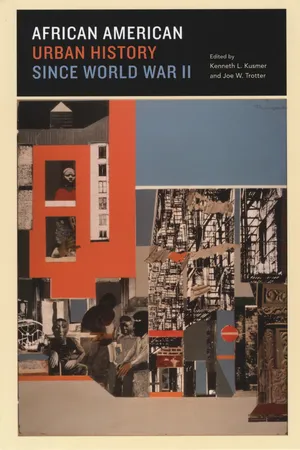
African American Urban History since World War II
eBook - PDF

African American Urban History since World War II

  1. English
  2. PDF
  3. Available on iOS & Android
eBook - PDF

African American Urban History since World War II

About this book

Historians have devoted surprisingly little attention to African American urban history ofthe postwar period, especially compared with earlier decades. Correcting this imbalance, African American Urban History since World War II features an exciting mix of seasoned scholars and fresh new voices whose combined efforts provide the first comprehensive assessment of this important subject.

The first of this volume's five groundbreaking sections focuses on black migration and Latino immigration, examining tensions and alliances that emerged between African Americans and other groups. Exploring the challenges of residential segregation and deindustrialization, later sections tackle such topics as the real estate industry's discriminatory practices, the movement of middle-class blacks to the suburbs, and the influence of black urban activists on national employment and social welfare policies. Another group of contributors examines these themes through the lens of gender, chronicling deindustrialization's disproportionate impact on women and women's leading roles in movements for social change. Concluding with a set of essays on black culture and consumption, this volume fully realizes its goal of linking local transformations with the national and global processes that affect urban class and race relations.

Frequently asked questions

Yes, you can cancel anytime from the Subscription tab in your account settings on the Perlego website. Your subscription will stay active until the end of your current billing period. Learn how to cancel your subscription.
No, books cannot be downloaded as external files, such as PDFs, for use outside of Perlego. However, you can download books within the Perlego app for offline reading on mobile or tablet. Learn more here.
Perlego offers two plans: Essential and Complete
  • Essential is ideal for learners and professionals who enjoy exploring a wide range of subjects. Access the Essential Library with 800,000+ trusted titles and best-sellers across business, personal growth, and the humanities. Includes unlimited reading time and Standard Read Aloud voice.
  • Complete: Perfect for advanced learners and researchers needing full, unrestricted access. Unlock 1.4M+ books across hundreds of subjects, including academic and specialized titles. The Complete Plan also includes advanced features like Premium Read Aloud and Research Assistant.
Both plans are available with monthly, semester, or annual billing cycles.
We are an online textbook subscription service, where you can get access to an entire online library for less than the price of a single book per month. With over 1 million books across 1000+ topics, we’ve got you covered! Learn more here.
Look out for the read-aloud symbol on your next book to see if you can listen to it. The read-aloud tool reads text aloud for you, highlighting the text as it is being read. You can pause it, speed it up and slow it down. Learn more here.
Yes! You can use the Perlego app on both iOS or Android devices to read anytime, anywhere — even offline. Perfect for commutes or when you’re on the go.
Please note we cannot support devices running on iOS 13 and Android 7 or earlier. Learn more about using the app.
Yes, you can access African American Urban History since World War II by Kenneth L. Kusmer, Joe W. Trotter, Kenneth L. Kusmer,Joe W. Trotter in PDF and/or ePUB format, as well as other popular books in Social Sciences & North American History. We have over one million books available in our catalogue for you to explore.

Table of contents

  1. Contents
  2. Contributors
  3. Acknowledgments
  4. Introduction
  5. Part One: The Second Great Migration and the New Immigration
  6. Part Two: The Second Ghetto and the Suburb
  7. Part Three: Class, Race, and Politics
  8. Part Four: Gender, Class, and Social-Welfare Policy
  9. Part Five: Culture, Consumption, and the Black Community
  10. Notes
  11. Index