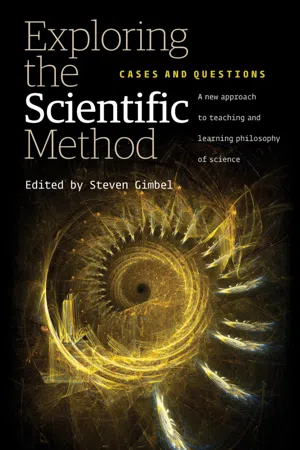
Exploring the Scientific Method
eBook - PDF

Exploring the Scientific Method

Cases and Questions

  1. English
  2. PDF
  3. Available on iOS & Android
eBook - PDF

Exploring the Scientific Method

Cases and Questions

About this book

From their grade school classrooms forward, students of science are encouraged to memorize and adhere to the "scientific method"—a model of inquiry consisting of five to seven neatly laid-out steps, often in the form of a flowchart. But walk into the office of a theoretical physicist or the laboratory of a biochemist and ask "Which step are you on?" and you will likely receive a blank stare. This is not how science works. But science does work, and here award-winning teacher and scholar Steven Gimbel provides students the tools to answer for themselves this question: What actually is the scientific method?

           
Exploring the Scientific Method pairs classic and contemporary readings in the philosophy of science with milestones in scientific discovery to illustrate the foundational issues underlying scientific methodology. Students are asked to select one of nine possible fields—astronomy, physics, chemistry, genetics, evolutionary biology, psychology, sociology, economics, or geology—and through carefully crafted case studies trace its historical progression, all while evaluating whether scientific practice in each case reflects the methodological claims of the philosophers. This approach allows students to see the philosophy of science in action and to determine for themselves what scientists do and how they ought to do it.

            
Exploring the Scientific Method will be a welcome resource to introductory science courses and all courses in the history and philosophy of science.        

Frequently asked questions

Yes, you can cancel anytime from the Subscription tab in your account settings on the Perlego website. Your subscription will stay active until the end of your current billing period. Learn how to cancel your subscription.
No, books cannot be downloaded as external files, such as PDFs, for use outside of Perlego. However, you can download books within the Perlego app for offline reading on mobile or tablet. Learn more here.
Perlego offers two plans: Essential and Complete
  • Essential is ideal for learners and professionals who enjoy exploring a wide range of subjects. Access the Essential Library with 800,000+ trusted titles and best-sellers across business, personal growth, and the humanities. Includes unlimited reading time and Standard Read Aloud voice.
  • Complete: Perfect for advanced learners and researchers needing full, unrestricted access. Unlock 1.4M+ books across hundreds of subjects, including academic and specialized titles. The Complete Plan also includes advanced features like Premium Read Aloud and Research Assistant.
Both plans are available with monthly, semester, or annual billing cycles.
We are an online textbook subscription service, where you can get access to an entire online library for less than the price of a single book per month. With over 1 million books across 1000+ topics, we’ve got you covered! Learn more here.
Look out for the read-aloud symbol on your next book to see if you can listen to it. The read-aloud tool reads text aloud for you, highlighting the text as it is being read. You can pause it, speed it up and slow it down. Learn more here.
Yes! You can use the Perlego app on both iOS or Android devices to read anytime, anywhere — even offline. Perfect for commutes or when you’re on the go.
Please note we cannot support devices running on iOS 13 and Android 7 or earlier. Learn more about using the app.
Yes, you can access Exploring the Scientific Method by Steven Gimbel in PDF and/or ePUB format, as well as other popular books in Biological Sciences & Epistemology in Philosophy. We have over one million books available in our catalogue for you to explore.
140 
syntactic 
view 
of 
theories
Notes
1. 
See 
Immanuel 
Kant, 
“e 
Transcendental 
Analytic,” 
in 
Critique 
of 
Pure 
Reason
21–43 
(Buf-
falo, 
NY: 
Prometheus, 
1990).
2. 
Hans 
Reichenbach, 
Experience 
and 
Prediction
(Chicago: 
University 
of 
Chicago 
Press, 
1938), 
esp. 
chapter 
5, 
“Probability 
and 
Induction” 
(297–406).
3. 
W. 
V. 
O. 
Quine, 
“Natural 
Kinds,” 
in 
Ontological 
Relativity 
and 
Other 
Essays
26–68 
(New 
York: 
Columbia 
University 
Press, 
1969).
4. 
Gilbert 
Harman, 
“Simplicity 
as 
Pragmatic 
Criterion 
for 
Deciding 
What 
Hypotheses 
to 
Take 
Seriously” 
in 
Grue!
ed. 
Douglas 
Stalker, 
153–72 
(Chicago: 
Open 
Court, 
1994). 
Stalker 
col-
lects 
fiſteen 
approaches 
to 
unraveling 
Goodman’s 
riddle 
and 
is 
must-read 
for 
anyone 
deeply 
bothered 
by 
the 
argument.
5. 
Peter 
Achinstein, 
e 
Nature 
of 
Explanation.
(Oxford: 
Oxford 
University 
Press, 
1983), 
esp. 
“e 
Paradox 
of 
the 
Ravens” 
(367–74).

Table of contents

  1. Contents
  2. Introduction
  3. How to Use This Book
  4. Syntactic View of Theories
  5. Holistic View of Theories
  6. Semantic View of Theories
  7. Critical Views of Scientific Theories
  8. Closing Remarks
  9. Deductivism Case Study Readings
  10. Inductivism Case Study Readings
  11. Bibliography
  12. Index