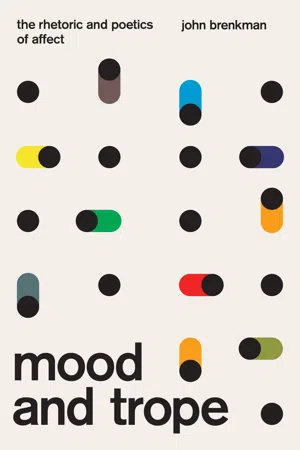
In Mood and Trope, John Brenkman introduces two provocative propositions to affect theory: that human emotion is intimately connected to persuasion and figurative language; and that literature, especially poetry, lends precision to studying affect because it resides there not in speaking about feelings, but in the way of speaking itself.
Engaging a quartet of modern philosophers—Kant, Nietzsche, Heidegger, and Deleuze—Brenkman explores how they all approach the question of affect primarily through literature and art. He draws on the differences and dialogues among them, arguing that the vocation of criticism is incapable of systematicity and instead must be attuned to the singularity and plurality of literary and artistic creations. In addition, he confronts these four philosophers and their essential concepts with a wide array of authors and artists, including Pinter and Poe, Baudelaire, Jorie Graham and Li-Young Lee, Shakespeare, Tino Sehgal, and Francis Bacon. Filled with surprising insights, Mood and Trope provides a rich archive for rethinking the nature of affect and its aesthetic and rhetorical stakes.
- English
- ePUB (mobile friendly)
- Available on iOS & Android
eBook - ePub
About this book
Information
Publisher
University of Chicago PressYear
2020Print ISBN
9780226673264
9780226673127
eBook ISBN
9780226673431
PART I
The Poetics of Affect
/1/ Before inaugurating modern aesthetic theory in the Critique of Judgment, Kant explored the aesthetic in the root sense of perceiving and sensing (aisthesis). The “transcendental aesthetic” postulates that in order for external objects to be perceived in space and time, the mind must sense space and time without the presence of any such external object—a sensing of itself. Space and time are the mind’s self-affection. This touchstone of modern philosophy shapes debates regarding affect, sensation, and space and time, as well as aesthetic theory. Merleau-Ponty contests the disembodied nature of Kant’s postulate by examining the ambiguities of touching/being touched/touching oneself. Daniel Heller-Roazen and Judith Butler, in intriguingly different interpretations of Merleau-Ponty, address the otherness in self-affection, Aristotelian friendship for the one and the traumatic core of selfhood for the other, reflecting the difference of ancient and modern structures of feeling. Self-arousing passions such as jealousy are turned outward in Aristotle but inward in modern settings. Harold Pinter’s Betrayal dramatizes jealousy’s involuted rage, an affecting of oneself rather than a violence inflicted on another. A juxtaposition of Poe and Freud brings to light the question of affect and self-affection in aesthetic theory itself. Does reception retrace the artwork’s creation, or are the motives and gratifications of creation radically divergent from the gratifications and affects in reception? Heidegger’s approach to mood, emotion, or state-of-mind as attunement questions the Kantian inside/outside in perception and feeling. Beyond that, it sits at the heart of such central concepts as the “ontological difference,” “present-at-hand” and “ready-to-hand,” “equipment” and “artwork,” and the temporality of Angst.
/2/ Lyric poetry plumbs the link between mood and trope, that is, feeling and language, affect and expression. There is a passion of the signifier, whether the figurative action of poetry or the animating motives of critical method. Paul de Man exemplifies the linguistic turn in literary studies, especially in readings of Rousseau and Baudelaire. Counterposed to some of his most powerful insights, which implacably lead to the binary logical impasse of interpretation he calls “aporia,” is the triadic mood–understanding–discourse. In poetic discourse, trope provokes interpretation, and interpretation discloses mood. The affective labyrinth of Baudelaire’s poetry and its duality of spleen and ideal occasion an attempt to give methodological consistency to the Heideggerian triad. Two problematics come to the fore. The question of subjectivity, interiority, selfhood, and identity is posed by poetry that knits or knots together mood–I–trope. And the question of pathos and form, the relation of the poet’s suffering and creativity, is acute with Baudelaire, whose verse forms have often been interpreted as the salutary imposition of order on the emotional and existential chaos of his life and character. Against such a therapeutic view, Maurice Blanchot and Erich Auerbach support a consideration of Baudelaire’s poetry as giving form to, rather than constraining or healing, the disorder of his soul. Another angle on mood and trope as well as pathos and form is found in the poetry of Li-Young Lee, for whom exile, family, and the past century’s “diary of fires” create layers of memory and dream, imagination and witness. Via Lee and Baudelaire the question of the lyric I comes into focus anew, reviving the dialectical approaches of Hegel and Nietzsche to the “self” in poetic creation.
/3/ Heidegger’s most extensive contribution to aesthetic theory is “The Origin of the Work of Art,” the essay that develops his seminal notions of earth and world; the distinction of mere things, equipment, and artworks; and truth as an effect of the difference between what an artwork represents and what it discloses. Gilles Deleuze’s most concrete reflection on art is his Francis Bacon: The Logic of Sensation. For Heidegger, the question of being is at the heart of philosophy and of art; for Deleuze, it is the question of life and sensation—ontology versus vitalism. Heidegger begins with something like the adolescent who awakens to the world inherited from others and questions what it is, that it is, how it can become one’s own. Deleuze begins with being alive: “Even when one is a rat. . . .” Two such incommensurate philosophical orientations unexpectedly converge when it comes to reflecting on the nature of the artwork. In Heidegger’s aesthetics, earth plays a role analogous to sensation in Deleuze’s. Out of their shared concern to foreground the materiality of art and not reduce it to matter (hylē, materia) to which the artist gives form (morphē, forma), Deleuze and Heidegger converge around three theses on art: its difference from what it represents, its paradoxical standing as “the self-positing of the created,” and its exceeding of any communicative relation between creator and recipient. From these emerges an enigma about aesthetic receptivity itself. In Deleuze’s terms, the affect of an artwork is independent of both creator and recipient, and the work is only experienced by viewers, listeners, or readers “if they have the strength for it.” But what is this independence? And what is this strength? Shakespeare’s Sonnet 120 provides a test, bringing the discussion of affect and art back to the rhetoric of poetry and bridging the divide that would separate sensation and affect from hermeneutics. Interpretation is the way to the work’s affect. Finally, Heidegger’s way of connecting language, art, and truth is interrogated via Deleuze’s bracketing of “truth” in favor of the idea that science, philosophy, and art are three distinct—indeed, coequal but incommensurate—modes of thinking. Art, he asserts, thinks in percepts and affects.
1
Affect, Self-Affection, Attunement
nam quotiens liquidis porreximus oscula lymphis,
hic totiens ad me resupino nititur ore.
posse putes tangi: minimum est, quod amantibus obstat.
For, often as I stretch my lips toward the lucent wave, so often with upturned face he strives to lift his lips to mine. You would think he could be touched—so small a thing separates our loving hearts.
OVID, Metamorphoses III, 451–53
Touch
Long before Kant inaugurated modern aesthetic theory in the Critique of Judgment, he explored the aesthetic in the root sense of perceiving and sensing (aisthesis). Under the heading of the Transcendental Aesthetic in the Critique of Pure Reason, he addresses the conditions of possibility of feeling and perception. When Descartes explains in The Passions of the Soul that an emotional state cannot be directly willed but can only be “aroused or suppressed . . . indirectly through the representation of things” that are associated with it, he tacitly introduces auto-affection into the discussion of affect. The notion of auto-affection makes its appearance in modern thought in various guises, usually in connection with attempts to grasp the fundamental conditions of sensory and perceptual experience. The locus classicus is the Transcendental Aesthetic.
Kant postulates that space and time are the “two pure forms of sensible intuition, serving as principles of a priori knowledge,” in the sense of “pure intuition and the mere forms of appearances” without which no empirical objects could appear to the mind and which are themselves prior to any such appearance and do not require the presence of any empirical object.1 “By means of outer sense, a property of our mind, we represent to ourselves objects as outside us, and all without exception in space. . . . We can never represent to ourselves the absence of space, though we can quite well think it as empty of objects. It must therefore be regarded as the condition of possibility of appearances, and not as a determination dependent upon them.”2 As the pure (and necessary) form of sensible intuition and of appearances, space is empty. Time is comparable, but with a twist. Like space, time is necessary for appearances to be sensed and is independent of them: “Neither coexistence nor succession would ever come within our perception, if the representation of time were not presupposed as underlying them a priori. . . . We cannot, in respect of appearances in general, remove time itself, though we can quite well think time as void of appearances. Time is, therefore, given a priori. In it alone is actuality of appearances possible at all.”3 Time is not simply comparable to space, however, since as “the form of inner sense, that is, of the intuition of ourselves and of our inner state,” time is “the formal a priori condition of all appearance whatsoever. Space, as the pure form of all outer intuition, is so far limited; it serves as the a priori condition only of outer appearances.” While “all outer appearances are in space,” “all appearances whatsoever, that is, all objects of the senses,” inner and outer, “are in time.”4
It is easy to see why this crux right at the outset of the First Critique became a point of reference and controversy for philosophers ever after. It led Kant himself to acknowledge that his claim that time is “an inner sense in respect of the form of that sense,” that is, that time is the pure form of our inner sense of ourselves, touches on a vexing question: “The whole difficulty is as to how a subject can inwardly intuit itself; and this is a difficulty common to every theory.”5 It is beyond the scope and capacity of my project to resolve the difficulty; I want simply to mark it so that it can be recognized in the various theoretical texts to be encountered. The shape of the difficulty for Kant lies in keeping up the distinction between pure contentless self-sensing by which the subject intuits itself (time as pure a priori intuition) over against any notion of self-consciousness as a foundational knowledge of self. Inner sense is self-affection, not self-knowledge: “It can be nothing but the mode in which the mind is affected through its own activity (namely, through its positing of its representation), and so is affected by itself.”6 Self-consciousness in the epistemological sense of the endeavor “to seek out (to apprehend) that which lies in the mind” cannot be foundational because it presupposes, and is limited by, the self-affection of inner sense as time: the mind “intuits itself not as it would represent itself if immediately self-active, but as it is affected by itself, and therefore as it appears to itself, not as it is.”7 As it appears to itself, not as it is: one difficulty may thus be resolved by distinguishing inner sense as self-affection from self-activity in the sense of the sovereign positing of knowledge, but another difficulty lingers: auto-affection implies some sort of joining of receptivity and activity.
The problem of human—or sentient—beings’ inward intuiting of themselves is a question, then, of the fold along whose crease suffering and doing, undergoing and acting, passivity and activity, feeling and making felt are joined and distinguished. If our thinking were to start not from the transcendental aesthetic but from a supposed immediacy of bodily experience, the exemplary auto-affection might be the sense of touch, since to touch is to make oneself be touched and to be touched is to feel oneself touching. And what if it is literally a question of touching oneself, from licking one’s lips to showering, from masturbation to interlocking the fingers of one’s hands or simply touching one hand with the other? This last is the example used by Maurice Merleau-Ponty in a reflection on touching and being touched that crops up at crucial points in the draft and fragments of his unfinished work The Visible and the Invisible.
According to his reflection, even as I touch my other hand while it is touching something else, the two (or three) events of sensation do not really coincide. The term coincidence is given a richly ambiguous temporal, logical, and symbolic significance:
We spoke summarily of a reversibility of the seeing and the visible, of the touching and the touched. It is time to emphasize that it is a reversibility always imminent and never realized in fact. My left hand is always on the verge of touching my right hand touching the things but I never reach coincidence; the coincidence eclipses at the moment of realization, and one of two things always occurs: either my right hand really passes over to the rank of touched, but then its hold on the world is interrupted; or it retains its hold on the world, but then I do not really touch it—my right hand touching, I palpate with my left hand only its outer covering.8
The sense of noncoincidence, nonunity, interrupted reversibility leads Merleau-Ponty to postulate that “this hiatus between my right hand touched and my right hand touching” implies that within tactility itself lies the untouchable.9 From the undeveloped “working notes”: “To touch and to touch oneself . . . do not coincide in the body: the touching is never exactly touched. This does not mean that they coincide ‘in the mind’ or at the level of ‘consciousness.’ Something else is needed for the junction to be made: it takes place in the untouchable.”10
Merleau-Ponty is here in the midst of working out his idea of flesh, through which he rethinks being-in-the-world in the light of thoroughly embodied Dasein. Heidegger establishes that the world is not something wholly outside me since I am in the world. For Merleau-Ponty, the sense of sight and the sense of touch bring to appearance the visible and the tangible; the world occurs as the visible and tangible, and I am in the world as sight and touch but also as visible and tangible to others and so to the world. There is, in his marvelous metaphor, an “intertwining” or “chiasm” of touching and the tangible and seeing and the visible. Again with reference to the hand as felt from within, as touching something and as touched by the other hand: “Through this crisscrossing within it of the touching and the tangible, [my hand’s] own movements incorporate themselves into the universe they interrogate, are recorded on the same map as it: the two systems are applied upon one another, as the two halves of an orange.”11 The crisscrossing or chiasm of embodied Dasein and the world i...
Table of contents
- Cover
- Title Page
- Copyright Page
- Contents
- Introduction
- Part I The Poetics of Affect
- Part II Feeling and the Vocation of Criticism
- Acknowledgments
- Notes
- Index
Trusted by 375,005 students
Access to over 1.5 million titles for a fair monthly price.
Study more efficiently using our study tools.
Frequently asked questions
Yes, you can cancel anytime from the Subscription tab in your account settings on the Perlego website. Your subscription will stay active until the end of your current billing period. Learn how to cancel your subscription
No, books cannot be downloaded as external files, such as PDFs, for use outside of Perlego. However, you can download books within the Perlego app for offline reading on mobile or tablet. Learn how to download books offline
Perlego offers two plans: Essential and Complete
- Essential is ideal for learners and professionals who enjoy exploring a wide range of subjects. Access the Essential Library with 800,000+ trusted titles and best-sellers across business, personal growth, and the humanities. Includes unlimited reading time and Standard Read Aloud voice.
- Complete: Perfect for advanced learners and researchers needing full, unrestricted access. Unlock 1.5M+ books across hundreds of subjects, including academic and specialized titles. The Complete Plan also includes advanced features like Premium Read Aloud and Research Assistant.
We are an online textbook subscription service, where you can get access to an entire online library for less than the price of a single book per month. With over 1.5 million books across 990+ topics, we’ve got you covered! Learn about our mission
Look out for the read-aloud symbol on your next book to see if you can listen to it. The read-aloud tool reads text aloud for you, highlighting the text as it is being read. You can pause it, speed it up and slow it down. Learn more about Read Aloud
Yes! You can use the Perlego app on both iOS and Android devices to read anytime, anywhere — even offline. Perfect for commutes or when you’re on the go.
Please note we cannot support devices running on iOS 13 and Android 7 or earlier. Learn more about using the app
Please note we cannot support devices running on iOS 13 and Android 7 or earlier. Learn more about using the app
Yes, you can access Mood and Trope by John Brenkman in PDF and/or ePUB format, as well as other popular books in Literature & European Literary Criticism. We have over 1.5 million books available in our catalogue for you to explore.