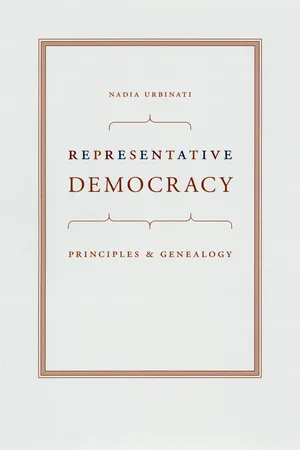
Representative Democracy
eBook - PDF

Representative Democracy

Principles and Genealogy

  1. English
  2. PDF
  3. Available on iOS & Android
eBook - PDF

Representative Democracy

Principles and Genealogy

About this book

It is usually held that representative government is not strictly democratic, since it does not allow the people themselves to directly make decisions. But here, taking as her guide Thomas Paine's subversive view that "Athens, by representation, would have surpassed her own democracy," Nadia Urbinati challenges this accepted wisdom, arguing that political representation deserves to be regarded as a fully legitimate mode of democratic decision making—and not just a pragmatic second choice when direct democracy is not possible.
As Urbinati shows, the idea that representation is incompatible with democracy stems from our modern concept of sovereignty, which identifies politics with a decision maker's direct physical presence and the immediate act of the will. She goes on to contend that a democratic theory of representation can and should go beyond these identifications. Political representation, she demonstrates, is ultimately grounded in a continuum of influence and power created by political judgment, as well as the way presence through ideas and speech links society with representative institutions. Deftly integrating the ideas of such thinkers as Rousseau, Kant, Emmanuel Joseph Sieyès, Paine, and the Marquis de Condorcet with her own, Urbinati constructs a thought-provoking alternative vision of democracy.

Frequently asked questions

Yes, you can cancel anytime from the Subscription tab in your account settings on the Perlego website. Your subscription will stay active until the end of your current billing period. Learn how to cancel your subscription.
At the moment all of our mobile-responsive ePub books are available to download via the app. Most of our PDFs are also available to download and we're working on making the final remaining ones downloadable now. Learn more here.
Perlego offers two plans: Essential and Complete
  • Essential is ideal for learners and professionals who enjoy exploring a wide range of subjects. Access the Essential Library with 800,000+ trusted titles and best-sellers across business, personal growth, and the humanities. Includes unlimited reading time and Standard Read Aloud voice.
  • Complete: Perfect for advanced learners and researchers needing full, unrestricted access. Unlock 1.4M+ books across hundreds of subjects, including academic and specialized titles. The Complete Plan also includes advanced features like Premium Read Aloud and Research Assistant.
Both plans are available with monthly, semester, or annual billing cycles.
We are an online textbook subscription service, where you can get access to an entire online library for less than the price of a single book per month. With over 1 million books across 1000+ topics, we’ve got you covered! Learn more here.
Look out for the read-aloud symbol on your next book to see if you can listen to it. The read-aloud tool reads text aloud for you, highlighting the text as it is being read. You can pause it, speed it up and slow it down. Learn more here.
Yes! You can use the Perlego app on both iOS or Android devices to read anytime, anywhere — even offline. Perfect for commutes or when you’re on the go.
Please note we cannot support devices running on iOS 13 and Android 7 or earlier. Learn more about using the app.
Yes, you can access Representative Democracy by Nadia Urbinati in PDF and/or ePUB format, as well as other popular books in Politics & International Relations & Political Philosophy. We have over one million books available in our catalogue for you to explore.

Table of contents

  1. Contents
  2. Acknowledgments
  3. Introduction
  4. Representation and Democracy
  5. Rousseau’s Unrepresentable Sovereign
  6. Will and Judgment: The Kantian Revision
  7. A Nation of Electors: Sieye’s Model of Representative Government
  8. Thomas Paine and the Perfecting of Simple Democracy
  9. A Republic of Citizens: Condorcet’s Indirect Democracy
  10. Conclusion: A Surplus of Politics
  11. Notes
  12. Bibliography
  13. Index