"Although it will be of primary interest to those who are engaged in composition themselves, [this] book is also recommended for readers who may wish to gain further insight into just what makes jazz composition so different from traditional approaches."—Malcolm Bessom, The Music Magazine
- English
- ePUB (mobile friendly)
- Available on iOS & Android
eBook - ePub
Composing for the Jazz Orchestra
About this book
Information
Subtopic
Jazz Music1
ALPHABETICAL CHORD SYMBOLS
The phrase “alphabetical chord symbols” refers to a musical shorthand which is used to represent chords. It is similar to the system of Roman numeral notation used in traditional harmony except for the use of capital letters (A, B, C) rather than Roman numerals (I, II, III).
A. The alphabetical letter indicates the root tone upon which the chord is built. A letter without any number indicates a triad, which is a chord extended up to the third and fifth. Unless otherwise indicated, the third is major and the fifth is perfect.

1. A minor third is indicated by the abbreviation “min.”

2. “+5” or (better) “♯5” at the end of the symbol indicates an augmented fifth. It is best to inclose this indication in parentheses.

3. “−5” or (better) “♭5” at the very end of the symbol indicates a diminished fifth—also best inclosed in parentheses.

4. A small circle or “dim.” after the letter indicates a minor third and a diminished fifth.

B. The Arabic numeral “6” indicates that the major sixth is to be added to the triad. The Arabic numerals “69” indicate that both the sixth and the major ninth are to be added.

C. The Arabic numeral “7” indicates that the minor seventh is to be added to the triad.

1. A major seventh is indicated by “maj.” or “Maj.” placed after the alphabetical letter.

2. When “7” is preceded by a small circle or by “dim.,” it represents a diminished seventh, which is enharmonically a major sixth. B07 or B dim.7 stands for B D F A♭.

D. The Arabic numeral “9” indicates that the seventh (minor, unless major seventh is indicated) and the major ninth are to be added to the triad.

1. A lowered ninth is indicated like this: C7 (−9) or (better) C7 (♭9).

2. A raised ninth is indicated like this: C7 (+9) or (better) C7(♯9).

E. The Arabic numeral “11” indicates that the seventh (minor seventh unless major seventh is indicated), major ninth, and perfect eleventh are to be added to the triad.

A raised eleventh is indicated by a “+” preceding the “11” or as in the second example below.

F. The Arabic numeral “13” indicates that the seventh, ninth, eleventh, and major thirteenth are to be added to the triad.

NOTE WELL: The symbols for minor affect only the third; the symbols for major affect only the seventh.
The process of naming the tones indicated by the alphabetical chord symbols is called “spelling the chord.” When spelling the chord, the notes should be written on the staff. Since the alphabetical chord symbol doesn’t indicate a particular octave, the chord should be spelled in the octave which will involve the least number of ledger lines above or below the staff.
The chord symbols below form a simple variation of the harmonic structure of the “blues”:
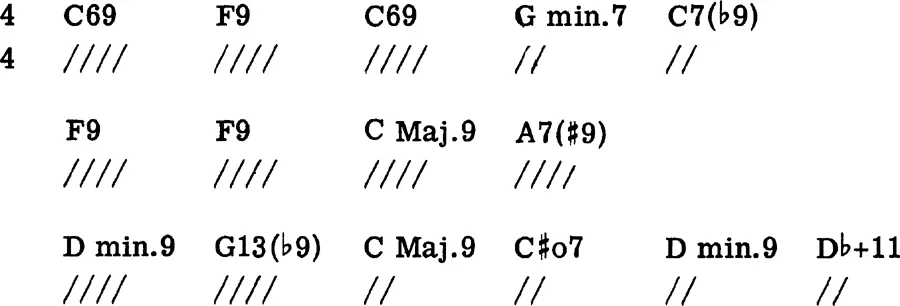
The vergules (/) under each chord indicate the number of beats the ch...
Table of contents
- Cover
- Copyright
- Title Page
- Dedication
- Preface
- Contents
- 1. Alphabetical Chord Symbols
- 2. The Six Types of Chords
- 3. Elaboration of the Six Types of Chords
- 4. Basic Harmonic Considerations
- 5. The Ranges of the Instruments
- 6. Voicing
- 7. Close Position Voicing (I)
- 8. Close Position Voicing (II)
- 9. Close Position Voicing (III)
- 10. Open Position Voicing (I)
- 11. Open Position Voicing (II)
- 12. Open Position Voicing (III)
- 13. Non-Chordal Tones
- 14. Harmonization of Non-Chordal Tones (I)
- 15. Harmonization of Non-Chordal Tones (II)
- 16. The Thickened Line
- 17. The Widened Line
- 18. Percussion
- 19. The Double Bass
- 20. The Guitar
- 21. The Piano
- 22. A Preliminary view of the Ensemble
- 23. The Basic Ensemble Method
- 24. The Four-Tone Ensemble Method
- 25. The Percussive Ensemble Method
- 26. Brass Mutes
- 27. The Background
- 28. The Planning of Orchestration
- 29. Combinations of Instruments
- 30. Identities
- 31. Chords Derived from Scales
- 32. The Progression of Chords derived from Scales
- 33. Mixed Voicing
- 34. Mixed Ensembles
- Notes
Trusted by 375,005 students
Access to over 1.5 million titles for a fair monthly price.
Study more efficiently using our study tools.
Frequently asked questions
Yes, you can cancel anytime from the Subscription tab in your account settings on the Perlego website. Your subscription will stay active until the end of your current billing period. Learn how to cancel your subscription
No, books cannot be downloaded as external files, such as PDFs, for use outside of Perlego. However, you can download books within the Perlego app for offline reading on mobile or tablet. Learn how to download books offline
Perlego offers two plans: Essential and Complete
- Essential is ideal for learners and professionals who enjoy exploring a wide range of subjects. Access the Essential Library with 800,000+ trusted titles and best-sellers across business, personal growth, and the humanities. Includes unlimited reading time and Standard Read Aloud voice.
- Complete: Perfect for advanced learners and researchers needing full, unrestricted access. Unlock 1.5M+ books across hundreds of subjects, including academic and specialized titles. The Complete Plan also includes advanced features like Premium Read Aloud and Research Assistant.
We are an online textbook subscription service, where you can get access to an entire online library for less than the price of a single book per month. With over 1.5 million books across 990+ topics, we’ve got you covered! Learn about our mission
Look out for the read-aloud symbol on your next book to see if you can listen to it. The read-aloud tool reads text aloud for you, highlighting the text as it is being read. You can pause it, speed it up and slow it down. Learn more about Read Aloud
Yes! You can use the Perlego app on both iOS and Android devices to read anytime, anywhere — even offline. Perfect for commutes or when you’re on the go.
Please note we cannot support devices running on iOS 13 and Android 7 or earlier. Learn more about using the app
Please note we cannot support devices running on iOS 13 and Android 7 or earlier. Learn more about using the app
Yes, you can access Composing for the Jazz Orchestra by William Russo in PDF and/or ePUB format, as well as other popular books in Media & Performing Arts & Jazz Music. We have over 1.5 million books available in our catalogue for you to explore.