- English
- ePUB (mobile friendly)
- Available on iOS & Android
eBook - ePub
About this book
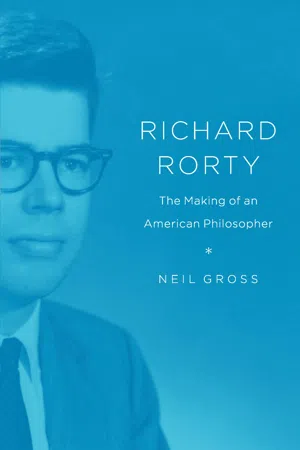
On his death in 2007, Richard Rorty was heralded by the New York Times as "one of the world's most influential contemporary thinkers." Controversial on the left and the right for his critiques of objectivity and political radicalism, Rorty experienced a renown denied to all but a handful of living philosophers. In this masterly biography, Neil Gross explores the path of Rorty's thought over the decades in order to trace the intellectual and professional journey that led him to that prominence.
The child of a pair of leftist writers who worried that their precocious son "wasn't rebellious enough," Rorty enrolled at the University of Chicago at the age of fifteen. There he came under the tutelage of polymath Richard McKeon, whose catholic approach to philosophical systems would profoundly influence Rorty's own thought. Doctoral work at Yale led to Rorty's landing a job at Princeton, where his colleagues were primarily analytic philosophers. With a series of publications in the 1960s, Rorty quickly established himself as a strong thinker in that tradition—but by the late 1970s Rorty had eschewed the idea of objective truth altogether, urging philosophers to take a "relaxed attitude" toward the question of logical rigor. Drawing on the pragmatism of John Dewey, he argued that philosophers should instead open themselves up to multiple methods of thought and sources of knowledge—an approach that would culminate in the publication of Philosophy and the Mirror of Nature, one of the most seminal and controversial philosophical works of our time.
In clear and compelling fashion, Gross sets that surprising shift in Rorty's thought in the context of his life and social experiences, revealing the many disparate influences that contribute to the making of knowledge. As much a book about the growth of ideas as it is a biography of a philosopher, Richard Rorty will provide readers with a fresh understanding of both the man and the course of twentieth-century thought.
The child of a pair of leftist writers who worried that their precocious son "wasn't rebellious enough," Rorty enrolled at the University of Chicago at the age of fifteen. There he came under the tutelage of polymath Richard McKeon, whose catholic approach to philosophical systems would profoundly influence Rorty's own thought. Doctoral work at Yale led to Rorty's landing a job at Princeton, where his colleagues were primarily analytic philosophers. With a series of publications in the 1960s, Rorty quickly established himself as a strong thinker in that tradition—but by the late 1970s Rorty had eschewed the idea of objective truth altogether, urging philosophers to take a "relaxed attitude" toward the question of logical rigor. Drawing on the pragmatism of John Dewey, he argued that philosophers should instead open themselves up to multiple methods of thought and sources of knowledge—an approach that would culminate in the publication of Philosophy and the Mirror of Nature, one of the most seminal and controversial philosophical works of our time.
In clear and compelling fashion, Gross sets that surprising shift in Rorty's thought in the context of his life and social experiences, revealing the many disparate influences that contribute to the making of knowledge. As much a book about the growth of ideas as it is a biography of a philosopher, Richard Rorty will provide readers with a fresh understanding of both the man and the course of twentieth-century thought.
Frequently asked questions
Yes, you can cancel anytime from the Subscription tab in your account settings on the Perlego website. Your subscription will stay active until the end of your current billing period. Learn how to cancel your subscription.
No, books cannot be downloaded as external files, such as PDFs, for use outside of Perlego. However, you can download books within the Perlego app for offline reading on mobile or tablet. Learn more here.
Perlego offers two plans: Essential and Complete
- Essential is ideal for learners and professionals who enjoy exploring a wide range of subjects. Access the Essential Library with 800,000+ trusted titles and best-sellers across business, personal growth, and the humanities. Includes unlimited reading time and Standard Read Aloud voice.
- Complete: Perfect for advanced learners and researchers needing full, unrestricted access. Unlock 1.4M+ books across hundreds of subjects, including academic and specialized titles. The Complete Plan also includes advanced features like Premium Read Aloud and Research Assistant.
We are an online textbook subscription service, where you can get access to an entire online library for less than the price of a single book per month. With over 1 million books across 1000+ topics, we’ve got you covered! Learn more here.
Look out for the read-aloud symbol on your next book to see if you can listen to it. The read-aloud tool reads text aloud for you, highlighting the text as it is being read. You can pause it, speed it up and slow it down. Learn more here.
Yes! You can use the Perlego app on both iOS or Android devices to read anytime, anywhere — even offline. Perfect for commutes or when you’re on the go.
Please note we cannot support devices running on iOS 13 and Android 7 or earlier. Learn more about using the app.
Yes, you can access Richard Rorty by Neil Gross in PDF and/or ePUB format, as well as other popular books in Philosophy & Philosopher Biographies. We have over one million books available in our catalogue for you to explore.
Information
Index
Abbott, Andrew, 343
absolutes, philosophical, 95
“academic depression,” 297
academic field, 241–43. See also under Bourdieu
academic freedom, 291–92, 327
academic habitus, 243, 245–46
academic life, politics of, 320–21
academic professionalization, 289–95, 298–99
Academic Revolution, The (Jencks and Riesman), 310
Achieving Our Country (Rorty), 23, 322, 323
action-theoretical processes, 263. See also Structure of Social Action
Actor-Network theory, 11n28
Actuality, 134–35
Adams, Henry, 112
Addams, Jane, 75
Adler, Mortimer, 86, 95, 106, 109, 111, 122
Alexander, Jeffrey, 256, 258–63
Althusser, Louis, 247
American Committee for Cultural Freedom (ACCF), 54–56, 58–60
American Council of Learned Societies, 203
American Philosophical Association (APA) Eastern Division, 18, 220;
1979 convention, 223–25;
Executive Committee, 221, 224;
Nominating Committee and 1979 election, 220–25;
pluralist revolt, 217–27;
presidents, 217;
Program Committee, 222;
Rorty as president of, 216–17, 224–26
American Revolution Bicentennial Administration (ARBA), 328–29
American Workers Party, 54
analytic and nonanalytic approaches,
Rorty as translator between, 149
analytic and nonanalytic philosophers:
conflict between, 196;
dialogue between, 17, 150, 152;
Rorty on, 180–81. See also pluralist revolt
“analytic establishment,” 221–23
analytic philosopher(s), 186;
Rorty as, 4, 17–19, 160, 191, 308, 313
analytic philosophy, 3, 4;
Catholic philosophers and, ...
Table of contents
- Cover
- Title Page
- Copyright
- Contents
- Preface for My Fellow Sociologists
- Acknowledgements
- Archival Sources
- Introduction
- One. James Rorty
- Two. Winifred Raushenbush
- Three. The Hutchins College
- Four. M.A. in Philosophy, 1949-1952
- Five. Ph.D. at Yale, 1952-1956
- Six. Wellesley College, 1958-1961
- Seven. Princeton University, 1961-1965
- Eight. Princeton University, 1965-1982
- Nine. The Theory of Intellectual Self- Concept
- Ten. Rorty Reexamined
- Conclusion
- Index