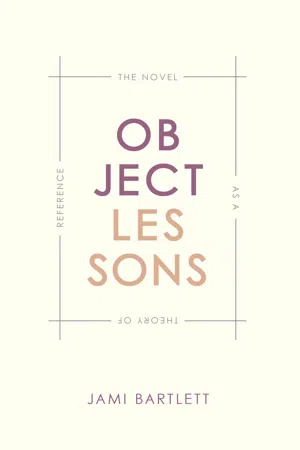
Object Lessons explores a fundamental question about literary realism: How can language evoke that which is not language and render objects as real entities? Drawing on theories of reference in the philosophy of language, Jami Bartlett examines novels by George Meredith, William Makepeace Thackeray, Elizabeth Gaskell, and Iris Murdoch that provide allegories of language use in their descriptions, characters, and plots. Bartlett shows how these authors depict the philosophical complexities of reference by writing through and about referring terms, the names and descriptions that allow us to "see" objects. At the same time, she explores what it is for words to have meaning and delves into the conditions under which a reference can be understood. Ultimately, Object Lessons reveals not only how novels make references, but also how they are about referring.
- English
- ePUB (mobile friendly)
- Available on iOS & Android
eBook - ePub
About this book
Information
1
Meredith & Ends
A description is composed of sentences whose order one can generally reverse: I can describe this room by a series of clauses whose order is not important. A gaze roams as it wishes. Nothing more natural, nothing more true, than this vagrancy; for . . . truth is chance.
But, if this latitude, and the habit of facility which goes with it, become the dominating factor, it gradually dissuades writers from employing their ability for abstraction, just as it reduces to nothing the slightest necessity for concentration on the reader’s part, in order to win him over with immediate effects, rhetorical shock tactics . . .
This mode of creating, legitimate in principle, and to which we owe so many beautiful things, leads, like the abuse of landscape, to the diminution of the intellectual part of art.
« PAUL VALÉRY, “Degas, Danse, Dessin” »
George Meredith is a canonical writer generally agreed to be bad at writing, and this chapter is less about why this is the case or how one could go about recovering him, than it is about what we find in Meredith when we are no longer looking. I will complicate the assumption, adapted from Valéry above, that novelists share a fraught relationship to the work that description does; that the task of the novelist is to motivate character, plot, and “intellect” in spite of it; and that the result separates good novels from bad. There is a grandeur in the simplicity of my approach that smacks of Meredith—he opens his 1879 novel The Egoist by pitting The Comic Spirit against The Book of Earth—but I intend to make use of a kind of modest close reading that is in many ways counterintuitive to the way we read novels in general and Meredith in particular. Rather than seizing on his attempts at motivated description in order to accumulate conflicting or corroborating interpretations of why he’s saying what he says the way he says it, I want to isolate and reduce the semantic content of those descriptions to the point where they mean very little. This will allow me to resituate the trade-off that Valéry describes between the detail and the abstraction, so that, rather than engaging arguments about the reflexive complexity of the novel genre and its contemporary social or “intellectual” commitments, I can create a harmonics between Meredith’s granular descriptions and the philosophy of language. This discourse, concerned with how words mean but not what or why, will offer us a different approach to the mechanics of description, and a new vocabulary for its role in novel theory.
The first page of the Critical Heritage anthology devoted to Meredith’s reception levels its attack at his “difficult” style, “liable to charges of affectation, obscurity, structural weakness, and a lack of proportion.” Even worse, his bad descriptions are contagious: it is, it seems, impossible for critics to distinguish between them, for they often use the same examples to evidence “his successful experiments and his lapses from good taste.” There has never been agreement “about his permanent place in letters,” and arguments to this effect abound in “bitterness and exaggeration.” Even in his own lifetime, when one is often valued just for hanging on, Meredith “failed to make an impact on the public at large or to obtain from the critical Press the degree of respect and understanding to which he was entitled.”1 This is grim stuff, but it is charged with the inducement of a dare; Meredith’s awfulness is just an obstacle to be overcome, and our resistance to his intricacy is born of both an unimaginative relationship to the pleasures of description, and an unrigorous examination of the reasons why we read what we do.
Meredith’s “lapses in good taste,” figured as “affectation” and “obscurity” in the Critical Heritage, galvanize the distinction Valéry makes between the chanciness of particularity and the stability of abstraction, and recast his separation of description from the “intellectual part of art” as a process, a syllogism that folds Meredith’s abstractions into his accretion of details.2 Critics have tried to account for this rhetorical process by turning to the compression of his aphorisms. In “The Decay of Lying” Oscar Wilde writes that Meredith “is always breaking his shins over his own wit” and that “By its means he has planted round his garden a hedge full of thorns, and red with wonderful roses.”3 Something in those roses stands in for both Meredith’s aestheticism and its origins; his martyrdom makes itself reiteratively available as an act and its product, so that in ignoring his critics and hurting himself, he produces a thing of beauty that none but the most discriminating reader can see, and then can only reference as an exquisite act. Wilde shows us how much easier it is to explain this effect than its cause. His evaluation is less about describing what isn’t there than in referencing something that isn’t describable; he effectively reenacts the postponements, refractions, and otherwise subtended complications of Meredith’s project even while holding them dear. In taking what Meredith does for what Meredith is, Wilde conveys Meredith’s badness through a conceptual displacement that substitutes the method for the work itself. Meredith falls from the useful, the beautiful, and the good—his taste is only lapsed —and the less that remains is an invitation to explicate him.4
What Wilde is reaching for is a sliding between two incommensurable terms: Meredith’s particulars and his universals, his difficultly and his ease, his style and his subject. He is reaching, in other words, for an accommodation for the reader, a relation that would both name the space between and hold still the way back and forth between one term and another. Throughout this chapter, I will be assuming two commonsense behaviors that accommodation entails: first, that in any conversation between Meredith and his readers, the readers assume certain information in order for that conversation to make sense, in order to accommodate themselves to Meredith’s way of thinking; and second, that readers who cannot reasonably accommodate themselves to Meredith’s way of thinking begin to shift their assumptions, destabilizing their position in relation to Meredith and the assumptions that lie behind that position. In other words, accommodation understands Meredith’s descriptions to be inseparable from their eventual interpretation; it marks the capacity to conceptualize one thing in and through another, but what results from that conceptualization is always going to be an unfounded guess.5
This chapter is an attempt to put some pressure on this series of displacements, arguing throughout that what we have seen in the criticism of Meredith’s work is an unfinished and misleading version of the work he is doing in his fiction. Rather than looking at the static images that he describes as isolatable and inherently meaningless—his accretive metaphors, aphorisms, and characterizations—I will draw on their use in Meredith’s descriptions of postponed or incomplete action. I will stick with The Egoist, the novel that the summary judgment of the Critical Heritage considers his most characteristic (and characteristically irritating), and I will argue that what we think of as the displacements in Meredith’s descriptions are actually crucial sources of motivation in themselves, for both his novel’s structure and plot, and his intellectual project as a whole. This approach explicitly counters those critical gestures that attach descriptions to their own interpretative unpacking, because I think Meredith’s descriptions contain and embody their own interpretations, just as any other performed action could be said to contain the intentions that caused it to happen. I have chosen to analyze descriptions of intentional action because they encourage a reader’s interpretation; I choose descriptions of intentional action in Meredith’s work because his aphoristic tendencies point to a mind interested in the way meaning is conveyed; and I choose such descriptions because novels are about action, and embedding meaning in actions is always going to be tricky for an aphorist.
One of the more consistent assumptions of critics who deal with the intentional structure of a text is that the designers of a text are by definition the actors whose conception of a thing determines how it is, and how it is is an expressive capacity that cannot be understood apart from a participation in its sociolinguistic practices. To say this several different ways: an author’s intention is present-tense representation; it is a potentially knowledge-bearing state that generates the facts that make it true; it is productive of what is already known, and it realizes the author’s knowledge of it. In this vein, Steven Knapp and Walter Benn Michaels have argued that there can be no intentionless meanings,6 and Wimsatt and Beardsley claim that “[j]udging a poem is like judging a pudding or a machine” in that only if it “works” at all do we infer the intention of its artificer.7 Even Paul de Man and Michel Foucault, while explicitly refuting this evaluative characterization of literature as an intentional action, cannot help but slide into an hermeneutical dead-end when discussing it: de Man argues that “interpretation of an intentional act or an intentional object always implies an understanding of the intent,”8 and Foucault argues that despite the irrelevance of the interiority of intentions, thoughts, or subjects, their (seemingly inevitable) dispersion as an exteriority is rooted “in the search for totalities, the descriptions of relations of exteriority for the theme of the transcendental foundation, [and] the analysis of accumulations for the quest of the origin.”9 This trajectory, from the New Critical insistence on the explication of the autonomous text to a deconstructive insistence on the system of relations that circumscribe both reader and text into a kind of mutual deterritorialization, displaces the irreducible particularity of intentional descriptions, actions, and descriptions-of-actions. In applying coherence to potentially isolatable and inherently meaningless things, it reenacts the slide from the object to its interpretation in the same way that Meredith’s critics have, embedding the thing done into its doing.
This chapter takes the opposite position: that objects like described intentional actions—especially when atomized in and as aphoristic images—entail their interpretations as processes internal to themselves. In being isolatable, they are not meaningless; their reference to a specific act is not constitutive of their meaning. Rather, their compression creates a friction whose meaning self-presents. When we follow this track to its conclusion, our definition of intention changes. We begin to think of descriptions as essences that express a process of understanding intention as an analysis of the links between the details that make an action intentional. Ludwig Wittgenstein makes this point:
“I was going to say. . . .”—You remember various details. But not even all of them together shew your intention. It is as if a snapshot of a scene had been taken, but only a few scattered details of it were to be seen: here a hand, there a bit of face, or a hat—the rest is dark. And now it is as if we knew quite certainly what the whole picture represented. As if I could read the darkness.
These “details” are not irrelevant in the sense in which other circumstances which I can remember equally well are irrelevant. But if I tell someone “For a moment I was going to say, . . .” he does not learn those details from this, nor need he guess them. He need not know, for instance, that I had already opened my mouth to speak. But he can “fill out the picture” in this way. (And this capacity is part of understanding what I tell him.)10
The easiest way of thinking about the kinds of connections Wittgenstein considers crucial to “filling in” the picture of an intentional action is to look at the scene itself and not at the story behind it. We should be prepared to read the darkness, to allow ourselves not to account for everything or to situate it inside a wider, more empirical understanding of the way we rationalize and narrativize action; rather, we should intuitively sense the noncalculative reasons behind intentional action. Philosopher Candace Vogler gives us the simple act of crossing a street: “You shift weight to one foot and step off the curb and step onto the street and enter the café at the other side. This is true and, we may suppose, what you intend. What we cannot say is that you A, B, and C in order to cross the road, or that you cross the road in order to get to the other side, or that you intend anything that might be expressed in this idiom.”11 Like the assumption that Wittgenstein had “opened his mouth to speak” without having to say it, the movement from one foot to the other is filled in with a practical consideration, not a consideration of desirability. “And the best that I can propose” Wittgenstein writes, “is that we should yield to the temptation to use this picture, but then investigate how the application of the picture goes.”12 Practical considerations make the person acting king of whatever logical end the action fills in, but it is the process of determining that logical end from the scant components of a composite picture in the darkness that pressurizes and expresses the description it evokes. So, some descriptions of walking across the street will be true, but not others, and the ones that can be excluded are excluded because they involve predictions about ends other than the ones inside the edges of the snapshot.
We can see from Wittgenstein’s interpretation that isolating descriptions of intentional action can generate a different kind of meaning from that which we get when we overload objects with a presumptive analysis of the epistemologies that will disclose their intention. In the aphoristic terms that are shot through both Meredith’s and Wittgenstein’s prose, describing is witnessing. “Don’t think but look!”13 The snapshot discloses forms of propositions that are independent of what can be experienced empirically, psychologically, and speculatively. Thus, the question we ought to ask of the literary criticism of descriptions is, “Does it contain any ontological, metaphysical, religious, or epistemological presupposition?” If it does, it cannot properly account for the structural aspects of our understanding.14 The pressure inside a description is caused by the heaping up of isolated details that are frustrated by their present-ness, their inability to gesture or develop outward; they can only evoke resemblances, echoes, and relations. The question for analytic philosophy, then, is not “What is the snapshot a snapshot of?” but “How do we use statements to express our sudden understanding of the snapshot?”—the statements that produce Wittgenstein’s admittedly optimistic effect: “And now it is as if we knew quite certainly what the whole picture represented.” We are not scrutinizing an inner psychological experience that guides our understanding, but the actual use we make of it; by reference to its obtaining circumstances, the structure of language reveals the structure of “what is.”
I have arranged the remainder of this chapter into three parts: first, I concentrate on Meredith’s descriptions at the level of the sentence, reading a moment in The Egoist that analytic philosophy can illuminate as crucial for an understanding of the relation between characterization and description in Meredith’s work. Second, I explain the ways in which the density of these descriptions creates characters through their intentional actions in the novel. Finally, I demonstrate, using significant moments of descriptive activity in The Egoist, how an analytic philosophy of action could reveal new sources of motivation in the broader organization of this novel and in others. Scenes that are considered unproductive in terms of the movement of the novel’s plot and character development, moments that show us Meredith at what has seemed like his least disciplined, are reintegrated into a broader understanding of his project and its repudiation of the kinds of displacements and gestures outward—displacements that I have termed accommodations—that we have found in his critical heritage and the criticism of literary description in general. I hope to show that the “failure” that critics apologize for entails a far more productive understanding of narration and its engines; rather than saying so very much, we will find Meredith saying as precious little as possible about problems that have yet to receive the description they deserve.
As Meredith’s The Egoist begins, Sir Willoughby Patterne is described as enjoying the proposition of proposing to Clara Middleton; he enjoys the fact that “she had money and health and beauty, the triune of perfect starriness, which makes all men astronomers.”15 Clara, however, enjoys the fact that Willoughby flaunts his “amiable superlatives” in front of her: “He was the heir of successful competitors. He had a style, a tone, an artist tailor, an authority of manner: he had in the hopeful ardour of the chase among a multitude a freshness that gave him advantage; and together with his undeviating energy when there was a prize to be won and possessed, these were scarcely resistible. He spared no pains, for he was adust and athirst for t...
Table of contents
- Cover
- Title Page
- Copyright Page
- Dedication
- Contents
- Acknowledgments
- Introduction
- 1 Meredith & Ends
- 2 Throwing Things in Thackeray
- 3 Gaskell’s Lost Objects
- 4 Murdoch and the Monolith
- Notes
- Bibliography
- Index
Trusted by 375,005 students
Access to over 1.5 million titles for a fair monthly price.
Study more efficiently using our study tools.
Frequently asked questions
Yes, you can cancel anytime from the Subscription tab in your account settings on the Perlego website. Your subscription will stay active until the end of your current billing period. Learn how to cancel your subscription
No, books cannot be downloaded as external files, such as PDFs, for use outside of Perlego. However, you can download books within the Perlego app for offline reading on mobile or tablet. Learn how to download books offline
Perlego offers two plans: Essential and Complete
- Essential is ideal for learners and professionals who enjoy exploring a wide range of subjects. Access the Essential Library with 800,000+ trusted titles and best-sellers across business, personal growth, and the humanities. Includes unlimited reading time and Standard Read Aloud voice.
- Complete: Perfect for advanced learners and researchers needing full, unrestricted access. Unlock 1.5M+ books across hundreds of subjects, including academic and specialized titles. The Complete Plan also includes advanced features like Premium Read Aloud and Research Assistant.
We are an online textbook subscription service, where you can get access to an entire online library for less than the price of a single book per month. With over 1.5 million books across 990+ topics, we’ve got you covered! Learn about our mission
Look out for the read-aloud symbol on your next book to see if you can listen to it. The read-aloud tool reads text aloud for you, highlighting the text as it is being read. You can pause it, speed it up and slow it down. Learn more about Read Aloud
Yes! You can use the Perlego app on both iOS and Android devices to read anytime, anywhere — even offline. Perfect for commutes or when you’re on the go.
Please note we cannot support devices running on iOS 13 and Android 7 or earlier. Learn more about using the app
Please note we cannot support devices running on iOS 13 and Android 7 or earlier. Learn more about using the app
Yes, you can access Object Lessons by Jami Bartlett in PDF and/or ePUB format, as well as other popular books in Literature & English Literary Criticism. We have over 1.5 million books available in our catalogue for you to explore.