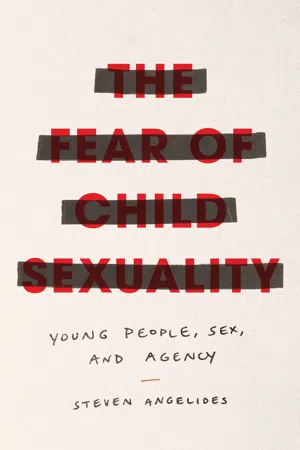
Continued public outcries over such issues as young models in sexually suggestive ads and intimate relationships between teachers and students speak to one of the most controversial fears of our time: the entanglement of children and sexuality. In this book, Steven Angelides confronts that fear, exploring how emotional vocabularies of anxiety, shame, and even contempt not only dominate discussions of youth sexuality but also allow adults to avoid acknowledging the sexual agency of young people. Introducing case studies and trends from Australia, the United Kingdom, and North America, he challenges assumptions on a variety of topics, including sex education, age-of-consent laws, and sexting. Angelides contends that an unwillingness to recognize children's sexual agency results not in the protection of young people but in their marginalization.
- English
- ePUB (mobile friendly)
- Available on iOS & Android
eBook - ePub
About this book
Information
Publisher
University of Chicago PressYear
2019Print ISBN
9780226648637
9780226648460
eBook ISBN
9780226648774
Notes
Preface
1. Land of Giants, “Cannibal Dolls,” in Cannibal Dolls/Seven Men, MP3, CD Baby, 2008 (originally released on vinyl by AV Records, Canada, 1982).
2. Kathryn Bond Stockton, The Queer Child, or Growing Sideways in the Twentieth Century (Durham, NC: Duke University Press, 2009), 126.
3. Rebecca Sullivan, “Miu Miu Ad Banned in UK for ‘Inappropriately Sexualising Young Women,’” news.com.au, May 8, 2015, http://www.news.com.au/lifestyle/fashion/miu-miu-ad-banned-in-uk-for-inappropriately-sexualising-young-women/story-fnjev30n-1227346978810.
4. Quoted in Sullivan, “Miu Miu Ad Banned.”
5. Quoted in Sullivan, “Miu Miu Ad Banned.”
6. On the United States, see American Psychological Association, Report of the APA Task Force on the Sexualization of Girls (Washington, DC: American Psychological Association, 2007). On Canada, see Canadian Women’s Foundation, Fact Sheet: Moving Girls into Confidence, updated January 2014, http://canadianwomen.org/sites/canadianwomen.org/files//FactSheet-Girls-ACTIVE_2.pdf; and Susan Delacourt, “It’s the Girl’s Fault?,” Toronto Star, July 16, 2009, http://www.thestar.com/news/politics_blog/2009/07/its-the-girls-fault-.html. On the United Kingdom, see David Buckingham, Rebekah Willett, Sara Bragg, and Rachel Russell, Sexualised Goods Aimed at Children: A Report to the Scottish Parliament Equal Opportunities Committee (Edinburgh: Scottish Parliament Equal Opportunities Committee, 2010); Linda Papadopoulos, Sexualisation of Young People Review (London: Home Office, 2010); and Reg Bailey, Letting Children Be Children: Report of an Independent Review of the Commercialisation and Sexualisation of Childhood (London: Department for Education, 2011). On Australia, see Commonwealth of Australia, Senate Standing Committee on Environment, Communications and the Arts, Sexualisation of Children in the Contemporary Media (Canberra: Parliament of Australia, 2008); Emma Rush and Andrea La Nauze, Letting Children Be Children: Stopping the Sexualisation of Children in Australia, Australia Institute, Discussion Paper No. 93 (December 2006); Rush and La Nauze, Corporate Paedophilia: Sexualisation of Children in Australia, Australia Institute, Discussion Paper No. 90 (October 2006).
7. Quoted in Sullivan, “Miu Miu Ad Banned.”
8. Stevi Jackson, Childhood and Sexuality (Oxford: Blackwell, 1982); Stevi Jackson and Sue Scott, “Risk Anxiety and the Social Construction of Childhood,” in Risk and Sociocultural Theory: New Directions and Perspectives, ed. Deborah Lupton (Cambridge: Cambridge University Press, 1999): 86–107.
9. While British sociologists and cultural studies scholars in the 1970s such as Jock Young, Stanley Cohen, and Stuart Hall spearheaded the popularization of the concept of moral panic, American and British historians and sexuality scholars such as Carole Vance, Gayle Rubin, Estelle Freedman, Jeffrey Weeks, Simon Watney, and Lisa Duggan were pioneers in the 1980s of applying the concept to sexuality conflict. See Jock Young, The Drugtakers: The Social Meaning of Drug Use (London: Paladin, 1971); Stanley Cohen, Folk Devils and Moral Panics: The Creation of the Mods and Rockers (London: MacGibbon & Kee, 1972); Stuart M. Hall, Policing the Crisis: Mugging, the State, and Law and Order (London: Macmillan, 1978); Carole S. Vance, ed., Pleasure and Danger: Exploring Female Sexuality (Boston: Routledge and Kegan Paul, 1984); Gayle Rubin, “Thinking Sex: Notes for a Radical Theory of the Politics of Sexuality,” in Vance, Pleasure and Danger; Estelle B. Freedman, “‘Uncontrolled Desires’: The Response to the Sexual Psychopath, 1920–1960,” Journal of American History 74 (1987): 83–106; Jeffrey Weeks, Sex, Politics, and Society: The Regulation of Sexuality Since 1800 (London: Longman, 1981); Weeks, Sexuality and Its Discontents: Meanings, Myths, and Modern Sexualities (London: Routledge and Kegan Paul, 1985); Simon Watney, Policing Desire: Pornography, AIDS and the Media (Minneapolis: University of Minnesota Press, 1987); and Lisa Duggan and Nan D. Hunter, Sex Wars: Sexual Dissent and Political Culture (New York: Routledge, 1995).
10. Frank DiCataldo, The Perversion of Youth: Controversies in the Assessment and Treatment of Juvenile Sex Offenders (New York: New York University Press, 2009), 1. See also James R. Kincaid, Erotic Innocence: The Culture of Child Molesting (Durham, NC: Duke University Press, 1998); Kincaid, Child-Loving: The Erotic Child and Victorian Culture (New York: Routledge, 1992); Judith Levine, Harmful to Minors: The Perils of Protecting Children from Sex (Minneapolis: University of Minnesota Press, 2002); Steven Bruhm and Natasha Hurley, eds., Curiouser: On the Queerness of Children (Minneapolis: University of Minnesota Press, 2004); and Nancy Lesko, Act Your Age! A Cultural Construction of Adolescence, 2nd ed. (New York: Routledge, 2012).
11. Kevin Ohi, “Molestation 101: Child Abuse, Homophobia, and The Boys of St. Vincent,” GLQ 6, no. 2 (2000): 196.
12. Ohi, “Molestation 101,” 196. On childhood innocence and moral panics, see also Kerry H. Robinson, Innocence, Knowledge, and the Construction of Childhood: The Contradictory Nature of Sexuality and Censorship in Children’s Contemporary Lives (London: Routledge, 2013), 42–63.
13. Stockton, The Queer Child, 12.
14. I first made this argument about child sexuality being placed under erasure beginning from the 1970s and 1980s in Steven Angelides, “Feminism, Child Sexual Abuse, and the Erasure of Child Sexuality,” GLQ 10, no. 2 (2004): 141–77. My use of the phrase under erasure is not to be confused with either Martin Heidegger’s or Jacques Derrida’s practice of sous rature, or writing “under erasure,” even if there might be points of overlap. See Gayatri Chakravorty Spivak, “Translator’s Preface,” in Of Grammatology, by Jacques Derrida, trans. Spivak, 40th anniv. ed. (Baltimore: Johns Hopkins University Press, 2016).
15. R. Danielle Egan, Becoming Sexual: A Critical Appraisal of the Sexualization of Girls (Malden, MA: Polity, 2013), 10.
16. DiCataldo, in The Perversion of Youth, 118, says something similar: “There has been limited interest in mapping the wondrous diversity of childhood sexuality and how a child’s unique expression of sexuality informs one about the unique idiom of that person.”
17. Emma Renold, Jessica Ringros...
Table of contents
- Cover
- Title Page
- Copyright Page
- Contents
- Preface: Under Erasure
- one / The Uncanny Sexual Child
- two / Premarital Sex
- three / Child Sexual Abuse
- four / Homosexual Pedophilia
- five / Power
- six / Gender
- seven / Sexting
- Acknowledgments
- Notes
- Index
Trusted by 375,005 students
Access to over 1.5 million titles for a fair monthly price.
Study more efficiently using our study tools.
Frequently asked questions
Yes, you can cancel anytime from the Subscription tab in your account settings on the Perlego website. Your subscription will stay active until the end of your current billing period. Learn how to cancel your subscription
No, books cannot be downloaded as external files, such as PDFs, for use outside of Perlego. However, you can download books within the Perlego app for offline reading on mobile or tablet. Learn how to download books offline
Perlego offers two plans: Essential and Complete
- Essential is ideal for learners and professionals who enjoy exploring a wide range of subjects. Access the Essential Library with 800,000+ trusted titles and best-sellers across business, personal growth, and the humanities. Includes unlimited reading time and Standard Read Aloud voice.
- Complete: Perfect for advanced learners and researchers needing full, unrestricted access. Unlock 1.5M+ books across hundreds of subjects, including academic and specialized titles. The Complete Plan also includes advanced features like Premium Read Aloud and Research Assistant.
We are an online textbook subscription service, where you can get access to an entire online library for less than the price of a single book per month. With over 1.5 million books across 990+ topics, we’ve got you covered! Learn about our mission
Look out for the read-aloud symbol on your next book to see if you can listen to it. The read-aloud tool reads text aloud for you, highlighting the text as it is being read. You can pause it, speed it up and slow it down. Learn more about Read Aloud
Yes! You can use the Perlego app on both iOS and Android devices to read anytime, anywhere — even offline. Perfect for commutes or when you’re on the go.
Please note we cannot support devices running on iOS 13 and Android 7 or earlier. Learn more about using the app
Please note we cannot support devices running on iOS 13 and Android 7 or earlier. Learn more about using the app
Yes, you can access The Fear of Child Sexuality by Steven Angelides in PDF and/or ePUB format, as well as other popular books in Psychology & Developmental Psychology. We have over 1.5 million books available in our catalogue for you to explore.