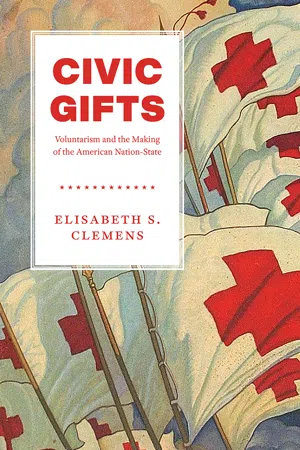
In Civic Gifts, Elisabeth S. Clemens takes a singular approach to probing the puzzle that is the United States. How, she asks, did a powerful state develop within an anti-statist political culture? How did a sense of shared nationhood develop despite the linguistic, religious, and ethnic differences among settlers and, eventually, citizens? Clemens reveals that an important piece of the answer to these questions can be found in the unexpected political uses of benevolence and philanthropy, practices of gift-giving and reciprocity that coexisted uneasily with the self-sufficient independence expected of liberal citizens Civic Gifts focuses on the power of gifts not only to mobilize communities throughout US history, but also to create new forms of solidarity among strangers. Clemens makes clear how, from the early Republic through the Second World War, reciprocity was an important tool for eliciting both the commitments and the capacities needed to face natural disasters, economic crises, and unprecedented national challenges. Encompassing a range of endeavors from the mobilized voluntarism of the Civil War, through Community Chests and the Red Cross to the FDR-driven rise of the March of Dimes, Clemens shows how voluntary efforts were repeatedly articulated with government projects. The legacy of these efforts is a state co-constituted with, as much as constrained by, civil society.
- English
- ePUB (mobile friendly)
- Available on iOS & Android
eBook - ePub
About this book
Information
Publisher
University of Chicago PressYear
2020Print ISBN
9780226670836
9780226559360
eBook ISBN
9780226670973
1
Principles of Association and Combination
Private associations of men for the purposes of promoting arts, sciences, benevolence or charity are very laudable, and have been found beneficial in all countries. But whenever such societies attempt to convert the private attachment of their members into an instrument of political warfare, they are, in all cases, hostile to government. They are useful in pulling down bad governments; but they are dangerous to good government, and necessarily destroy liberty and equality of rights in a free country.
Noah Webster, “The Revolution in France” (1794)1
In declaring their independence from the British Empire in 1776, North American colonists embarked on a spiraling sequence of practical problem-solving. What organization of governance could be squared with commitments to life, liberty, the consent of the governed, and the principle that all men are created equal? Each of these terms was the focus of heated debates and seemingly endless dilemmas could be produced by different combinations of these concepts. If liberty allows individuals to achieve different levels of economic success, in what sense are all men (or, at least, adult white men) still equal? If the governed consent to a system of rule and therefore domination (at least in the interval between elections), in what sense are they still free?
At a philosophical level, such questions continue to fuel reflection and debate. But, in practice, the tensions between these proclaimed ideals and practical problems of governance generated a rich history of organizational innovation and recombination. To the extent that these diverse models of citizenship and social order were durably reproduced yet substantially incompatible, they represented a set of constitutive contradictions or intrinsic tensions that have driven American political development.2 The compromises between the self-government of free citizens and an extensive economy based on slavery were the most fateful of these contradictions.3 But they were not the only tensions that became embedded—more or less securely—in the new kind of political order ushered in by a revolution in the name of self-government.
In rejecting traditional models of monarchical rule and declaring all men equal, the inheritors of that revolution added degrees of difficulty to the project of constructing a new form of government. Authority should not offend the equality of (male, white, ideally property-owning) citizens. Solidarity should be imagined in ways that do not threaten individual liberty. The French Revolution celebrated one possible solution to these dilemmas in its motto of liberté, egalité, fraternité. Leading revolutionaries, argues Pierre Ronsavallon, put fraternité or friendship “at the center of social life,” judging it to be “the most complete and necessary form of the social bond. Friendship, as a form of social cement, thus ceased to belong exclusively to the realm of private affections and took on a collective dimension that called for a pledge and implied a responsibility to all members of the society.”4 These interpersonal bonds were critically important given the French Revolution’s pronounced hostility to forms of intermediate or corporate social organization, including the clubs, associations, and religious congregations.
Although differing from friendship in its specifics as a social form, benevolence had a similar capacity to function as “social cement,” linking individuals to collective projects and a sense of the social. The distinctiveness of the American effort to invent democratic governance is evident in the trans-Atlantic commentary of the time. Europeans, observes historian Joyce Appleby, “were astounded by the presence of social order in America in the absence of social solidarity. Federalist leaders shared this sense of the situation and ‘saw their principal political problem as one of adhesion: how to keep people in such a large sprawling republic from flying apart in pursuit of their partial local interests.’”5 Absent some basis for solidarity, governance would be more difficult still. As Alexis de Tocqueville would observe a few decades after the American Revolution, “When the bonds among men cease to be solid and permanent, it is impossible to get large numbers of them to act in common without persuading each person whose cooperation is required that self-interest obliges him to join his efforts voluntarily to those of all the others.”6
One response would be to work mightily on the mobilization of self-interest. Within the decade or two following the adoption of the Constitution, political entrepreneurs were inventing a new organizational form—the mass political party—to facilitate action and mobilization within the institutional framework. But a second possibility was to create new kinds of bonds. Alongside the invention of the mass political party, a new form of civic or voluntary association flourished and came to be taken as the distinctive feature of this new democratic polity. Associations might generate solidarity among free citizens and serve as vehicles for organizing across community and state lines.7
Although the Constitution of 1789 established jurisdictional boundaries for state and federal governments, it provided much less guidance on how to organize across those jurisdictional lines and at the intersection of different domains of social life.8 This silence, in turn, provoked efforts to remedy the perceived fragility of the new constitutional order and counteract the fissive dynamics within the federal system. During those first decades of the new Republic, this structural challenge repeatedly provoked organizational innovation. Secret or selective associations, such as the Masons and the Society of the Cincinnati, created and sustained networks among neighbors, between occupational interests, and across state lines.9 The First Bank of the United States emerged as a “great regulating wheel” at the center of a system of relations with the state banks in the management of public and private credit.10 Operating in the space opened by the ongoing disestablishment of religion across the colonies-turned-states, multiplying reform groups advocated for temperance, founded Sunday schools, and evangelized on the western frontier as part of what came to be known as the “Benevolent Empire” or the “Evangelical United Front.”11 Each of these organizational experiments was a response to the weaknesses that many perceived in the new constitutional order. All represented combinations of private association and official political institutions that might produce a novel system of governance capable of replacing the monarchical and imperial arrangements rejected by the Revolution.
The problem, as Noah Webster insisted, was that such political combinations might be “useful in pulling down bad governments; but . . . dangerous to good government.” His diagnosis, written in response to the escalating Terror of the French Revolution of 1794, turned on the role of the Jacobin societies, which “were voluntary associations, unclothed with any legal authority.” Yet to enforce the decisions of the Convention across the entire country, these societies were “clothed with the sanction of a constitutional form. . . . A single club, by this curious artifice, gave law to France.” One association claimed to represent and direct the whole. Read through this analysis of the extreme phases of the French Revolution, the logic connecting association to political danger is clear: “By this principle of combination, has a party, originally small, been enabled to triumph over all opposition.”12 Webster’s analysis resonated with the concerns of Federalists disturbed by the growing political presence of new “Democratic” societies: “The societies seemed to adopt techniques of insurrection appropriate for the imperial crisis but at odds with the new republic’s political structures. . . . ‘Nobody will deny the usefulness of popular Societies, in cases of revolutions,’ noted one observer.”13 But associations, however useful they might have been as vehicles of justified revolutionary mobilization, carried the potential for the emergence of faction, the tyranny of a well-organized minority, and the subversion of the sovereignty of the people as a whole.
The potent threat that Webster and many of his contemporaries attributed to political association may surprise readers whose understanding of American civil society derives from a stylized summary of Alexis de Tocqueville’s Democracy in America. Based on extensive travels less than four decades after the publication of Webster’s essay, that classic analysis celebrated private associations as the key to the robustness of American democracy, a striking contrast to the much different aftermath of revolution in France.14 Viewed through this trans-Atlantic comparison, Tocqueville portrayed association as a “principle of combination” that moved easily across the spheres of civil, political, and economic life, generating capacities for collective action and shaping new kinds of political selves.15 Viewed historically, however, the political role of private association poses a different question to an analysis of nation-state-building. How were “self-created societies,” condemned in those terms by no less than President Washington, transformed from threats to the republic into legitimate and familiar vehicles for a wide range of civic activities that might even function as a shadow form of governance?16
The practical history of making “self-created societies” both safe for American democracy and useful for nation-state-building involved experiments with and refashionings of already familiar organizational models. “Self-created” societies threatened to displace the exercise of popular sovereignty with a cacophony of partial interests, subordinating individual conscience to organizational goals and extracting individual contributions with their dauntingly efficient associational machinery. A resolution of these dilemmas, however partial, required the invention of new organizational forms and etiquettes to engage private association with public projects, the defining feature of “infrastructural power.” The corporate form was harnessed to benevolence and then to sweeping reform mobilizations, anchored by a new discourse of “voluntarism.” But the efflorescence of organizing also fed on itself, with movements seeking to capture other associations, resulting in multiplying lines of schism and conflict. Although the organizational experiments of those decades after the revolution produced a new political ordering, it was an ordering fraught with constitutive contradictions among the assembled pieces that would shape the trajectory of nation-state-building.17
Self-Created Societies as Political Threats
In the aftermath of the Revolution, Americans divided over the question of whether revolutionary means could be deployed for post-revolutionary purposes. Once a new sovereign nation was established, many argued, the right to revolution was extinguished. The “freedom of assembly” enshrined in the Bill of Rights protected the ability of communities to protest unjust policy, but this was something quite different than the modern freedom of association that guarantees the rights of particular groups to organize themselves apart from the majority.18 The central issue was captured by the contrast between “constitutional” and “self-created” societies. Those organizations of patriots that had been established through “conventions” at the level of towns or colonies could claim to represent the people. By tracing their origins to an established political authority, they rebuffed accusations that they represented only themselves and therefore constituted factions hostile to popular sovereignty.19
When societies were “self-created,” however, even the unquestioned patriotic service of members was no guarantee against such suspicions. The Society of the Cincinnati, whose membership was restricted to “officers and their first-born sons,” was attacked as “an attempt by a nationally connected political and military elite to create an American nobility” while also functioning as a charitable mutual benefit association to provide relief for “the unfortunate members, or their widows or heirs.”20 There was no consensus on the place of such private, restricted, even secretive associations within a new kind of polity. As critics of the Cincinnati charged, “self-creation removed the society from legal constraint and allowed it to usurp a power forbidden to the states or the nation,” namely the creation of a hereditary nobility.21
Disagreements over the legitimacy of self-created societies and the organized expression of public opinion also fueled conflicts between the emerging configurations of Democratic-Republicans and Federalists. These debates intensified in 1793 and 1794 with the tax resistance that would become the Whiskey Rebellion22 and the shifting character of the ongoing revolution in France. In that context, President Washington criticized “self-created societies” as a threat to the government.23 Having accepted the office of “president general” of the Society of Cincinnati, Washington then led the annual meeting through a revision of its own charter, abandoning its hereditary character, excluding foreign membership, and surrendering control of any funds to state legislatures: “the American states and people could not accept the hybridizing of private benevolence and coordinated public leadership.”24 Through these changes, “the promiscuous mixing of mutual benevolence and state- and national-level political didacticism would be ended.”25 Washington’s distrust of private association was shared by Jefferson who, as late as 1824, “worried that they ‘may rivalise and jeopardize the march of regular government.’” Like Washington, Jefferson “believed that permitting the spread of voluntary associations and corporations would threaten equality by allowing a small minority, a cabal, to exercise disproportionate influence over public life.”26
If private attachment threatened true popular sovereignty, the seemingly admirable qualities of benevolent action also endangered claims to political equality. Unreciprocated gifts were understood to generate dependence and a sense of personal humiliation. They might also allow the privileged few to accumulate concentrated power. One early experiment in combining patriotic organization and charity, the Washington Benevolent Society, provoked precisely this criticism in the form of accusations that it was “bribing the needy and avaricious under the mask of benevolence.”27 Here, benevolence threatened political virtue to the extent it reduced less-advantaged citizens to dependence on the gifts of others, an acknowledgment of their lack of self-sufficiency and independence.
Beyond the fear that charity-as-bribery might taint electoral processes, many saw benevolent organiza...
Table of contents
- Cover
- Title Page
- Copyright Page
- Dedication
- Contents
- Introduction
- 1: Principles of Association and Combination
- 2: Civil War, Civic Expansion: The “Divine Method” of Patriotism
- 3: Municipal Benevolence
- 4: The Expansible Nation-State
- 5: “Everything but Government Submarines”: Limits of a Semi-governmental System
- 6: In the Shadow of the New Deal
- 7: The People’s Partnership
- 8: Good Citizens of a World Power
- 9: Combinatorial Politics and Constitutive Contradictions
- Acknowledgments
- Appendices
- List of Abbreviations
- List of Archives
- Notes
- References
- Index
Trusted by 375,005 students
Access to over 1.5 million titles for a fair monthly price.
Study more efficiently using our study tools.
Frequently asked questions
Yes, you can cancel anytime from the Subscription tab in your account settings on the Perlego website. Your subscription will stay active until the end of your current billing period. Learn how to cancel your subscription
No, books cannot be downloaded as external files, such as PDFs, for use outside of Perlego. However, you can download books within the Perlego app for offline reading on mobile or tablet. Learn how to download books offline
Perlego offers two plans: Essential and Complete
- Essential is ideal for learners and professionals who enjoy exploring a wide range of subjects. Access the Essential Library with 800,000+ trusted titles and best-sellers across business, personal growth, and the humanities. Includes unlimited reading time and Standard Read Aloud voice.
- Complete: Perfect for advanced learners and researchers needing full, unrestricted access. Unlock 1.5M+ books across hundreds of subjects, including academic and specialized titles. The Complete Plan also includes advanced features like Premium Read Aloud and Research Assistant.
We are an online textbook subscription service, where you can get access to an entire online library for less than the price of a single book per month. With over 1.5 million books across 990+ topics, we’ve got you covered! Learn about our mission
Look out for the read-aloud symbol on your next book to see if you can listen to it. The read-aloud tool reads text aloud for you, highlighting the text as it is being read. You can pause it, speed it up and slow it down. Learn more about Read Aloud
Yes! You can use the Perlego app on both iOS and Android devices to read anytime, anywhere — even offline. Perfect for commutes or when you’re on the go.
Please note we cannot support devices running on iOS 13 and Android 7 or earlier. Learn more about using the app
Please note we cannot support devices running on iOS 13 and Android 7 or earlier. Learn more about using the app
Yes, you can access Civic Gifts by Elisabeth S. Clemens in PDF and/or ePUB format, as well as other popular books in Social Sciences & North American History. We have over 1.5 million books available in our catalogue for you to explore.