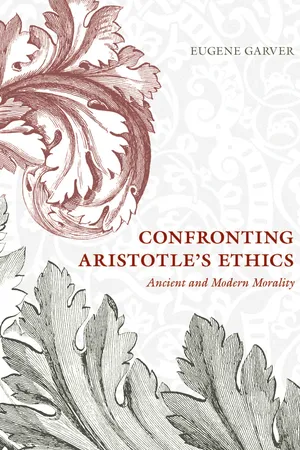
What is the good life? Posing this question today would likely elicit very different answers. Some might say that the good life means doing good—improving one's community and the lives of others. Others might respond that it means doing well—cultivating one's own abilities in a meaningful way. But for Aristotle these two distinct ideas—doing good and doing well—were one and the same and could be realized in a single life. In Confronting Aristotle's Ethics, Eugene Garver examines how we can draw this conclusion from Aristotle's works, while also studying how this conception of the good life relates to contemporary ideas of morality.
The key to Aristotle's views on ethics, argues Garver, lies in the Metaphysics or, more specifically, in his thoughts on activities, actions, and capacities. For Aristotle, Garver shows, it is only possible to be truly active when acting for the common good, and it is only possible to be truly happy when active to the extent of one's own powers. But does this mean we should aspire to Aristotle's impossibly demanding vision of the good life? In a word, no. Garver stresses the enormous gap between life in Aristotle's time and ours. As a result, this bookwill be a welcome rumination on not only Aristotle, but the relationship between the individual and society in everyday life.
- 301 pages
- English
- PDF
- Available on iOS & Android
eBook - PDF
About this book
Information
Publisher
University of Chicago PressYear
2008Print ISBN
9780226270197
9780226283982
eBook ISBN
9780226284019
Topic
PhilosophySubtopic
Ancient & Classical PhilosophyTable of contents
- Contents
- Acknowledgments
- List of Abbreviations of Aristotle's Works
- Introduction
- 1. What Aristotle's Rhetoric Can Tell Us about the Rationality of Virtue
- 2. Decision, Rational Powers, and Irrational Powers
- 3. The Varieties of Moral Failure
- 4. Passion and the Two Sides of Virtue
- 5. Aristotle's Ethical Virtues Are Political Virtues
- 6. The Ethical Dimensions of Aristotle's Metaphysics
- 7. Living Politically and Living Rationally: Choosing Ends and Choosing Lives
- Notes
- Name Index
- Index of Passages in Aristotle's Works
Trusted by 375,005 students
Access to over 1.5 million titles for a fair monthly price.
Study more efficiently using our study tools.
Frequently asked questions
Yes, you can cancel anytime from the Subscription tab in your account settings on the Perlego website. Your subscription will stay active until the end of your current billing period. Learn how to cancel your subscription
No, books cannot be downloaded as external files, such as PDFs, for use outside of Perlego. However, you can download books within the Perlego app for offline reading on mobile or tablet. Learn how to download books offline
Perlego offers two plans: Essential and Complete
- Essential is ideal for learners and professionals who enjoy exploring a wide range of subjects. Access the Essential Library with 800,000+ trusted titles and best-sellers across business, personal growth, and the humanities. Includes unlimited reading time and Standard Read Aloud voice.
- Complete: Perfect for advanced learners and researchers needing full, unrestricted access. Unlock 1.5M+ books across hundreds of subjects, including academic and specialized titles. The Complete Plan also includes advanced features like Premium Read Aloud and Research Assistant.
We are an online textbook subscription service, where you can get access to an entire online library for less than the price of a single book per month. With over 1.5 million books across 990+ topics, we’ve got you covered! Learn about our mission
Look out for the read-aloud symbol on your next book to see if you can listen to it. The read-aloud tool reads text aloud for you, highlighting the text as it is being read. You can pause it, speed it up and slow it down. Learn more about Read Aloud
Yes! You can use the Perlego app on both iOS and Android devices to read anytime, anywhere — even offline. Perfect for commutes or when you’re on the go.
Please note we cannot support devices running on iOS 13 and Android 7 or earlier. Learn more about using the app
Please note we cannot support devices running on iOS 13 and Android 7 or earlier. Learn more about using the app
Yes, you can access Confronting Aristotle's Ethics by Eugene Garver in PDF and/or ePUB format, as well as other popular books in Philosophy & Ancient & Classical Philosophy. We have over 1.5 million books available in our catalogue for you to explore.