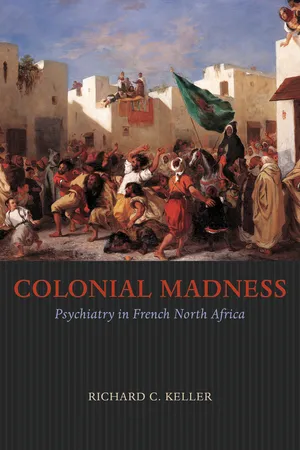
Nineteenth-century French writers and travelers imagined Muslim colonies in North Africa to be realms of savage violence, lurid sexuality, and primitive madness. Colonial Madness traces the genealogy and development of this idea from the beginnings of colonial expansion to the present, revealing the ways in which psychiatry has been at once a weapon in the arsenal of colonial racism, an innovative branch of medical science, and a mechanism for negotiating the meaning of difference for republican citizenship.
Drawing from extensive archival research and fieldwork in France and North Africa, Richard Keller offers much more than a history of colonial psychology. Colonial Madness explores the notion of what French thinkers saw as an inherent mental, intellectual, and behavioral rift marked by the Mediterranean, as well as the idea of the colonies as an experimental space freed from the limitations of metropolitan society and reason. These ideas have modern relevance, Keller argues, reflected in French thought about race and debates over immigration and France's postcolonial legacy.
- 309 pages
- English
- PDF
- Available on iOS & Android
eBook - PDF
About this book
Information
Publisher
University of Chicago PressYear
2008Print ISBN
9780226429731
9780226429724
eBook ISBN
9780226429779
Topic
PsicologíaSubtopic
Historia africanaTable of contents
- Contents
- Acknowledgments
- Introduction: Madness and Colonization
- 1 Pinel in the Maghreb: Liberation and Confi nement in a Landscape of Sickness
- 2 The Shaping of Colonial Psychiatry: Geographies of Innovation and Economies of Care
- 3 Spaces of Experimentation, Sites of Contestation: Doctors, Patients, and Treatments
- 4 Between Clinical and Useful Knowledge: Race, Ethnicity, and the Conquest of the “Primitive”
- 5 Violence, Resistance, and the Poetics of Suffering: Colonial Madness between Frantz Fanon and Kateb Yacine
- 6 Underdevelopment, Migration, and Dislocation: Postcolonial Histories of Colonial Psychiatry
- Conclusion: Pills and Paving Stones, Centers and Margins
- Notes
- Bibliography
- Index
Trusted by 375,005 students
Access to over 1.5 million titles for a fair monthly price.
Study more efficiently using our study tools.
Frequently asked questions
Yes, you can cancel anytime from the Subscription tab in your account settings on the Perlego website. Your subscription will stay active until the end of your current billing period. Learn how to cancel your subscription
No, books cannot be downloaded as external files, such as PDFs, for use outside of Perlego. However, you can download books within the Perlego app for offline reading on mobile or tablet. Learn how to download books offline
Perlego offers two plans: Essential and Complete
- Essential is ideal for learners and professionals who enjoy exploring a wide range of subjects. Access the Essential Library with 800,000+ trusted titles and best-sellers across business, personal growth, and the humanities. Includes unlimited reading time and Standard Read Aloud voice.
- Complete: Perfect for advanced learners and researchers needing full, unrestricted access. Unlock 1.5M+ books across hundreds of subjects, including academic and specialized titles. The Complete Plan also includes advanced features like Premium Read Aloud and Research Assistant.
We are an online textbook subscription service, where you can get access to an entire online library for less than the price of a single book per month. With over 1.5 million books across 990+ topics, we’ve got you covered! Learn about our mission
Look out for the read-aloud symbol on your next book to see if you can listen to it. The read-aloud tool reads text aloud for you, highlighting the text as it is being read. You can pause it, speed it up and slow it down. Learn more about Read Aloud
Yes! You can use the Perlego app on both iOS and Android devices to read anytime, anywhere — even offline. Perfect for commutes or when you’re on the go.
Please note we cannot support devices running on iOS 13 and Android 7 or earlier. Learn more about using the app
Please note we cannot support devices running on iOS 13 and Android 7 or earlier. Learn more about using the app
Yes, you can access Colonial Madness by Richard C. Keller in PDF and/or ePUB format, as well as other popular books in Psicología & Historia africana. We have over 1.5 million books available in our catalogue for you to explore.