eBook - ePub
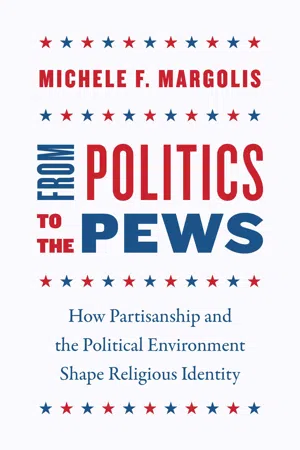
From Politics to the Pews
How Partisanship and the Political Environment Shape Religious Identity
- English
- ePUB (mobile friendly)
- Available on iOS & Android
eBook - ePub
From Politics to the Pews
How Partisanship and the Political Environment Shape Religious Identity
About this book
One of the most substantial divides in American politics is the "God gap." Religious voters tend to identify with and support the Republican Party, while secular voters generally support the Democratic Party. Conventional wisdom suggests that religious differences between Republicans and Democrats have produced this gap, with voters sorting themselves into the party that best represents their religious views.
Michele F. Margolis offers a bold challenge to the conventional wisdom, arguing that the relationship between religion and politics is far from a one-way street that starts in the church and ends at the ballot box. Margolis contends that political identity has a profound effect on social identity, including religion. Whether a person chooses to identify as religious and the extent of their involvement in a religious community are, in part, a response to political surroundings. In today's climate of political polarization, partisan actors also help reinforce the relationship between religion and politics, as Democratic and Republican elites stake out divergent positions on moral issues and use religious faith to varying degrees when reaching out to voters.
Frequently asked questions
Yes, you can cancel anytime from the Subscription tab in your account settings on the Perlego website. Your subscription will stay active until the end of your current billing period. Learn how to cancel your subscription.
At the moment all of our mobile-responsive ePub books are available to download via the app. Most of our PDFs are also available to download and we're working on making the final remaining ones downloadable now. Learn more here.
Perlego offers two plans: Essential and Complete
- Essential is ideal for learners and professionals who enjoy exploring a wide range of subjects. Access the Essential Library with 800,000+ trusted titles and best-sellers across business, personal growth, and the humanities. Includes unlimited reading time and Standard Read Aloud voice.
- Complete: Perfect for advanced learners and researchers needing full, unrestricted access. Unlock 1.4M+ books across hundreds of subjects, including academic and specialized titles. The Complete Plan also includes advanced features like Premium Read Aloud and Research Assistant.
We are an online textbook subscription service, where you can get access to an entire online library for less than the price of a single book per month. With over 1 million books across 1000+ topics, we’ve got you covered! Learn more here.
Look out for the read-aloud symbol on your next book to see if you can listen to it. The read-aloud tool reads text aloud for you, highlighting the text as it is being read. You can pause it, speed it up and slow it down. Learn more here.
Yes! You can use the Perlego app on both iOS or Android devices to read anytime, anywhere — even offline. Perfect for commutes or when you’re on the go.
Please note we cannot support devices running on iOS 13 and Android 7 or earlier. Learn more about using the app.
Yes, you can access From Politics to the Pews by Michele F. Margolis in PDF and/or ePUB format, as well as other popular books in Politics & International Relations & Political Ideologies. We have over one million books available in our catalogue for you to explore.
Information
Publisher
University of Chicago PressYear
2018Print ISBN
9780226555782, 9780226555645eBook ISBN
9780226555812Appendix
Youth-Parent Socialization Panel
| Table A.1 1965–1973: Republicans and Democrats did not diverge in church attendance | |||
|---|---|---|---|
| 1973 church attendance | |||
| (1) | (2) | (3) | |
| 1965 partisanship | |||
| Republican | −0.02 | −0.01 | 0.02 |
| (0.04) | (0.04) | (0.05) | |
| Independent | −0.07* | −0.07* | −0.04 |
| (0.04) | (0.04) | (0.04) | |
| 1965 church attendance | |||
| A few times a year | 0.13 | 0.14* | 0.13 |
| (0.09) | (0.08) | (0.10) | |
| Once or twice a month | 0.19** | 0.19** | 0.12 |
| (0.09) | (0.09) | (0.10) | |
| Almost every week | 0.42** | 0.42** | 0.29** |
| (0.08) | (0.08) | (0.10) | |
| Intercept | 0.21** | 0.13 | 0.07 |
| (0.08) | (0.10) | (0.11) | |
| Demographic controls | No | Yes | Yes |
| Upbringing controls | No | No | Yes |
| N | 558 | 558 | 558 |
Source: Youth-Parent Socialization Panel Study.
Note: Estimates are OLS coefficients with clustered standard errors in parentheses. The dependent variable of 1973 church attendance ...
Table of contents
- Cover
- Title Page
- Copyright Page
- Dedication
- Contents
- Acknowledgments
- one / Group Identities and Politics in the United States
- two / Putting Things in Context: Religious and Political Attachments over Time
- three / A Life-Cycle Theory of Religion and Politics
- four / Tracking Religious Trajectories over a Lifetime
- five / Partisans’ Religious Responses to the Political Environment
- six / The Religious and Political Consequences of Political Knowledge
- seven / Faithful Partisans: A Closer Look at African Americans
- eight / Generalizing the Life-Cycle Theory: A Reevaluation of the 1960 Election
- nine / The Religious Sort
- Appendix
- Notes
- References
- Index