- English
- ePUB (mobile friendly)
- Available on iOS & Android
eBook - ePub
About this book
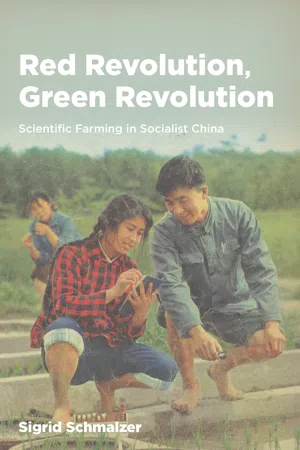
In 1968, the director of USAID coined the term "green revolution" to celebrate the new technological solutions that promised to ease hunger around the worldâand forestall the spread of more "red," or socialist, revolutions. Yet in China, where modernization and scientific progress could not be divorced from politics, green and red revolutions proceeded side by side.
In Red Revolution, Green Revolution, Sigrid Schmalzer explores the intersection of politics and agriculture in socialist China through the diverse experiences of scientists, peasants, state agents, and "educated youth." The environmental costs of chemical-intensive agriculture and the human costs of emphasizing increasing production over equitable distribution of food and labor have been felt as strongly in China as anywhereâand yet, as Schmalzer shows, Mao-era challenges to technocracy laid important groundwork for today's sustainability and food justice movements. This history of "scientific farming" in China offers us a unique opportunity not only to explore the consequences of modern agricultural technologies but also to engage in a necessary rethinking of fundamental assumptions about science and society.
Frequently asked questions
Yes, you can cancel anytime from the Subscription tab in your account settings on the Perlego website. Your subscription will stay active until the end of your current billing period. Learn how to cancel your subscription.
No, books cannot be downloaded as external files, such as PDFs, for use outside of Perlego. However, you can download books within the Perlego app for offline reading on mobile or tablet. Learn more here.
Perlego offers two plans: Essential and Complete
- Essential is ideal for learners and professionals who enjoy exploring a wide range of subjects. Access the Essential Library with 800,000+ trusted titles and best-sellers across business, personal growth, and the humanities. Includes unlimited reading time and Standard Read Aloud voice.
- Complete: Perfect for advanced learners and researchers needing full, unrestricted access. Unlock 1.4M+ books across hundreds of subjects, including academic and specialized titles. The Complete Plan also includes advanced features like Premium Read Aloud and Research Assistant.
We are an online textbook subscription service, where you can get access to an entire online library for less than the price of a single book per month. With over 1 million books across 1000+ topics, weâve got you covered! Learn more here.
Look out for the read-aloud symbol on your next book to see if you can listen to it. The read-aloud tool reads text aloud for you, highlighting the text as it is being read. You can pause it, speed it up and slow it down. Learn more here.
Yes! You can use the Perlego app on both iOS or Android devices to read anytime, anywhere â even offline. Perfect for commutes or when youâre on the go.
Please note we cannot support devices running on iOS 13 and Android 7 or earlier. Learn more about using the app.
Yes, you can access Red Revolution, Green Revolution by Sigrid Schmalzer in PDF and/or ePUB format, as well as other popular books in Biological Sciences & Chinese History. We have over one million books available in our catalogue for you to explore.
Information
Table of contents
- Cover
- Title Page
- Copyright Page
- Dedication
- Contents
- List of Illustrations
- INTRODUCTION
- 1 Agricultural Science and the Socialist State
- 2 Pu Zhelong: Making Socialist Science Work
- 3 Yuan Longping: âIntellectual Peasantâ
- 4 Chinese Peasants: âExperienceâ and âBackwardnessâ
- 5 Seeing Like a State Agent
- 6 The Lei Feng Paradox
- 7 Opportunity and Failure
- EPILOGUE
- Acknowledgments
- Notes
- Sources
- Index
- Plates