- 1,059 pages
- English
- PDF
- Available on iOS & Android
eBook - PDF
About this book
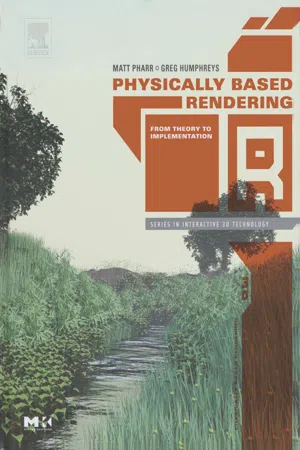
Rendering is a crucial component of computer graphics— the conversion of a description of a 3D scene into an image for display. Algorithms for animation, geometric modeling, and texturing all must feed their results through some sort of rendering process for the results to be visible in an image. Focusing on realistic images, physically based rendering incorporates ideas from a range of disciplines, including physics, biology, psychology, cognitive science, and mathematics. This book presents the algorithms of modern photorealistic rendering and follows step by step the creation of a complete rendering system. As each new rendering concept is introduced it is also shown implemented in code—there is no better way to understand the subtle and complex process of rendering. The code itself is highly readable, written in the literate programming style that mixes text describing the system with the code that implements it. The result is a stunning achievement in graphics education for students, professionals, and researchers.
- CD-ROM with the source code for a complete rendering system for Windows, OS X, and Linux—with many examples of images created by the system throughout the 4 color text
- The code and text are tightly woven together through the technique of literate programming with a unique indexing feature that lists all locations of functions, variables, and methods on the page they are first described
- The most complete guide to understanding, designing, and building a rendering system
Information
Subtopic
Computer GraphicsIndex
Computer ScienceTable of contents
- Front Cover
- Physically Based Rendering: From Theory to Implementation
- Copyright Page
- Content
- Foreword
- Preface
- CHAPTER 01. INTRODUCTION
- CHAPTER 02. GEOMETRY AND TRANSFORMATIONS
- CHAPTER 03. SHAPES
- CHAPTER 04. PRIMITVES AND INTERSECTION ACCELERATION
- CHAPTER 05. COLOR AND RADIOMETRY
- CHAPTER 06. CEMERA MODELS
- CHAPTER 07. SAMPLING AND RECONSTRUCTION
- CHAPTER 08. FILM AND THE IMAGING PIPELINE
- CHAPTER 09. REFLECTION MODELS
- CHAPTER 10. MATERIALS
- CHAPTER 11. TEXTURE
- CHAPTER 12. VOLUME SCATTERING
- CHAPTER 13. LIGHT SOURCES
- CHAPTER 14. MONTE CARLO INTEGRATION I: BASIC CONCEPTS
- CHAPTER 15. MONTE CARLO INTEGRATION II: IMPROVING EFFICIENCY
- CHAPTER 16. LIGHT TRANSPORT I: SURFACE REFLECTION
- CHAPTER 17. LIGHT TRANSPORT II: VOLUME RENDERING
- CHAPTER 18. SUMMARY AND CONCLUSION
- APPENDIXES
- REFERENCES
- INDEX
- ABOUT THE CD-ROM
- COLOPHON
Trusted by 375,005 students
Access to over 1.5 million titles for a fair monthly price.
Study more efficiently using our study tools.
Frequently asked questions
Yes, you can cancel anytime from the Subscription tab in your account settings on the Perlego website. Your subscription will stay active until the end of your current billing period. Learn how to cancel your subscription
No, books cannot be downloaded as external files, such as PDFs, for use outside of Perlego. However, you can download books within the Perlego app for offline reading on mobile or tablet. Learn how to download books offline
Perlego offers two plans: Essential and Complete
- Essential is ideal for learners and professionals who enjoy exploring a wide range of subjects. Access the Essential Library with 800,000+ trusted titles and best-sellers across business, personal growth, and the humanities. Includes unlimited reading time and Standard Read Aloud voice.
- Complete: Perfect for advanced learners and researchers needing full, unrestricted access. Unlock 1.5M+ books across hundreds of subjects, including academic and specialized titles. The Complete Plan also includes advanced features like Premium Read Aloud and Research Assistant.
We are an online textbook subscription service, where you can get access to an entire online library for less than the price of a single book per month. With over 1.5 million books across 990+ topics, we’ve got you covered! Learn about our mission
Look out for the read-aloud symbol on your next book to see if you can listen to it. The read-aloud tool reads text aloud for you, highlighting the text as it is being read. You can pause it, speed it up and slow it down. Learn more about Read Aloud
Yes! You can use the Perlego app on both iOS and Android devices to read anytime, anywhere — even offline. Perfect for commutes or when you’re on the go.
Please note we cannot support devices running on iOS 13 and Android 7 or earlier. Learn more about using the app
Please note we cannot support devices running on iOS 13 and Android 7 or earlier. Learn more about using the app
Yes, you can access Physically Based Rendering by Matt Pharr,Greg Humphreys in PDF and/or ePUB format, as well as other popular books in Computer Science & Computer Graphics. We have over 1.5 million books available in our catalogue for you to explore.