- 445 pages
- English
- PDF
- Available on iOS & Android
eBook - PDF
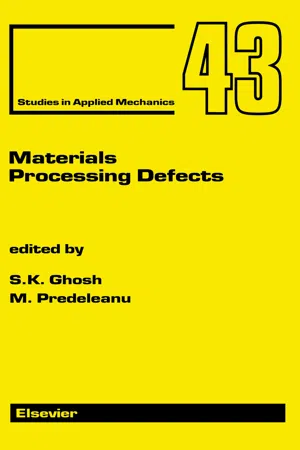
Materials Processing Defects
About this book
The technological field of defects, and more appropriately, avoidance of them, is very current in perhaps all sectors of the manufacturing industry. This is particularly important to reduce/minimize waste everywhere to address lean production procedures. The recent advances in finite plasticity and visioplasticity, damage modelling, instability theories, fracture modelling, computer numerical techniques and process simulation etc. offer new approaches and tools for defect prediction, analyses and guidelines for designing components to be manufactured by traditional and emerging process technologies.This volume contains contributions from well known researchers and experts in the field presenting an up-to-date overview of advances in this area. Subjects covered include: micro- and macro-scale observation of defects; localization and instability analysis; damage modelling and fracture criteria; defect prediction methods; design considerations to avoid defects.
Information
Table of contents
- Cover
- Preface
- Dedication
- Contents
- Chapter 1. Some Comments on the Structure of Technology of Plasticity in R&D and Production
- Chapter 2. James Nasmyth (1808–1890): The Steam Hammer and the Mechanics of Vee-anvil Forging
- Chapter 3. Modeling Dynamic Strain Localization in Inelastic Solids
- Chapter 4. Void Growth under Triaxial Stress State and its Influence on Sheet Metal Forming Limits
- Chapter 5. The Prediction of Necking and Wrinkles in Deep Drawing Processes Using the FEM
- Chapter 6. Constitutive Models for Microvoid Nucleation, Growth and Coalescence in Elastoplasticity, Finite Element Reference Modelling
- Chapter 7. Theoretical and Numerical Modelling of Isotropic or Anisotropic Ductile Damage in Metal Forming Processes
- Chapter 8. Research on Forging Processes for Production α + β Titanium Alloy TC11 Disks
- Chapter 9. Modelling of Fracture Initiation in Metalforming Processes
- Chapter 10. Formability Determination for Production Control
- Chapter 11. Design of Experiments, a Statistical Method to Analyse Sheet Metal Forming Defects Effectively
- Chapter 12. Formability, Damage and Corrosion Resistance of Coated Steel Sheets
- Chapter 13. Model of Metal Fracture in Cold Deformation and Ductivity Restoration
- Chapter 14. Prediction of Necking in 3-D Sheet Metal Forming Processes with Finite Element Simulation
- Chapter 15. Deformability versus Fracture Limit Diagrams
- Chapter 16. Prediction of Geometrical Defects in Sheet Metal Forming Processes by Semi-Implicit FEM
- Chapter 17. Evolution of Structural Anisotropy in Metal Forming Processes
- Chapter 18. Computer Aided Design of Optimised Forgings
- Chapter 19. Defects in Thermal Sprayed and Vapour Deposited Thick and Thin Hard-wearing Coatings
- Chapter 20. A Study of Workability Criteria in Bulk Forming Processes
- Chapter 21. Degradation of Metal Matrix Composite under Plastic Straining
- Chapter 22. Crack Prevention and Increase of Workability of Brittle Materials by Cold Extrusion
- Chapter 23. A Database for some Physical Defects in Metal Forming Processes
- Chapter 24. Split Ends and Central Burst Defects in Rolling
- Chapter 25. Form-Filling in Forging and Section-Rolling
Trusted by 375,005 students
Access to over 1.5 million titles for a fair monthly price.
Study more efficiently using our study tools.
Frequently asked questions
Yes, you can cancel anytime from the Subscription tab in your account settings on the Perlego website. Your subscription will stay active until the end of your current billing period. Learn how to cancel your subscription
No, books cannot be downloaded as external files, such as PDFs, for use outside of Perlego. However, you can download books within the Perlego app for offline reading on mobile or tablet. Learn how to download books offline
Perlego offers two plans: Essential and Complete
- Essential is ideal for learners and professionals who enjoy exploring a wide range of subjects. Access the Essential Library with 800,000+ trusted titles and best-sellers across business, personal growth, and the humanities. Includes unlimited reading time and Standard Read Aloud voice.
- Complete: Perfect for advanced learners and researchers needing full, unrestricted access. Unlock 1.5M+ books across hundreds of subjects, including academic and specialized titles. The Complete Plan also includes advanced features like Premium Read Aloud and Research Assistant.
We are an online textbook subscription service, where you can get access to an entire online library for less than the price of a single book per month. With over 1.5 million books across 990+ topics, we’ve got you covered! Learn about our mission
Look out for the read-aloud symbol on your next book to see if you can listen to it. The read-aloud tool reads text aloud for you, highlighting the text as it is being read. You can pause it, speed it up and slow it down. Learn more about Read Aloud
Yes! You can use the Perlego app on both iOS and Android devices to read anytime, anywhere — even offline. Perfect for commutes or when you’re on the go.
Please note we cannot support devices running on iOS 13 and Android 7 or earlier. Learn more about using the app
Please note we cannot support devices running on iOS 13 and Android 7 or earlier. Learn more about using the app
Yes, you can access Materials Processing Defects by M. Predeleanu,S.K. Ghosh in PDF and/or ePUB format, as well as other popular books in Technology & Engineering & Materials Science. We have over 1.5 million books available in our catalogue for you to explore.