eBook - PDF
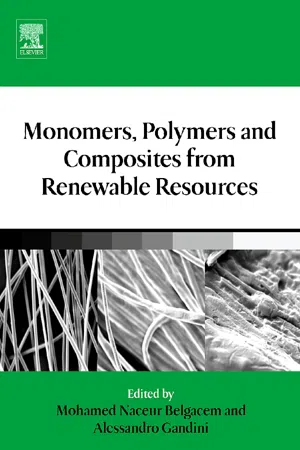
Monomers, Polymers and Composites from Renewable Resources
- 562 pages
- English
- PDF
- Available on iOS & Android
eBook - PDF
Monomers, Polymers and Composites from Renewable Resources
About this book
The progressive dwindling of fossil resources, coupled with the drastic increase in oil prices, have sparked a feverish activity in search of alternatives based on renewable resources for the production of energy.
Given the predominance of petroleum- and carbon-based chemistry for the manufacture of organic chemical commodities, a similar preoccupation has recently generated numerous initiatives aimed at replacing these fossil sources with renewable counterparts. In particular, major efforts are being conducted in the field of polymer science and technology to prepare macromolecular materials based on renewable resources. The concept of the bio-refinery, viz. the rational exploitation of the vegetable biomass in terms of the separation of its components and their utilisation as such, or after suitable chemical modifications, is thus gaining momentum and considerable financial backing from both the public and private sectors.
This collection of chapters, each one written by internationally recognised experts in the corresponding field, covers in a comprehensive fashion all the major aspects related to the synthesis, characterization and properties of macromolecular materials prepared using renewable resources as such, or after appropriate modifications. Thus, monomers such as terpenes and furans, oligomers like rosin and tannins, and polymers ranging from cellulose to proteins and including macromolecules synthesized by microbes, are discussed with the purpose of showing the extraordinary variety of materials that can be prepared from their intelligent exploitation.
Particular emphasis has been placed on recent advances and imminent perspectives, given the incessantly growing interest that this area is experiencing in both the scientific and technological realms.
- Discusses bio-refining with explicit application to materials
- Replete with examples of applications of the concept of sustainable development
- Presents an impressive variety of novel macromolecular materials
Information
Table of contents
- Front Cover
- Monomers, Polymers and Composites from Renewable Resources
- Copyright Page
- Contents
- Foreword
- List of Contributors
- Chapter 1 The State of the Art
- Chapter 2 Terpenes: Major Sources, Properties and Applications
- Chapter 3 Materials from Vegetable Oils: Major Sources, Properties and Applications
- Chapter 4 Rosin: Major Sources, Properties and Applications
- Chapter 5 Sugars as Monomers
- Chapter 6 Furan Derivatives and Furan Chemistry at the Service of Macromolecular Materials
- Chapter 7 Surfactants from Renewable Sources: Synthesis and Applications
- Chapter 8 Tannins: Major Sources, Properties and Applications
- Chapter 9 Lignins: Major Sources, Structure and Properties
- Chapter 10 Industrial Commercial Lignins: Sources, Properties and Applications
- Chapter 11 Lignins as Components of Macromolecular Materials
- Chapter 12 Partial or Total Oxypropylation of Natural Polymers and the Use of the Ensuing Materials as Composites or Polyol Macromonomers
- Chapter 13 Hemicelluloses: Major Sources, Properties and Applications
- Chapter 14 Cork and Suberins: Major Sources, Properties and Applications
- Chapter 15 Starch: Major Sources, Properties and Applications as Thermoplastic Materials
- Chapter 16 Cellulose Chemistry: Novel Products and Synthesis Paths
- Chapter 17 Bacterial Cellulose from Glucanacetobacter xylinus: Preparation, Properties and Applications
- Chapter 18 Surface Modification of Cellulose Fibres
- Chapter 19 Cellulose-Based Composites and Nanocomposites
- Chapter 20 Chemical Modification of Wood
- Chapter 21 Polylactic Acid: Synthesis, Properties and Applications
- Chapter 22 Polyhydroxyalkanoates: Origin, Properties and Applications
- Chapter 23 Proteins as Sources of Materials
- Chapter 24 Polyelectrolytes Derived from Natural Polysaccharides
- Chapter 25 Chitin and Chitosan: Major Sources, Properties and Applications
- Index
- Colour Plate
Trusted by 375,005 students
Access to over 1.5 million titles for a fair monthly price.
Study more efficiently using our study tools.
Frequently asked questions
Yes, you can cancel anytime from the Subscription tab in your account settings on the Perlego website. Your subscription will stay active until the end of your current billing period. Learn how to cancel your subscription
No, books cannot be downloaded as external files, such as PDFs, for use outside of Perlego. However, you can download books within the Perlego app for offline reading on mobile or tablet. Learn how to download books offline
Perlego offers two plans: Essential and Complete
- Essential is ideal for learners and professionals who enjoy exploring a wide range of subjects. Access the Essential Library with 800,000+ trusted titles and best-sellers across business, personal growth, and the humanities. Includes unlimited reading time and Standard Read Aloud voice.
- Complete: Perfect for advanced learners and researchers needing full, unrestricted access. Unlock 1.5M+ books across hundreds of subjects, including academic and specialized titles. The Complete Plan also includes advanced features like Premium Read Aloud and Research Assistant.
We are an online textbook subscription service, where you can get access to an entire online library for less than the price of a single book per month. With over 1.5 million books across 990+ topics, we’ve got you covered! Learn about our mission
Look out for the read-aloud symbol on your next book to see if you can listen to it. The read-aloud tool reads text aloud for you, highlighting the text as it is being read. You can pause it, speed it up and slow it down. Learn more about Read Aloud
Yes! You can use the Perlego app on both iOS and Android devices to read anytime, anywhere — even offline. Perfect for commutes or when you’re on the go.
Please note we cannot support devices running on iOS 13 and Android 7 or earlier. Learn more about using the app
Please note we cannot support devices running on iOS 13 and Android 7 or earlier. Learn more about using the app
Yes, you can access Monomers, Polymers and Composites from Renewable Resources by Mohamed Naceur Belgacem,Alessandro Gandini in PDF and/or ePUB format, as well as other popular books in Technology & Engineering & Physical & Theoretical Chemistry. We have over 1.5 million books available in our catalogue for you to explore.