eBook - PDF
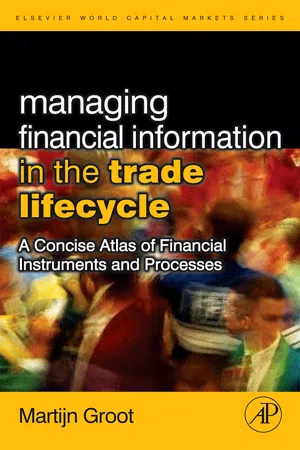
Managing Financial Information in the Trade Lifecycle
A Concise Atlas of Financial Instruments and Processes
- 275 pages
- English
- PDF
- Available on iOS & Android
eBook - PDF
Managing Financial Information in the Trade Lifecycle
A Concise Atlas of Financial Instruments and Processes
About this book
Information is the oxygen supply of the financial markets. Financial information, or data, is so important that companies such as Barclays and Citigroup now have executive positions of Chief Data Officer or Head of Data Acquisition. This book, by a long-time industry insider at one of the leading data management vendors, discusses the present and future of financial data management by focusing on the lifecycle of the financial instruments (stocks, bonds, options, derivatives) that generate and require data to keep the markets moving. This book is a concise reference manual of the financial information supply chain and how to maximize effectiveness and minimize cost.
- First book fully dedicated to financial information supply chain and how to manage it effectively
- Addresses hot topics that readers need to know: regulatory reporting regulations, data pooling, hubs, and data exchanges
- Draws from actual lessons learned and presents many real-life scenarios of the business
Information
Topic
Personal DevelopmentSubtopic
Information ManagementTable of contents
- Front Cover
- Managing Financial Information in the Trade Lifecycle
- Copyright Page
- Table of Contents
- Foreword
- Dedication Page
- Series Editor's Preface
- Chapter 1: The Changing Financial Services Landscape
- Chapter 2: The Instrument Lifecycle: The Life and Times of Financial Instruments
- Chapter 3: The Information Supply Chain: Overview of the Financial Content Market
- Chapter 4: Information Needs in the Transaction Lifecycle
- Chapter 5: Metrics and Criteria for Success in Infrastructure
- Chapter 6: Concluding Comments
- Index
Trusted by 375,005 students
Access to over 1.5 million titles for a fair monthly price.
Study more efficiently using our study tools.
Frequently asked questions
Yes, you can cancel anytime from the Subscription tab in your account settings on the Perlego website. Your subscription will stay active until the end of your current billing period. Learn how to cancel your subscription
No, books cannot be downloaded as external files, such as PDFs, for use outside of Perlego. However, you can download books within the Perlego app for offline reading on mobile or tablet. Learn how to download books offline
We are an online textbook subscription service, where you can get access to an entire online library for less than the price of a single book per month. With over 1.5 million books across 990+ topics, we’ve got you covered! Learn about our mission
Look out for the read-aloud symbol on your next book to see if you can listen to it. The read-aloud tool reads text aloud for you, highlighting the text as it is being read. You can pause it, speed it up and slow it down. Learn more about Read Aloud
Yes! You can use the Perlego app on both iOS and Android devices to read anytime, anywhere — even offline. Perfect for commutes or when you’re on the go.
Please note we cannot support devices running on iOS 13 and Android 7 or earlier. Learn more about using the app
Please note we cannot support devices running on iOS 13 and Android 7 or earlier. Learn more about using the app
Yes, you can access Managing Financial Information in the Trade Lifecycle by Martijn Groot in PDF and/or ePUB format, as well as other popular books in Personal Development & Information Management. We have over 1.5 million books available in our catalogue for you to explore.