eBook - PDF
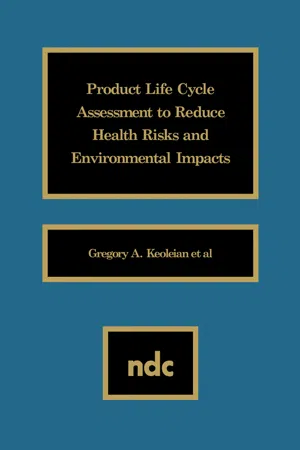
Product Life Cycle Assessment to Reduce Health Risks and Environmental Impacts
- 302 pages
- English
- PDF
- Available on iOS & Android
eBook - PDF
Product Life Cycle Assessment to Reduce Health Risks and Environmental Impacts
About this book
Life cycle design is a proactive approach for integrating pollution prevention and resource conservation strategies into the development of more ecologically and economically sustainable product systems. Cross media pollutant transfer and the shifting of other impacts can be avoided by addressing the entire life cycle, which includes raw materials acquisition, materials processing, manufacturing and assembly, use and service, retirement, disposal and the ultimate fate of residuals.The goal of life cycle design is to minimize aggregate risks and impacts over this life cycle. This goal can only be attained through the balancing of environmental, performance, cost, cultural, legal, and technical requirements of the product system. Concepts such as concurrent design, total quality management, cross- disciplinary teams, and multi-attribute decision making are essential elements of life cycle design that help meet these goals. The framework for life cycle design was developed to be applicable for all product domains. It was written to assist not only design professionals but all other constituents who have an important role in life cycle design including corporate executives, product managers, production workers, distributors, environmental health and safety staff, purchasers, accountants, marketers, salespersons, legal staff, consumers, and government regulators. A coordinated effort is required to institute changes needed for successful implementation of life cycle design.Part I seeks to promote the reduction of environmental imparts and health risks through a systems approach to design. The approach is based on the product life cycle, which includes raw materials acquisition and processing, manufacturing, use/service, resource recovery, and disposal. A life cycle design framework was developed to provide guidance for more effectively conserving resources and energy, preventing pollution, and reducing the aggregate environmental impacts and health risks associated with a product system. This framework addresses the product, process, distribution, and management/information components of each product system.Part II describes the three components of a life cycle assessment (inventory analysis, impact analysis, and improvement analysis) as well as scoping activities, presents a brief overview of the development of the life cycle assessment process, and develops guidelines and principles for implementation of a product life cycle assessment. The major states in a life cycle are raw materials acquisition, manufacturing, consumer use/reuse/maintenance, and recycle/waste management. The basic steps of performing a life cycle inventory (defining the goals and system boundaries, including scoping; gathering and developing data; presenting and reviewing data; and interpreting and communicating results) are presented along with the general issues to be addressed. The system boundaries, assumptions, and conventions to be addressed in each stage of the inventory are presented.
Information
Table of contents
- Front Cover
- Product Life Cycle Assessment to Reduce Health Risks and Environmental Impacts
- Copyright Page
- Table of Contents
- Preface
- Notice
- PART I: LIFE CYCLE DESIGN
- CHAPTER 1. INTRODUCTION
- CHAPTER 2. LIFE CYCLE DESIGN BASICS
- CHAPTER 3. THE DEVELOPMENT PROCESS
- CHAPTER 4. DESIGN REQUIREMENTS
- CHAPTER 5. DESIGN STRATEGIES
- CHAPTER 6. ENVIRONMENTAL ANALYSIS TOOLS
- CHAPTER 7. LIFE CYCLE ACCOUNTING
- APPENDIX A: SOURCES OF ADDITIONAL INFORMATION
- APPENDIX B: SUMMARY OF MAJOR FEDERAL ENVIRONMENTAL LAWS
- APPENDIX C: OVERVIEW OF ENVIRONMENTAL IMPACTS
- APPENDIX D: DECISION MAKING
- APPENDIX E: ENVIRONMENTAL LABELING
- APPENDIX F: GLOSSARY
- PART II: LIFE CYCLE ASSESSMENT
- CHAPTER 8. INTRODUCTION
- CHAPTER 9. OVERVIEW
- 10. PROCEDURAL FRAMEWORK FOR LIFE CYCLE INVENTORY
- CHAPTER 11. GENERAL ISSUES IN PERFORMING A LIFE CYCLE INVENTORY
- CHAPTER 12. ISSUES APPLICABLE TO SPECIFIC LIFE CYCLE STAGES
- REFERENCES
- GLOSSARY
Trusted by 375,005 students
Access to over 1.5 million titles for a fair monthly price.
Study more efficiently using our study tools.
Frequently asked questions
Yes, you can cancel anytime from the Subscription tab in your account settings on the Perlego website. Your subscription will stay active until the end of your current billing period. Learn how to cancel your subscription
No, books cannot be downloaded as external files, such as PDFs, for use outside of Perlego. However, you can download books within the Perlego app for offline reading on mobile or tablet. Learn how to download books offline
Perlego offers two plans: Essential and Complete
- Essential is ideal for learners and professionals who enjoy exploring a wide range of subjects. Access the Essential Library with 800,000+ trusted titles and best-sellers across business, personal growth, and the humanities. Includes unlimited reading time and Standard Read Aloud voice.
- Complete: Perfect for advanced learners and researchers needing full, unrestricted access. Unlock 1.5M+ books across hundreds of subjects, including academic and specialized titles. The Complete Plan also includes advanced features like Premium Read Aloud and Research Assistant.
We are an online textbook subscription service, where you can get access to an entire online library for less than the price of a single book per month. With over 1.5 million books across 990+ topics, we’ve got you covered! Learn about our mission
Look out for the read-aloud symbol on your next book to see if you can listen to it. The read-aloud tool reads text aloud for you, highlighting the text as it is being read. You can pause it, speed it up and slow it down. Learn more about Read Aloud
Yes! You can use the Perlego app on both iOS and Android devices to read anytime, anywhere — even offline. Perfect for commutes or when you’re on the go.
Please note we cannot support devices running on iOS 13 and Android 7 or earlier. Learn more about using the app
Please note we cannot support devices running on iOS 13 and Android 7 or earlier. Learn more about using the app
Yes, you can access Product Life Cycle Assessment to Reduce Health Risks and Environmental Impacts by Gregory A. Keoleian in PDF and/or ePUB format, as well as other popular books in Biological Sciences & Environmental Science. We have over 1.5 million books available in our catalogue for you to explore.