- 592 pages
- English
- PDF
- Available on iOS & Android
eBook - PDF
Neural Models of language Processes
About this book
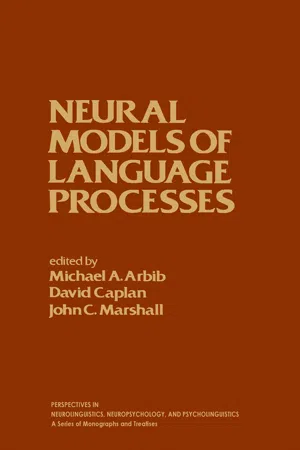
Neural Models of Language Processes offers an interdisciplinary approach to understanding the nature of human language and the means whereby we use it. The book is organized into five parts. Part I provides an opening framework that addresses three tasks: to place neurolinguistics in current perspective; to provide two case studies of aphasia; and to discuss the ""rules of the game"" of the various disciplines that contribute to this volume. Part II on artificial intelligence (AI) and processing models discusses the contribution of AI to neurolinguistics. The chapters in this section introduce three AI systems for language perception: the HWIM and HEARSAY systems that proceed from an acoustic input to a semantic interpretation of the utterance it represents, and Marcus9 system for parsing sentences presented in text. Studying these systems demonstrates the virtues of implemented or implementable models. Part III on linguistic and psycholinguistic perspectives includes studies such as nonaphasic language behavior and the linguistics and psycholinguistics of sign language. Part IV examines neurological perspectives such as the neuropathological basis of Broca's aphasia and the simulation of speech production without a computer. Part V on neuroscience and brain theory includes studies such as the histology, architectonics, and asymmetry of language areas; hierarchy and evolution in neurolinguistics; and perceptual-motor processes and the neural basis of language.
Information
Table of contents
- Front Cover
- Neural Models of Language Processes
- Copyright Page
- Table of Contents
- List of Contributors
- Preface
- PART I: AN OPENING PERSPECTIVE
- PART II: ARTIFICIAL INTELLIGENCE AND PROCESSING MODELS
- PART III: LINGUISTIC AND PSYCHOLINGUISTIC PERSPECTIVES
- PART IV: NEUROLOGICAL PERSPECTIVES
- PART V: NEUROSCIENCE AND BRAIN THEORY
- Index
Trusted by 375,005 students
Access to over 1.5 million titles for a fair monthly price.
Study more efficiently using our study tools.
Frequently asked questions
Yes, you can cancel anytime from the Subscription tab in your account settings on the Perlego website. Your subscription will stay active until the end of your current billing period. Learn how to cancel your subscription
No, books cannot be downloaded as external files, such as PDFs, for use outside of Perlego. However, you can download books within the Perlego app for offline reading on mobile or tablet. Learn how to download books offline
We are an online textbook subscription service, where you can get access to an entire online library for less than the price of a single book per month. With over 1.5 million books across 990+ topics, we’ve got you covered! Learn about our mission
Look out for the read-aloud symbol on your next book to see if you can listen to it. The read-aloud tool reads text aloud for you, highlighting the text as it is being read. You can pause it, speed it up and slow it down. Learn more about Read Aloud
Yes! You can use the Perlego app on both iOS and Android devices to read anytime, anywhere — even offline. Perfect for commutes or when you’re on the go.
Please note we cannot support devices running on iOS 13 and Android 7 or earlier. Learn more about using the app
Please note we cannot support devices running on iOS 13 and Android 7 or earlier. Learn more about using the app
Yes, you can access Neural Models of language Processes by Michael Arbib in PDF and/or ePUB format, as well as other popular books in Biological Sciences & Biochemistry. We have over 1.5 million books available in our catalogue for you to explore.