- 457 pages
- English
- PDF
- Available on iOS & Android
eBook - PDF
About this book
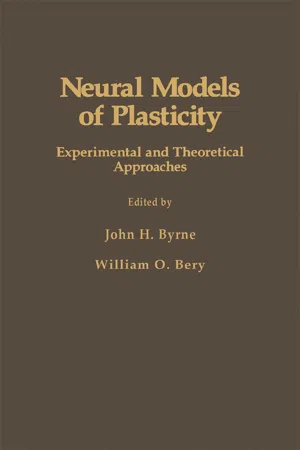
Neural Models of Plasticity: Experimental and Theoretical Approaches focuses on the use of theoretical and empirical methods in investigating the role of neuronal plasticity in learning, memory, and complex brain functions. It examines the neuromodulation in relation to associative learning and memory, developmental assembly of various components of learning and memory, cellular and molecular processes contributing to associative and non-associative learning, and higher-order features of classical conditioning. Organized into 19 chapters, this volume begins with an overview of the central pathways mediating conditioning in the marine mollusk Hermissenda and the behavior modified by conditioning, along with the role of neuromodulation in associative learning in this organism. It then proceeds with a discussion of learning and memory in the marine mollusk Aplysia, the Hebb rule for synaptic plasticity, a drive-reinforcement model of neuronal function for predicting classical conditioning phenomena, and the relationship between olfactory processing and associative memory. The reader is also introduced to a neural circuit for classical conditioning of the eyelid closure response, molecular mechanisms and roles of long-term depression in cerebellar function, and functions of neuronal networks in the hippocampus and neocortex in memory. The book concludes with a chapter on models of calcium regulation in neurons. This book is a valuable resource for neurobiologists, psychologists, adaptive systems theorists, and others working in the fields of anatomy, physiology, neurophysiology, molecular biophysics, chemistry, biology, and psychiatry.
Information
Table of contents
- Front Cover
- Neural Models of Plasticity: Experimental and Theoretical Approaches
- Copyright Page
- Table of Contents
- Contributors
- Preface
- Chapter 1. Associative Learning, Memory, and Neuromodulation in Hermissenda
- Chapter 2. Developmental Assembly of Multiple Components of Learning and Memory in Aplysia
- Chapter 3. Turtles All the Way Down: Some Molecular Mechanisms Underlying Long-Term Sensitization in Aplysia
- Chapter 4. Mathematical Model of Cellular and Molecular Processes Contributing to Associative and Nonassociative Learning in Aplysia
- Chapter 5. A Simple Circuit Model for Higher-Order Features of Classical Conditioning
- Chapter 6. The Hebb Rule for Synaptic Plasticity: Algorithms and Implementations
- Chapter 7. Classical Conditioning Phenomena Predicted by a Drive- Reinforcement Model of Neuronal Function
- Chapter 8. Olfactory Processing and Associative Memory: Cellular and Modeling Studies
- Chapter 9. Neural Circuit for Classical Conditioning of the Eyelid Closure Response
- Chapter 10. Long-Term Depression: Possible Cellular Mechanism for Learning Mediated by the Cerebellum
- Chapter 11. Simulation of a Classically Conditioned Response: A Cerebellar Neural Network Implementation of the Sutton–Barto–Desmond Model
- Chapter 12. Memory and the Hippocampus
- Chapter 13. Functions of Neuronal Networks in the Hippocampus and Neocortex in Memory
- Chapter 14. Long-Term Potentiation in Two Synaptic Systems of the Hippocampal Brain Slice
- Chapter 15. The Role of Norepinephrine in Long-Term Potentiation at Mossy-Fiber Synapses in the Hippocampus
- Chapter 16. Some Possible Functions of Simple Cortical Networks Suggested by Computer Modeling
- Chapter 17. Neural Architecture and Biophysics for Sequence Recognition
- Chapter 18. Local Synaptic and Electrical Interactions in Hippocampus: Experimental Data and Computer Simulations
- Chapter 19. Models of Calcium Regulation in Neurons
- Index
Trusted by 375,005 students
Access to over 1.5 million titles for a fair monthly price.
Study more efficiently using our study tools.
Frequently asked questions
Yes, you can cancel anytime from the Subscription tab in your account settings on the Perlego website. Your subscription will stay active until the end of your current billing period. Learn how to cancel your subscription
No, books cannot be downloaded as external files, such as PDFs, for use outside of Perlego. However, you can download books within the Perlego app for offline reading on mobile or tablet. Learn how to download books offline
Perlego offers two plans: Essential and Complete
- Essential is ideal for learners and professionals who enjoy exploring a wide range of subjects. Access the Essential Library with 800,000+ trusted titles and best-sellers across business, personal growth, and the humanities. Includes unlimited reading time and Standard Read Aloud voice.
- Complete: Perfect for advanced learners and researchers needing full, unrestricted access. Unlock 1.5M+ books across hundreds of subjects, including academic and specialized titles. The Complete Plan also includes advanced features like Premium Read Aloud and Research Assistant.
We are an online textbook subscription service, where you can get access to an entire online library for less than the price of a single book per month. With over 1.5 million books across 990+ topics, we’ve got you covered! Learn about our mission
Look out for the read-aloud symbol on your next book to see if you can listen to it. The read-aloud tool reads text aloud for you, highlighting the text as it is being read. You can pause it, speed it up and slow it down. Learn more about Read Aloud
Yes! You can use the Perlego app on both iOS and Android devices to read anytime, anywhere — even offline. Perfect for commutes or when you’re on the go.
Please note we cannot support devices running on iOS 13 and Android 7 or earlier. Learn more about using the app
Please note we cannot support devices running on iOS 13 and Android 7 or earlier. Learn more about using the app
Yes, you can access Neural Models of Plasticity by John H. Byrne in PDF and/or ePUB format, as well as other popular books in Psychology & Cognitive Psychology & Cognition. We have over 1.5 million books available in our catalogue for you to explore.