- 513 pages
- English
- PDF
- Available on iOS & Android
eBook - PDF
About this book
Information Visualization is the major revision of a classic work on information visualization. This book explores the art and science of why we see objects the way we do. Based on the science of perception and vision, the author presents the key principles at work for a wide range of applications - resulting in visualization of improved clarity, utility, and persuasiveness. This is the first work to use the science of perception to help serious designers and analysts optimize understanding and perception of their data visualizations.
This unique and essential guide to human visual perception and related cognitive principles will enrich courses on information visualization and empower designers to see their way forward. Its updated review of empirical research and interface design examples will do much to accelerate innovation and adoption of information visualization. New to this edition are a new chapter on visual thinking, new sections on face perception and flow visualization, and a much-expanded chapter on color and color sequences.
This book will appeal to interaction designers; graphic designers of all kinds (including web designers); financial analysts; research scientists and engineers; data miners; and managers faced with information-intensive challenges.
*First work to use the science of perception to help serious designers and analysts optimize understanding and perception of their data visualizations.* Major revision of this classic work, with a new chapter on visual thinking, new sections on face perception and flow visualization, and a much expanded chapter on color and color sequences. *New to this edition is the full color treatment throughout, to better display over 400 illustrations.
Information
•
Visualization
facilitates
hypothesis
formation.
For
example,
the
visualization
in
Figure
1.1
was
directly
responsible
for
a
research
paper
concerning
the
geological
significance
of
the
pockmark
features
(Gray
et
al.,
1997).
This
first
chapter
has
the
general
goal
of
defining
the
scope
of
a
science
of
visualization
based
on
perceptual
principles.
Much
of
it
is
devoted
to
outlining
the
intellectual
basis
of
the
endeavor
and
providing
an
overview
of
the
kinds
of
experimental
techniques
appropriate
to
visualization
research.
In
the
latter
half
of
the
chapter,
a
brief
overview
of
human
visual
processing
is
intro-
duced
to
provide
a
kind
of
road
map
to
the
more
detailed
analysis
of
later
chapters.
The
chapter
concludes
with
a
categorization
of
data.
It
is
important
to
have
a
conception
of
the
kinds
of
data
we
may
wish
to
visualize
so
that
we
can
talk
in
general
terms
about
the
ways
in
which
whole
classes
of
data
should
be
represented.
V
i
s
u
a
l
i
z
a
t
i
o
n
S
t
a
g
e
s
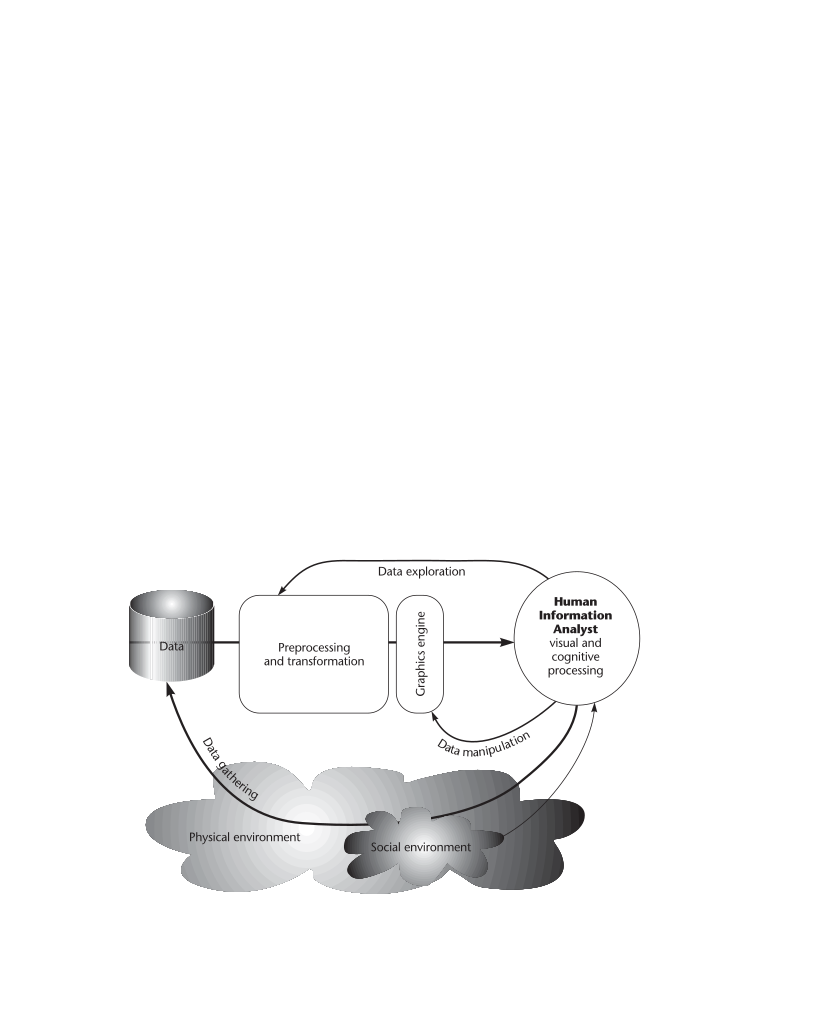
The
process
of
data
visualization
includes
four
basic
stages,
combined
in
a
number
of
feedback
loops.
These
are
illustrated
in
Figure
1.2.
4
INFORMATION
VISUALIZATION:
PERCEPTION
FOR
DESIGN
Figure
1.2
A
schematic
diagram
of
the
visualization
process.
Table of contents
- Cover
- Contents
- Figure Credits
- Foreword
- Preface
- Chapter 1 Foundation for a Science of Data Visualisation
- Chapter 2 The Environment, Optics, Resolution and the Display
- Chapter 3 Lightness, Brightness, Contrast and Constancy
- Chapter 4 Color
- Chapter 5 Visual Attention and Information that Pops Out
- Chapter 6 Static and Moving Patterns
- Chapter 7 Visual Objects and Data Objects
- Chapter 8 Space Perception and the Display of Data in Space
- Chapter 9 Images, Worlds and Gestures
- Chapter 10 Interacting with Visualizations
- Chapter 11 Thinking with Visualizations
- Appendix A Changing Primaries
- Appendix B CIE Color Measurement System
- Appendix C The Perceptual Evaluation of Visualization Techniques and Systems
- Bibliography
- Subject Index
- Author Index
- About the Author
Trusted by 375,005 students
Access to over 1.5 million titles for a fair monthly price.
Study more efficiently using our study tools.
Frequently asked questions
Yes, you can cancel anytime from the Subscription tab in your account settings on the Perlego website. Your subscription will stay active until the end of your current billing period. Learn how to cancel your subscription
No, books cannot be downloaded as external files, such as PDFs, for use outside of Perlego. However, you can download books within the Perlego app for offline reading on mobile or tablet. Learn how to download books offline
Perlego offers two plans: Essential and Complete
- Essential is ideal for learners and professionals who enjoy exploring a wide range of subjects. Access the Essential Library with 800,000+ trusted titles and best-sellers across business, personal growth, and the humanities. Includes unlimited reading time and Standard Read Aloud voice.
- Complete: Perfect for advanced learners and researchers needing full, unrestricted access. Unlock 1.5M+ books across hundreds of subjects, including academic and specialized titles. The Complete Plan also includes advanced features like Premium Read Aloud and Research Assistant.
We are an online textbook subscription service, where you can get access to an entire online library for less than the price of a single book per month. With over 1.5 million books across 990+ topics, we’ve got you covered! Learn about our mission
Look out for the read-aloud symbol on your next book to see if you can listen to it. The read-aloud tool reads text aloud for you, highlighting the text as it is being read. You can pause it, speed it up and slow it down. Learn more about Read Aloud
Yes! You can use the Perlego app on both iOS and Android devices to read anytime, anywhere — even offline. Perfect for commutes or when you’re on the go.
Please note we cannot support devices running on iOS 13 and Android 7 or earlier. Learn more about using the app
Please note we cannot support devices running on iOS 13 and Android 7 or earlier. Learn more about using the app
Yes, you can access Information Visualization by Colin Ware in PDF and/or ePUB format, as well as other popular books in Computer Science & Computer Graphics. We have over 1.5 million books available in our catalogue for you to explore.