- 412 pages
- English
- PDF
- Available on iOS & Android
eBook - PDF
About this book
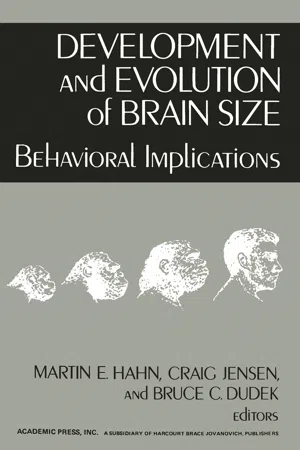
Development and Evolution of Brain Size: Behavioral Implications contains the proceedings of a symposium entitled ""Development and Evolution of Brain Size: Behavioral Implications,"" held at William Paterson College in Wayne, New Jersey, in April 1978. The papers explore the relationship between evolution and development and its implications for brain size and behavior. This book is comprised of 18 chapters and begins with an overview of the brain-behavior relationship, with emphasis on the importance of brain size for behavior; the effects of genetic selection for brain size on brain substructures and behavior; and whether genetic and environmental manipulations of brain size have similar consequences. The next two chapters explain evolutionary theory and the evolution of the human brain as well as diversity in brain size. A general model for brain evolution that offers some synthetic possibilities for approaching the questions of brain evolution, size, allometry, and reorganization is then described. The correlation between cerebral indices and behavioral differences is also discussed, along with biochemical correlates of selective breeding for brain size. The results of an experiment that assessed the effects of early undernutrition on brain and behavior of developing mice are presented. This monograph should be of interest to students and practitioners in a wide range of disciplines, including evolutionary biology and clinical psychology.
Information
Table of contents
- Front Cover
- Development and Evolution of Brain Size: Behavioral Implications
- Copyright Page
- Table of Contents
- Dedication
- List of Contributors
- Preface
- Acknowledgments
- Chapter 1. Introduction: Toword Understonding the Brain–Behavior Relationship
- Chapter 2. Evolutionary Theory and the Evolution of the Humon Brain
- Chapter 3. The Evolution of Diversity in Brain Size
- Chapter 4. Brain Size, Allometry, and Reorganization: Toward a Synthesis
- Chaprer 5. Cerebral Indices and Behavioral Differences
- Chapter 6. Correlated Brain and Intelligence Development in Humans
- Choprer 7. Genetic Techniques as Tools for Analysis of Brain–Behavior Relationships
- Chapter 8. Correlates of Mouse Brain Weight: A Search for Component Morphological Traits
- Chaprer 9. Drain Weight, Brain Chemical Content, and Their Early Manipulation
- Choprer 10. Fuller BWS Lines: History and Results
- Chapter 11. Learning Performances in Mice Genetically Selected for Brain Weight: Problems of Generality
- Chapter 12. Biochemical Correlates of Selective Breeding for Brain Size
- Chapter 13. Fuller BWS Lines: Parental Influences on Brain Size and Behavioral Development
- Chapter 14. Responsiveness of Brain Size to Individual Experience: Behavioral and Evolutionary Implications
- Chapter 15. Experience-Induced Changes in Brain Fine Structure: Their Behavioral Implications
- Chapter 16. Effects of Early Undernutrition on Brain and Behavior of Developing Mice
- Chaprer 17. Genetic Correlations between Brain Size and Some Behaviors of Housemice
- Chapter 18. The Role of Development in the Brain–Behavior Relationship
- AUTHOR INDEX
- SUBJECT INDEX
Trusted by 375,005 students
Access to over 1.5 million titles for a fair monthly price.
Study more efficiently using our study tools.
Frequently asked questions
Yes, you can cancel anytime from the Subscription tab in your account settings on the Perlego website. Your subscription will stay active until the end of your current billing period. Learn how to cancel your subscription
No, books cannot be downloaded as external files, such as PDFs, for use outside of Perlego. However, you can download books within the Perlego app for offline reading on mobile or tablet. Learn how to download books offline
Perlego offers two plans: Essential and Complete
- Essential is ideal for learners and professionals who enjoy exploring a wide range of subjects. Access the Essential Library with 800,000+ trusted titles and best-sellers across business, personal growth, and the humanities. Includes unlimited reading time and Standard Read Aloud voice.
- Complete: Perfect for advanced learners and researchers needing full, unrestricted access. Unlock 1.5M+ books across hundreds of subjects, including academic and specialized titles. The Complete Plan also includes advanced features like Premium Read Aloud and Research Assistant.
We are an online textbook subscription service, where you can get access to an entire online library for less than the price of a single book per month. With over 1.5 million books across 990+ topics, we’ve got you covered! Learn about our mission
Look out for the read-aloud symbol on your next book to see if you can listen to it. The read-aloud tool reads text aloud for you, highlighting the text as it is being read. You can pause it, speed it up and slow it down. Learn more about Read Aloud
Yes! You can use the Perlego app on both iOS and Android devices to read anytime, anywhere — even offline. Perfect for commutes or when you’re on the go.
Please note we cannot support devices running on iOS 13 and Android 7 or earlier. Learn more about using the app
Please note we cannot support devices running on iOS 13 and Android 7 or earlier. Learn more about using the app
Yes, you can access Development and Evolution of Brain Size by Martine Hahn in PDF and/or ePUB format, as well as other popular books in Biological Sciences & Zoology. We have over 1.5 million books available in our catalogue for you to explore.