- 233 pages
- English
- PDF
- Available on iOS & Android
eBook - PDF
Measuring Current, Voltage and Power
About this book
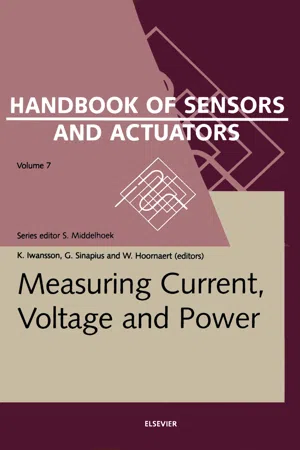
This authoritative new book focuses on recent developments in the instrumentation for sending voltages and currents. It covers new trends and challenges in the field, such as measurements of biocurrents, the increased speed of the components for data taking, testing of computers and integrated circuits where the measurement of rapid voltage and current variations on a very small geometrical scale is necessary. The first chapter concentrates on recent methods to sense voltages and currents, while the rest of the book investigates the applied side, covering for instance electrical power and energy measurements. The main purpose of this volume is to illustrate commonly employed techniques rather than track the scientific evolution and merits and therefore mainly covers patent literature aimed at industrial applications. It is an exciting addition, justifying the series' claim to cover state-of-the-art developments in both the applied and theoretical fields of sensors and actuators. The measurement of voltages and currents is a common task in the field of electricity and electronics. From a technical point of view it is useful to identify schematically different steps of such a measurement. In a first step a voltage or a current is sensed, intermediate steps such as amplification, transmission and further treatment may follow to yield the result in the final step. Today in most cases microprocessors perform the final steps of such measurements. Analog-to digital converters digitise a voltage that is proportional to the value to be measured and a processor performs further computations and handles the storage and the display of the results. The prerequisite for such measurements are sensors or transducers that respond in a known way to the voltage or current to be measured. The emphasis of this book is put on recent developments of the instrumentation for sensing voltages and currents. Aside from the general trend towards smaller, cheaper and more reliable instrumentation, new demands have arisen. New applications, like measurements of biocurrents, ask for higher sensitivities. Computers and integrated circuits pose new challenges. To exploit the increased speed of the components for data taking, suitable sensors are required. The accuracy that can be achieved depends more than ever on the first step, the acquisition of the raw data. The influence of the measurement process on the results becomes more crucial. Testing of integrated circuits themselves is a completely new application. For such tests one has to measure rapid voltage and current variations on very small geometrical scales. Here, as well as in the traditional high voltage applications, contactless measurements play an important role. The organisation of this book is as follows: In the first chapter different methods to sense voltages and currents are described. For the sake of completeness most commonly used methods are mentioned, we concentrate, however, on those developed recently. The chapters address the subject from the side of different applications in which voltages and currents are sensed. Since the main purpose of this publication is to illustrate commonly employed techniques rather than to track the scientific evolution and merits in particular fields, in general those publications that illustrate a particular measurement principle best have been cited. The citation of a particular reference does therefore not imply that this is the first or most pertinent publication in the respective field.
Information
Table of contents
- Front Cover
- Measuring Current, Voltage and Power
- Copyright Page
- Preface
- Table of Contents
- CHAPTER 1. SENSORS AND TRANSDUCERS
- CHAPTER 2. MEASURING HIGH VOLTAGES AND CURRENTS
- CHAPTER 3. SHIELDING AGAINST INTERFERENCES
- CHAPTER 4. MEASURING POWER
- CHAPTER 5. MEASURING ENERGY
- List of cited documents
- Index
Trusted by 375,005 students
Access to over 1.5 million titles for a fair monthly price.
Study more efficiently using our study tools.
Frequently asked questions
Yes, you can cancel anytime from the Subscription tab in your account settings on the Perlego website. Your subscription will stay active until the end of your current billing period. Learn how to cancel your subscription
No, books cannot be downloaded as external files, such as PDFs, for use outside of Perlego. However, you can download books within the Perlego app for offline reading on mobile or tablet. Learn how to download books offline
Perlego offers two plans: Essential and Complete
- Essential is ideal for learners and professionals who enjoy exploring a wide range of subjects. Access the Essential Library with 800,000+ trusted titles and best-sellers across business, personal growth, and the humanities. Includes unlimited reading time and Standard Read Aloud voice.
- Complete: Perfect for advanced learners and researchers needing full, unrestricted access. Unlock 1.5M+ books across hundreds of subjects, including academic and specialized titles. The Complete Plan also includes advanced features like Premium Read Aloud and Research Assistant.
We are an online textbook subscription service, where you can get access to an entire online library for less than the price of a single book per month. With over 1.5 million books across 990+ topics, we’ve got you covered! Learn about our mission
Look out for the read-aloud symbol on your next book to see if you can listen to it. The read-aloud tool reads text aloud for you, highlighting the text as it is being read. You can pause it, speed it up and slow it down. Learn more about Read Aloud
Yes! You can use the Perlego app on both iOS and Android devices to read anytime, anywhere — even offline. Perfect for commutes or when you’re on the go.
Please note we cannot support devices running on iOS 13 and Android 7 or earlier. Learn more about using the app
Please note we cannot support devices running on iOS 13 and Android 7 or earlier. Learn more about using the app
Yes, you can access Measuring Current, Voltage and Power by K. Iwansson,G. Sinapius,W. Hoornaert,S. Middelhoek in PDF and/or ePUB format, as well as other popular books in Technology & Engineering & Electrical Engineering & Telecommunications. We have over 1.5 million books available in our catalogue for you to explore.