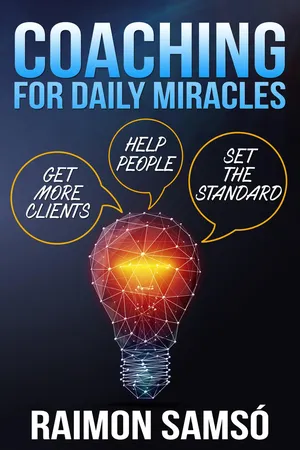
- 180 pages
- English
- ePUB (mobile friendly)
- Available on iOS & Android
eBook - ePub
About this book
Discover the ultimate e-book for compassionate individuals seeking to make a difference in the lives of others while achieving financial freedom. Are you a coach or therapist struggling to make a comfortable living? This e-book will empower you to dramatically increase your income while genuinely making a positive impact on the lives of your clients.
Do you sometimes feel overwhelmed by the challenges your clients face? This e-book will provide you with the tools and strategies necessary to truly support and guide your clients, propelling them towards lasting change and success.
Unlock Your Coaching Potential: Master the Art of Helping Others and Achieve Financial Freedom is your comprehensive guide to creating a thriving coaching business, attracting a steady stream of clients, and becoming a respected authority in your niche.
This e-book will teach you how to:
Develop a successful coaching practice from the ground up
Attract and retain loyal clients who value your expertise
Craft a fulfilling and financially secure lifestyle through coaching
Position yourself as the go-to expert in your coaching niche
Attain financial freedom and make a lasting impact on the lives of others
Throughout this e-book, the term "coach" will be used as an umbrella term to encompass various helping professionals such as therapists, consultants, educators, social workers, counselors, mentors, and trainers. This all-encompassing approach simplifies the content while remaining inclusive of various professions.
Unlock Your Coaching Potential is based on seven years of real-world experience, sharing invaluable insights and practical techniques that have transformed the lives of countless clients. It's the essential guide for those who genuinely care about helping others and are seeking a rewarding and prosperous career in the process. Don't miss this opportunity to elevate your coaching skills, impact lives, and achieve financial freedom.
Get your copy today!
Trusted by 375,005 students
Access to over 1.5 million titles for a fair monthly price.
Study more efficiently using our study tools.
Information
Part II
Offering Meaningful Help to Others
12

The 7 Voices of a Conscious Coach
I will recommend a book that taught me how to identify and modulate the 7 voices of a conscious coach. Know that every client is different, so you have to play different roles with each. Often a client needs you to play several roles at different times. I will reveal to you seven ways to deal with client issues.
Doug Silsbee is the author of the book The Mindful Coach: "Seven roles for facilitating leader development.” It is not published in Castilian for the moment. If you do not read English, I have summarised a part of his message, with his permission to take and quote citations from his great work.
Coaching focuses on developing awareness of the client’s attitudes and being, and is not as focused on achieving goals and results (which is an automatic consequence of personal change.) When working with people, apply more of the being than on the doing in order to obtain more comprehensive results.
When I became the person who could get whatever he wanted, it was very easy to do what had to be done.
According to Silsbee, the seven voices are:
- The Master: "A Master has made his work by working within himself." "The Master is more than something to be done do, it is a way of being." "We consider the following six voices and operational roles of the teacher's voice." He remains conscious and is always present because a teacher has already done his own work.
- The Partner: “The partner represents the commitment of the coach to client outcomes and takes responsibility for maintaining mutual trust and respect. He shares the responsibility for the coaching relationship with the client.
- The Investigator: The Investigator asks questions and is the voice that many training programs for coaches emphasise. It discovers the real needs of the client.
- The Reflector: “As the role of reflector, the coach serves as a mirror for the client, providing client feedback.” He provides and seeks feedback on the client’s self-awareness.
- The Professor: "The voice of the teacher provides information and knowledge that the client is not able to get for himself." "The Professor provides ways of looking at things, models, and tools of interpretation." He provides a new vocabulary, awards, and client knowledge. It recommends books as bibliotherapy.
- The Guide: "The Guide helps the client to perform practical actions. Your Guide includes recommended courses of action. " He provides the steps for taking action.
- The Contractor: "The Contractor supports the client and translates the coaching work into concrete actions. He supports the client by providing new insights for action. He keeps track of what was agreed upon and keeps the client focused.
In my experience, I have found that coaching does not follow a preset pattern and that it resembles a jazz session where improvisation is essential. There are certain guidelines, agreed, but in the end you improvise based on what you feel at a given moment.
In coaching, intuition is everything.
Coaching then becomes a dance where the client and the coach dance together; the coach uses one or the other 7 mentioned voices depending on the needs of the moment. Knowing what is necessary at all times is a matter of absolute presence, active listening, and connecting with intuition.
Share your feelings with the client; do not repress or deny those feelings.
The success of coaching means being honest with those you have chosen to serve and putting aside your ego. Clients will benefit from their hidden resources and not from the coach’s resources. In addition to serving your client, use examples or testimonials, not words or intellectual discourse. This is a topic that we have discussed before.
13
Resistance to Change and How to Overcome It
One thing that always struck me is that some people resist change and improvement. It's like being afraid of success. At first I was worried when I experienced resistance to change and improvement, but after learning that it happened to Sigmund Freud, I calmed down.
"Oh”, I thought, “if that happened to the great psychologist, the teacher of teachers, why should not it happen to a simple coach?"
Freud defined "resistance" as the paradoxical phenomenon of patients who, despite paying for therapy, did not want - deep down - to get rid of their neuroses. Maybe they wanted to lessen the impact of their effects, yes, but they did not want to be cured because they thought there was some advantage.
A person’s level of achievement is equal to his potential minus his resistance level. I've known very talented people among my clients who go overboard and hence unravel themselves. I don’t think the problem is adding more, but subtracting less.
Returning to Freud, the great psychologist found how patients often sought "a change that in reality, was not a change." I also found that not all people want to learn what they need most to learn, and are more resistant to precisely what they need most to solve. Accepting this phenomenon is a gesture of "respect" for the client, who ultimately will always be affected by when and how he’s going to change.
When a client is angry it is because he encounters a resistance that must be eliminated for him to make progress.
In a Course in Miracles® we read: "The patient hopes to learn to achieve the changes he wants without significantly changing his sense of self. The changes that the ego seeks are not real changes." However he feels he must have a different sense of being in the world and be more aware and happy, otherwise he would not seek a specialist’s help.
It is as if there are two voices struggling inside him: one identifies with the ego or individual self, and the other identifies with love and the essential self. The patient is seeking therapy, but he’s also profoundly resisting change, expecting the world to make that change.
Often, the response to client problems is not to your liking. And you ignore it.
The ego, for its rigidity, is not interested in finding real solutions. Its strategy for staying in the "no solution" zone is to seek answers where it knows it won’t find it. The metaphor is that of someone who looks for his keys in the street – under the sun where there is light – instead of looking where the keys might be - at home.
Too many people do not solve the problems in their lives simply because they look for solutions in places where they do not exist. Is it that hard to realise?
When wanting to be good is not enough, you pay full price.
Human beings are contradictory creatures: they long to be happy but the strategies they adopt lead to unhappiness. The resistance of the client / patient projects the internal problem to be solved outside, looking in places where there are no solutions. As Freud concluded, there is no connection between the means and the ends.
The client wants to be good but also wants a way to continue with the pain he wants to remove. Pain is the glue that binds him to certain events of the past. He suffers but retains his past, and that seems to be the deal. The client has experienced a loss yet quietly feels the pain of that loss, and clinging to that pain is their way of "not losing everything." He thinks it's better to feel pain than feel nothing.
As he recreates himself in his loss, day in and day out, he is unable to free himself from the pain.
Pain is "love in reverse." It is reversed because it brings what you do not want through its absence, not through its presence. It's dark love.
We fantasise about achieving happiness with the crazy idea that: we're apart, we are individuals, and we are detached from the source of everything tha...
Table of contents
- Cover
- Title Page
- Contents
- Dedication
- Introduction
- I. Get more clients, gain freedom, and lead a richer way of life
- II. Offering Meaningful Help to Others
Frequently asked questions
Yes, you can cancel anytime from the Subscription tab in your account settings on the Perlego website. Your subscription will stay active until the end of your current billing period. Learn how to cancel your subscription
No, books cannot be downloaded as external files, such as PDFs, for use outside of Perlego. However, you can download books within the Perlego app for offline reading on mobile or tablet. Learn how to download books offline
Perlego offers two plans: Essential and Complete
- Essential is ideal for learners and professionals who enjoy exploring a wide range of subjects. Access the Essential Library with 800,000+ trusted titles and best-sellers across business, personal growth, and the humanities. Includes unlimited reading time and Standard Read Aloud voice.
- Complete: Perfect for advanced learners and researchers needing full, unrestricted access. Unlock 1.5M+ books across hundreds of subjects, including academic and specialized titles. The Complete Plan also includes advanced features like Premium Read Aloud and Research Assistant.
We are an online textbook subscription service, where you can get access to an entire online library for less than the price of a single book per month. With over 1.5 million books across 990+ topics, we’ve got you covered! Learn about our mission
Look out for the read-aloud symbol on your next book to see if you can listen to it. The read-aloud tool reads text aloud for you, highlighting the text as it is being read. You can pause it, speed it up and slow it down. Learn more about Read Aloud
Yes! You can use the Perlego app on both iOS and Android devices to read anytime, anywhere — even offline. Perfect for commutes or when you’re on the go.
Please note we cannot support devices running on iOS 13 and Android 7 or earlier. Learn more about using the app
Please note we cannot support devices running on iOS 13 and Android 7 or earlier. Learn more about using the app
Yes, you can access Coaching for Daily Miracles by Raimon Samsó in PDF and/or ePUB format, as well as other popular books in Business & Business General. We have over 1.5 million books available in our catalogue for you to explore.