- 288 pages
- English
- PDF
- Available on iOS & Android
eBook - PDF
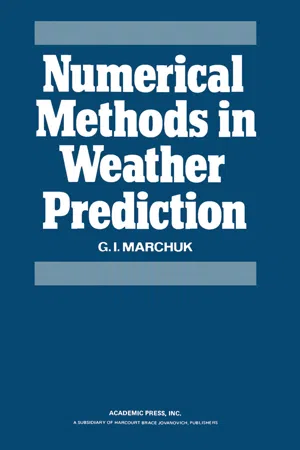
Numerical Methods in Weather Prediction
About this book
Numerical Methods in Weather Prediction focuses on the numerical methods for solving problems of weather prediction and explains the aspect of the general circulation of the atmosphere. This book explores the development in the science of meteorology, which provides investigators with improved means of studying physical processes by mathematical stimulation. Organized into eight chapters, this book starts with an overview of the significant physical factors that are instrumental in enriching the theoretical models of weather prediction. This text then examines the system of hydrodynamic equations and the equation of heat transfer related to large-scale atmospheric processes. Other chapters consider the quasigeostrophic approximation model, which is the basis for concepts of the dynamics of atmospheric motions and instrumental in establishing the basic features and laws of evolution of meteorological variables as applied to large-scale processes. The final chapter deals with the adjustment of the humidity field. This book is a valuable resource for meteorologists.
Information
Print ISBN
9780124706507
Subtopic
Meteorology & ClimatologyTable of contents
- Front Cover
- Numerical Methods in Weather Prediction
- Copyright Page
- Table of Contents
- Preface to the English Edition
- Preface to the Russian Edition
- Introduction
- Chapter 1. Basic Equations of Atmospheric Dynamics
- Chapter 2. The Quasigeostrophic Approximation
- Chapter 3. The Splitting–Up Method
- Chapter 4. The Splitting-Up Method Applied to the Weather Prediction Equations
- Chapter 5. A Weather Prediction Scheme Based on Conservation Laws
- Chapter 6. Humidity Prediction in the Atmosphere
- Chapter 7. The Radiation Field in Weather Prediction
- Chapter 8. Objective Analysis of Meteorological Fields
- References
- Subject Index
Trusted by 375,005 students
Access to over 1.5 million titles for a fair monthly price.
Study more efficiently using our study tools.
Frequently asked questions
Yes, you can cancel anytime from the Subscription tab in your account settings on the Perlego website. Your subscription will stay active until the end of your current billing period. Learn how to cancel your subscription
No, books cannot be downloaded as external files, such as PDFs, for use outside of Perlego. However, you can download books within the Perlego app for offline reading on mobile or tablet. Learn how to download books offline
Perlego offers two plans: Essential and Complete
- Essential is ideal for learners and professionals who enjoy exploring a wide range of subjects. Access the Essential Library with 800,000+ trusted titles and best-sellers across business, personal growth, and the humanities. Includes unlimited reading time and Standard Read Aloud voice.
- Complete: Perfect for advanced learners and researchers needing full, unrestricted access. Unlock 1.5M+ books across hundreds of subjects, including academic and specialized titles. The Complete Plan also includes advanced features like Premium Read Aloud and Research Assistant.
We are an online textbook subscription service, where you can get access to an entire online library for less than the price of a single book per month. With over 1.5 million books across 990+ topics, we’ve got you covered! Learn about our mission
Look out for the read-aloud symbol on your next book to see if you can listen to it. The read-aloud tool reads text aloud for you, highlighting the text as it is being read. You can pause it, speed it up and slow it down. Learn more about Read Aloud
Yes! You can use the Perlego app on both iOS and Android devices to read anytime, anywhere — even offline. Perfect for commutes or when you’re on the go.
Please note we cannot support devices running on iOS 13 and Android 7 or earlier. Learn more about using the app
Please note we cannot support devices running on iOS 13 and Android 7 or earlier. Learn more about using the app
Yes, you can access Numerical Methods in Weather Prediction by G Marchuk in PDF and/or ePUB format. We have over 1.5 million books available in our catalogue for you to explore.