eBook - PDF
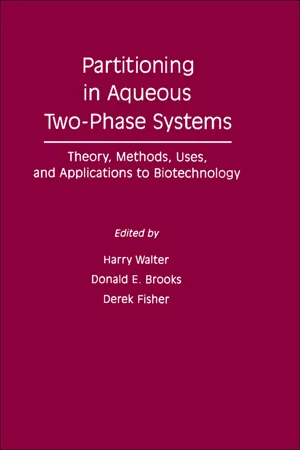
Partitioning In Aqueous Two – Phase System
Theory, Methods, Uses, and Applications To Biotechnology
- 731 pages
- English
- PDF
- Available on iOS & Android
eBook - PDF
Partitioning In Aqueous Two – Phase System
Theory, Methods, Uses, and Applications To Biotechnology
About this book
Partitioning in Aqueous Two-Phase Systems: Theory, Methods, Uses, and Applications to Biotechnology is a collection of papers that discusses the applications of aqueous two-phase systems to problems of separation and extraction of macromolecules, organelles, and cells. Papers focus on the theoretical basis and the practical details of the procedures used. Some of the papers describe in one or a few steps how two components can be separated by the investigator manipulating their partitions so that one component is in one phase and the other component is in the other phase or at the interface. Investigators can also avail of developed batch extractions for plant organelles, cell membranes, nucleic acids, and proteins. The book cites as an example the partitioning of right-side-out and inside-out vesicles (obtained from fragments of thylakoid membranes) to the top and bottom phases, respectively, of a Dx-PEG system. Other papers describe the use of the countercurrent distribution when single extraction steps are not sufficient to produce a separation in materials that do not differ greatly in their partitioning behavior. The collection can prove valuable for bio-chemists, cellular biologists, micro-biologists, and developmental biologists.
Information
Table of contents
- Front Cover
- Partitioning in Aqueous Two-Phase Systems: Theory, Methods, Uses, and Applications to Biotechnology
- Copyright Page
- Table of Contents
- Contributors
- Preface
- Abbreviations and Conventions
- Chapter 1. History of Aqueous Polymer Two-Phase Partition
- Chapter 2. Theoretical Aspects of Partitioning
- Chapter 3. Preparation of Phase Systems and Measurement of Their Physicochemical Properties
- Chapter 4. Thin-Layer Countercurrent Distribution and Apparatus
- Chapter 5. Other Types of Countercurrent Distribution Apparatus and Continuous Flow Chromatography Techniques
- Chapter 6. Partitioning of Proteins
- Chapter 7. Partitioning of Nucleic Acids
- Chapter 8. Interacting Systems and Binding Studied by Partitioning
- Chapter 9. Steroid Receptors and Steroid-Binding Plasma Proteins Studied by Partitioning
- Chapter 10. Surface Properties of Cells Reflected by Partitioning: Red Blood Cells as a Model
- Chapter 11. Separation and Subfractionation of Selected Mammalian Cell Populations
- Chapter 12. Partitioning of Bacteria, Virus, and Phage
- Chapter 13. Partitioning of Animal Membranes and Organelles
- Chapter 14. Partitioning of Plant Cells, Cell Walls, Membranes, and Organelles
- Chapter 15. Applications of Phase Partitioning in Biotechnology
- Chapter 16. Polymer-Ligands Used in Affinity Partitioning and Their Synthesis
- Chapter 17. Partitioning: A Comprehensive Bibliography
- Index
Trusted by 375,005 students
Access to over 1.5 million titles for a fair monthly price.
Study more efficiently using our study tools.
Frequently asked questions
Yes, you can cancel anytime from the Subscription tab in your account settings on the Perlego website. Your subscription will stay active until the end of your current billing period. Learn how to cancel your subscription
No, books cannot be downloaded as external files, such as PDFs, for use outside of Perlego. However, you can download books within the Perlego app for offline reading on mobile or tablet. Learn how to download books offline
Perlego offers two plans: Essential and Complete
- Essential is ideal for learners and professionals who enjoy exploring a wide range of subjects. Access the Essential Library with 800,000+ trusted titles and best-sellers across business, personal growth, and the humanities. Includes unlimited reading time and Standard Read Aloud voice.
- Complete: Perfect for advanced learners and researchers needing full, unrestricted access. Unlock 1.5M+ books across hundreds of subjects, including academic and specialized titles. The Complete Plan also includes advanced features like Premium Read Aloud and Research Assistant.
We are an online textbook subscription service, where you can get access to an entire online library for less than the price of a single book per month. With over 1.5 million books across 990+ topics, we’ve got you covered! Learn about our mission
Look out for the read-aloud symbol on your next book to see if you can listen to it. The read-aloud tool reads text aloud for you, highlighting the text as it is being read. You can pause it, speed it up and slow it down. Learn more about Read Aloud
Yes! You can use the Perlego app on both iOS and Android devices to read anytime, anywhere — even offline. Perfect for commutes or when you’re on the go.
Please note we cannot support devices running on iOS 13 and Android 7 or earlier. Learn more about using the app
Please note we cannot support devices running on iOS 13 and Android 7 or earlier. Learn more about using the app
Yes, you can access Partitioning In Aqueous Two – Phase System by Harry Walter in PDF and/or ePUB format, as well as other popular books in Biological Sciences & Biochemistry. We have over 1.5 million books available in our catalogue for you to explore.