eBook - PDF
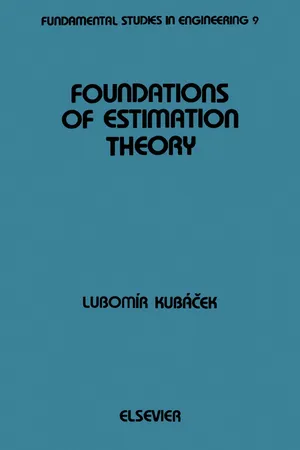
Foundations of Estimation Theory
About this book
The application of estimation theory renders the processing of experimental results both rational and effective, and thus helps not only to make our knowledge more precise but to determine the measure of its reliability. As a consequence, estimation theory is indispensable in the analysis of the measuring processes and of experiments in general.The knowledge necessary for studying this book encompasses the disciplines of probability and mathematical statistics as studied in the third or fourth year at university. For readers interested in applications, comparatively detailed chapters on linear and quadratic estimations, and normality of observation vectors have been included. Chapter 2 includes selected items of information from algebra, functional analysis and the theory of probability, intended to facilitate the reading of the text proper and to save the reader looking up individual theorems in various textbooks and papers; it is mainly devoted to the reproducing kernel Hilbert spaces, helpful in solving many estimation problems. The text proper of the book begins with Chapter 3. This is divided into two parts: the first deals with sufficient statistics, complete sufficient statistics, minimal sufficient statistics and relations between them; the second contains the mostimportant inequalities of estimation theory for scalar and vector valued parameters and presents properties of the exponential family of distributions.The fourth chapter is an introduction to asymptotic methods of estimation. The method of statistical moments and the maximum-likelihood method are investigated. The sufficient conditions for asymptotical normality of the estimators are given for both methods. The linear and quadratic methods of estimation are dealt with in the fifth chapter. The method of least squares estimation is treated. Five basic regular versions of the regression model and the unified linear model of estimation are described. Unbiased estimators for unit dispersion (factor of the covariance matrix) are given for all mentioned cases. The equivalence of the least-squares method to the method of generalized minimum norm inversion of the design matrix of the regression model is studied in detail. The problem of estimating the covariance components in the mixed model is mentioned as well. Statistical properties of linear and quadratic estimators developed in the fifth chapter in the case of normally distributed errors of measurement are given in Chapter 6. Further, the application of tensor products of Hilbert spaces generated by the covariance matrix of random error vector of observations is demonstrated. Chapter 7 reviews some further important methods of estimation theory. In the first part Wald's method of decision functions is applied to the construction of estimators. The method of contracted estimators and the method of Hoerl and Kennard are presented in the second part. The basic ideas of robustness and Bahadur's approach to estimation theory are presented in the third and fourth parts of this last chapter.
Information
Table of contents
- Front Cover
- Foundations of Estimation Theory
- Copyright Page
- Table of Contents
- CHAPTER 1. INTRODUCTION
- CHAPTER 2. PRELIMINARY CONCEPTS FROM ALGEBRA, FUNCTIONAL ANALYSIS AND PROBABILITY THEORY
- CHAPTER 3. FUNDAMENTAL NOTIONS FROM ESTIMATION THEORY
- CHAPTER 4. ESTIMATORS IN THE CASE OF LARGE SAMPLES
- CHAPTER 5. LINEAR AND QUADRATIC ESTIMATORS
- CHAPTER 6. NORMALITY OF OBSERVATION VECTORS
- CHAPTER 7. SOME OTHER TYPES OF ESTIMATORS
- CHAPTER 8. CONCLUSION
- REFERENCES
- SUBJECT INDEX
Trusted by 375,005 students
Access to over 1.5 million titles for a fair monthly price.
Study more efficiently using our study tools.
Frequently asked questions
Yes, you can cancel anytime from the Subscription tab in your account settings on the Perlego website. Your subscription will stay active until the end of your current billing period. Learn how to cancel your subscription
No, books cannot be downloaded as external files, such as PDFs, for use outside of Perlego. However, you can download books within the Perlego app for offline reading on mobile or tablet. Learn how to download books offline
Perlego offers two plans: Essential and Complete
- Essential is ideal for learners and professionals who enjoy exploring a wide range of subjects. Access the Essential Library with 800,000+ trusted titles and best-sellers across business, personal growth, and the humanities. Includes unlimited reading time and Standard Read Aloud voice.
- Complete: Perfect for advanced learners and researchers needing full, unrestricted access. Unlock 1.5M+ books across hundreds of subjects, including academic and specialized titles. The Complete Plan also includes advanced features like Premium Read Aloud and Research Assistant.
We are an online textbook subscription service, where you can get access to an entire online library for less than the price of a single book per month. With over 1.5 million books across 990+ topics, we’ve got you covered! Learn about our mission
Look out for the read-aloud symbol on your next book to see if you can listen to it. The read-aloud tool reads text aloud for you, highlighting the text as it is being read. You can pause it, speed it up and slow it down. Learn more about Read Aloud
Yes! You can use the Perlego app on both iOS and Android devices to read anytime, anywhere — even offline. Perfect for commutes or when you’re on the go.
Please note we cannot support devices running on iOS 13 and Android 7 or earlier. Learn more about using the app
Please note we cannot support devices running on iOS 13 and Android 7 or earlier. Learn more about using the app
Yes, you can access Foundations of Estimation Theory by L. Kubacek in PDF and/or ePUB format, as well as other popular books in Mathematics & Probability & Statistics. We have over 1.5 million books available in our catalogue for you to explore.